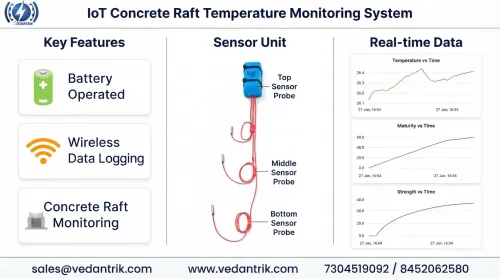

Concrete maturity often remains a misunderstood concept within the civil engineering sector due to its abstract nature. In simple terms, concrete maturity is a Time-Temperature Factor or Index that reflects the progress of cement hydration and the resulting strength development of concrete.
It follows the principle that the strength development of the concrete is directly influenced by both Time and Temperature.
It describes the cumulative effect of both temperature and time on strength development in concrete. The main objective behind the maturity is that concrete does not gain strength based on age but rather how temperature has influenced its hydration process over time.
A key point in concrete maturity is that different concrete’s same design with same maturity will have approximately the same strength, regardless of their temperature history that produced that maturity.
The maturity principle assumes that at higher temperatures cement hydration proceeds at a faster rate, accelerating the early-age strength development, while at lower temperatures rate of hydration is much slower, which delays the strength gain.
The temperature records are integrated over time using a maturity function such as the Nurse–Saul linear equation or Arrhenius activation-energy model, that provides a quantitative value for maturity.
By integrating temperature over time, maturity index can be established, which is typically expressed in °C·hours or °C·days, that correlates with strength development.
This allows engineers to make field decisions without waiting for CTM test results that itself has its own limitations and may not reflect field conditions accurately.
The major advantage that the maturity method provides for field teams is real-time strength tracking, especially when dealing with cold-weather concreting, hot-weather concreting, temperature-controlled pours, or fast-track construction schedules.
However, the major limitation that must be taken into consideration is that maturity is concrete mix-specific. A maturity curve developed for one concrete mix cannot be used for another because changes in cement type, SCMs, admixtures, or w/c ratio alter hydration behavior.
Keywords