Mumbai
+917304519092
+917304519092

Products

6814772a5d263414004dd4a4 Card 2

product image
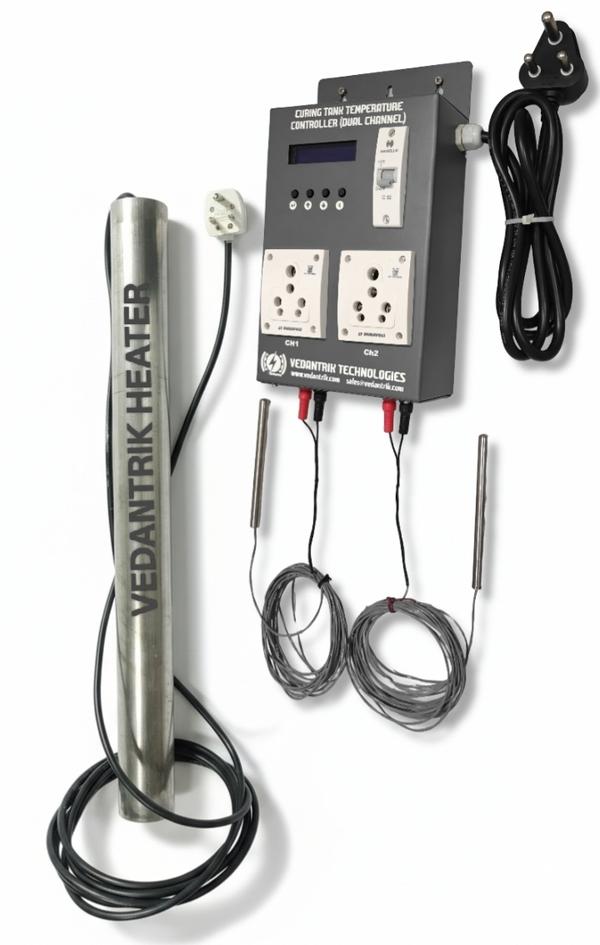
Curing Tank Temperature Controller

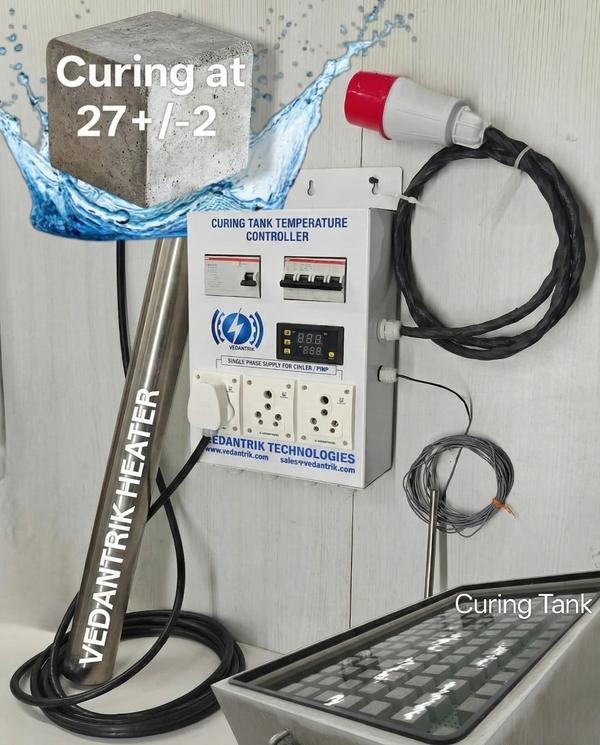
Curing Tank Temperature Controller for Concrete Cubes NABL Calibrated | Single & Three Phase | Waterproof & Shockproof | Heater, Chiller & Pump Ready Vedantrik Technologies presents an advanced curing tank temperature controller designed specifically for concrete cube curing tanks used in NABL-accredited laboratories, RMC plants, construction site labs, and infrastructure projects. The system accurately maintains the standard curing temperature of 27 ± 2 °C, as prescribed by IS and NABL guidelines. Equipped with an intelligent temperature controller, SS316 waterproof immersion heaters, and built-in electrical safety protections, this solution eliminates manual temperature monitoring and ensures consistent, audit-compliant curing conditions. Each system can be supplied with an NABL-traceable calibration certificate, making it suitable for laboratory audits and quality assurance processes. Concrete Curing Tank Temperature Control System This plug-and-play curing tank controller manages heating during winter and cooling during summer, ensuring uninterrupted and uniform curing of concrete test specimens. The controller supports both single phase and three phase power supplies, allowing it to work seamlessly with different tank sizes and heater configurations without any modification. Ideal Applications Concrete cube curing tanks NABL civil engineering laboratories Construction site testing laboratories RMC plants and QA/QC departments Infrastructure and government projects Technical Specifications – Curing Tank Controller Power Supply: Single Phase / Three Phase AC, 230 V Maximum Current Capacity: 32 Amps Temperature Set Point: 27 ± 2 °C Temperature Accuracy: ±1 °C Controller Power Cord Length: 2 meters Temperature Sensor Cable Length: 5 meters Plug & Play Connections Heater connection Chiller connection Water circulation pump connection Temperature sensor connection No skilled installation required. Key Features of Curing Tank Temperature Controller Compatible with single phase and three phase heaters Dedicated socket for chiller (summer curing) Dedicated socket for circulation pump Built-in short circuit and over-current protection Integrated MCB and RCCB for complete electrical safety Rugged design suitable for laboratory and onsite conditions Smart Heating & Cooling Logic (Energy Efficient) Heating Control – Winter Operation Heater switches OFF above 27 °C Heater switches ON below 25 °C Prevents overheating and reduces power consumption Chiller Control – Summer Operation Chiller switches ON above 29 °C Chiller switches OFF below 25 °C Maintains curing temperature as per NABL and IS standards Heater Selection Based on Curing Tank Volume Below 2000 liters: Single phase heater recommended Above 2000 liters: Three phase heater recommended The controller supports both heater types without any modification. Electrical Load Capacity of Controller Three Phase Heater Load Heater Rating: 4 kW per unit Minimum Load: 1 × 4 kW Maximum Load: 4 × 4 kW (Total 16 kW) Single Phase Heater Load Heater Rating: Up to 2 kW per unit Minimum Load: 1 heater Maximum Load: 3 heaters (Total 6 kW) Note: Single phase heaters draw higher current; therefore, lower total power is recommended. For large curing tanks, three phase heaters provide better efficiency and stability. SS316 Waterproof & Shockproof Immersion Heaters Three Phase Immersion Heater Power Rating: 4 kW Cable Length: 5 meters Cable Type: 5-core Heater Material: SS316 Protection: Waterproof & shockproof Single Phase Immersion Heater Power Rating: 2 kW Cable Length: 5 meters Cable Type: 3-core Heater Material: SS316 Protection: Waterproof & shockproof Recommended Heater Configuration for Curing Tanks Single Phase System (Small & Medium Tanks) 2000 liters: 1 × 2 kW heater 4000 liters: 2 × 2 kW heaters 6000 liters: 3 × 2 kW heaters Maintains 27 ± 2 °C curing temperature. Three Phase System (Large Tanks) Up to 2500 liters: 1 × 4 kW heater Up to 5000 liters: 2 × 4 kW heaters (8 kW) Up to 7500 liters: 3 × 4 kW heaters (12 kW) Up to 10,000 liters: 4 × 4 kW heaters (16 kW) Best Practices for Uniform Concrete Curing Interconnect multiple curing tanks using a water circulation pump For identical tanks in the same environment, one temperature sensor is sufficient For different tank sizes, place the sensor in the largest tank Use multiple controllers for independent temperature control Multichannel curing tank controller available for economical multi-tank operation NABL Compliance & Custom Solutions NABL-traceable temperature calibration certificate available Multichannel and customized curing tank controllers Designed for NABL labs, RMC plants, infrastructure projects, and site laboratories Contact for Pricing & Technical Support 📞 8452062580 📧 sales@vedantrik.com Topic covered above Curing tank temperature controller Concrete cube curing tank controller NABL curing tank temperature controller Concrete curing tank heater SS316 immersion heater for curing tank Single phase curing tank heater Three phase curing tank heater Concrete laboratory curing equipment Curing tank temperature control system

6814772a5d263414004dd4a4 Card 2

product image
Concrete Maturity meter

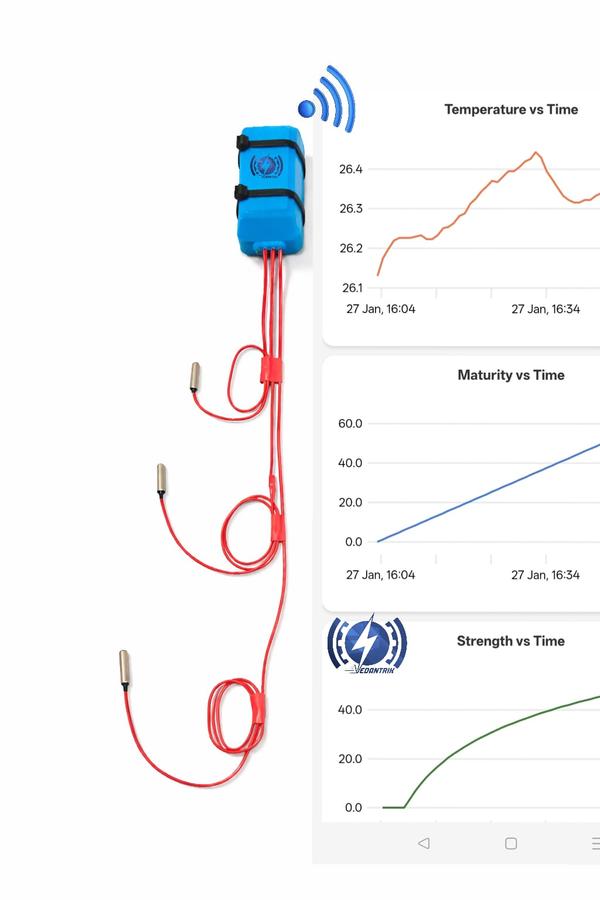
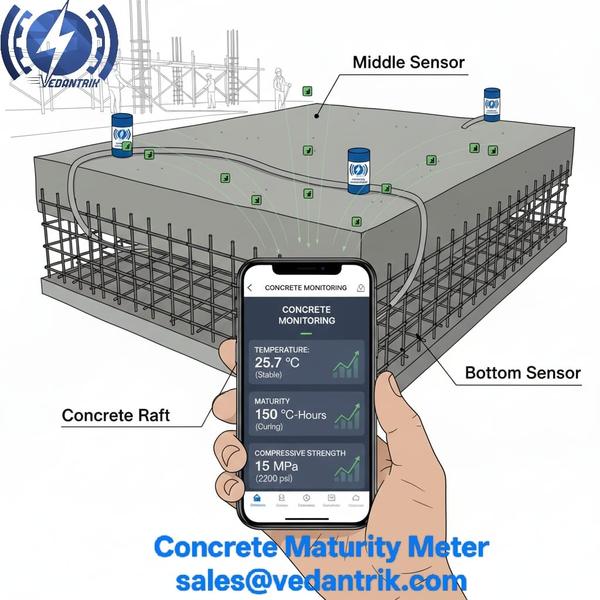
Vedantrik Technologies is first in India to develop and manufacture Sacrificial type Wireless Concrete Maturity Meter, which monitors temperature, maturity, and strength. Using Vedantrik Maturity Meter Per Point testing is 7-10 times Cheaper compared to any Imported or Re-usable type Maturity Meter Multi-Channel Sensing : Monitor Top, Middle, and Bottom concrete temperatures using a single Maturity Meter. Wireless Type: No cable routing, Seamlessly connect with mobile phones or laptops. On-Board Data Storage: Temperature, maturity, and strength data stored in inbuilt memory—download anytime. In-Built Battery Powered: No 24×7 external power supply required. No Expensive Reader Required: Your smartphone becomes the reader and monitor. ✔ True 3-in-1 Monitoring Temperature • Maturity • Strength — in one device. Sacrificial & Damage-Proof: Designed to be embedded—no special handling or protection needed. Lowest Cost per Point: More economical than reusable maturity meters. Low Capital Investment: Eliminates high upfront cost of reusable wired systems. Ideal for Multi-Location Projects: Deploy multiple sensors across sites without wiring or complexity. Smart sensing. Lower cost. Scalable deployment. Concrete Maturity meter is a device inserted in concrete structure while casting, to monitor the concrete maturity and strength of the actual concrete by measuring temperature variations within the concrete, the device calculates the maturity value to develop a co-relation between maturity and strength, enabling real-time strength monitoring of both precast and cast-in-place concrete and also useful for determining the correct time for foam work or shuttering removal and to decide when to stretch the tendons in PT Slabs. Vedantrik Technologies has developed India’s first Wireless type Concrete Maturity meter and installed it in India’s first bullet train Project at BKC. Concrete Maturity meter is available in various models like wireless and wired type, Sacrificial and Reusable type concrete maturity meter where only the sensor will be sacrificed and the transmitter part can be reused as per the different different application, concrete maturity meter for Concrete Road and infrastructure Projects, residential project and mass concrete temperature monitoring, temperature differential and for thermal gradient monitoring is also available. The temperature sensors are embedded into the concrete at the construction site to measure temperature continuously. The maturity value is then calculated based on the recorded temperature data and correlated with the concrete strength. This correlation must be established for the specific concrete mix design As per ASTM C1074 standards and remains valid as long as the mix design does not change. to Know more write on sales@vedantrik.com or Whatsapp 8452062580 Principle behind Concrete Maturity Measurement Method: The concrete maturity method is an empirical technique employed to predict the development of strength in concrete as a function of its temperature-time history. The fundamental principle underlying this method is that the rate of cement hydration process, along with the consequential strength gain, is not only influenced by the age of the concrete since the time of casting, but primarily by the combined effect of time and temperature. In essence the maturity method is useful in quantifying the degree of hydration by integrating temperature over time, thereby allowing to estimate the strength of in-situ concrete with great accuracy, especially during the early stages of curing. Concrete strength gain is intrinsically linked to the kinetics of cement hydration, a complex exothermic reaction between water and cementitious materials such as tricalcium silicate, dicalcium silicate, tricalcium aluminate, and tetracalcium aluminoferrite that leads to formation of calcium-silicate-hydrate (C-S-H) gel and other reaction products that contribute materials structural integrity. The rate of these hydration reactions are temperature dependent, so elevation in temperature increases the rate, mainly because of reduced activation energy barrier, while lower temperatures affect it in the opposite manner. However, this same hydration process can result in excessive heat generation that has a direct effect on the morphology and distribution of the hydration products. Hence, it can lead to temperature induced changes in the micro-structures, porosity and micro-cracking due to differential thermal gradients, especially in mass concrete. Furthermore elevated temperature can also affect the natural evolution of the micro-structures in the concrete, thereby affecting the structural and mechanical properties beyond that could be assessed by the maturity method. Nurse-Saul Method: The common approach for estimation of concrete’s strength from its maturity, utilizes the Nurse-Saul method, which assumes that there is a linear relationship between temperature and the rate of hydration. The general formula proposed is expressed in the form given below: M(t) = ∑ (Ta - T0) * Δt Where : M(t) = the temperature-time factor at age t, degree-days or degree-hours, Δt = a time interval, days or hours, Ta = average concrete temperature during time interval, Δt, °C, and To = datum temperature, °C. Arrhenius Method: The hydration process can halt altogether if the concrete remains below datum temperature, as it can be assumed that datum temperature sets a critical temperature threshold limit. Crossing this limit creates a condition where maturity is no longer linear and cannot be predicted until other supplementary cementitious mixtures (SCM) such as accelerators are added into the mix. In such cases where ambient temperature goes below datum temperature (0°C for India) the Arrhenius method gives a more accurate and reliable result. The Arrhenius method is based on activation energy that captures nonlinear temperature effects more accurately, especially under extreme hot or cold conditions.The general formula proposed is expressed in the form given below: te = ∑e-Q(1/Ta - 1/Ts) * Δt Where: te = equivalent age at a specified temperature Ts, days or h, Q = activation energy divided by the gas constant, K, Ta = average temperature of concrete during time interval Dt, K, Ts = specified temperature, K, and Δt = time interval, days or h. Measurement of Maturity and strength: Nurse-Saul function is the widely used method, which assumes that there is a linear relationship between temperature and the rate of hydration. The general formula is expressed in the form given below: M(t) = ∑ (Ta - T0) * Δt Where : M(t) = the temperature-time factor at age t, degree-days or degree-hours, Δt = time interval, days or hours, Ta = average concrete temperature during time interval, Δt, °C, and To = datum temperature, °C. After calculating the maturity values for each of the specified curing days and determining the corresponding compressive strengths from the CTM (Compression Testing Machine) results, plot a graph of maturity index versus compressive strength. Fit a trend-line to the data to identify the best-fit relationship, typically a logarithmic regression provides a good representation of the strength development in relation to maturity. Fc = a + b * log10 (M) Components of Concrete Maturity Method: Temperature Monitoring Equipment - Devices to measure and record concrete temperature over time. Concrete Strength Testing - Standard strength tests (e.g., ASTM C39 – Compressive strength of cylindrical concrete specimens). Reference Temperature - A specific temperature used in maturity calculations. For Nurse–Saul, the typical reference is 0°C (32°F) unless otherwise specified. Concrete Mix Design Information - The maturity method is mix-specific; a separate calibration curve is required for each mix. Data Collection and Analysis Tools - Software or spreadsheets to calculate maturity and estimate strength. Ensures real-time tracking and reporting. Components of Concrete Maturity Method: Temperature Monitoring Equipment - Devices to measure and record concrete temperature over time. Concrete Strength Testing - Standard strength tests (e.g., ASTM C39 – Compressive strength of cylindrical concrete specimens). Reference Temperature - A specific temperature used in maturity calculations. For Nurse–Saul, the typical reference is 0°C (32°F) unless otherwise specified. Concrete Mix Design Information - The maturity method is mix-specific; a separate calibration curve is required for each mix. Data Collection and Analysis Tools - Software or spreadsheets to calculate maturity and estimate strength. Ensures real-time tracking and reporting. Standard procedure: Overview (as per ASTM C1074) 1. Objective of Maturity Method Calibration (Co-Relation Establishment) The primary objective of the calibration process in ASTM C1074 is to establish a reliable relationship between concrete maturity and its compressive strength for a specific concrete mix. This relationship—called the strength–maturity curve—enables users to estimate in-place concrete strength based on temperature history rather than destructive testing. Since the maturity method is mix-specific, each unique concrete mixture requires its own calibration. 2. Selection and Preparation of Concrete Mix The calibration begins by selecting the specific concrete mix that will be used in the field. This includes confirming the materials, proportions, and mixing procedure. Fresh concrete from this mix is then used to cast a set of standard specimens depending on the project requirements, which will be cured and tested over time to develop the strength–maturity relationship. 3. Temperature Monitoring of Specimens To track the maturity development, thermocouples or temperature sensors are embedded in at least two of the cylinders immediately after casting. These sensors record the internal temperature of the specimens continuously over time. The temperature data is used to calculate the maturity index using either the Nurse–Saul function or the Arrhenius function, as specified in ASTM C1074. 4. Curing and Strength Testing Schedule The concrete specimens are cured under standard laboratory conditions, and are tested for compressive strength at multiple time intervals; for example, at 1, 3, 7, 14, and 28 days. The specific times should span the range of expected strengths during field monitoring. At each test age, the corresponding maturity index is calculated based on the recorded temperature history. 5. Developing the Strength–Maturity Relationship After collecting the strength and maturity data at each age, the results are plotted with concrete strength on the y-axis and maturity index on the x-axis. A best-fit curve (usually exponential or logarithmic) is applied to the data points to define the strength–maturity relationship for the given concrete mix. This curve becomes the foundation for estimating in-place strength based on measured maturity in the field. Result Interpretation of Concrete Maturity Method: Result interpretation in the maturity method involves comparing the maturity index (°C·hours or °C·days) calculated from the in-situ concrete to a previously developed calibration curve that relates maturity to compressive strength. By identifying the maturity value measured in the field and locating that point on the calibration curve, the corresponding compressive strength can be estimated. This allows for a reliable prediction of the in-place concrete strength at any given time, provided the conditions match those used during calibration. When maturity and strength relation established becomes invalid If Mix design changes. (Cement/Admixture/Chemicals/etc) calibration becomes invalid ,This can be considered as advantage instead of disadvantage, like if mix design changes, maturity vs time response will vary. Co-relation established in winter will not be valid in summer or vice versa. Ambient condition (do not insert concrete cube in curing Tank at the time of co-relation establishment as the actual concrete structure can not be immersed in curing tank) Small concrete used during Co-relation establishment, hence this co-relation will not be valid for Mass-Concrete due to Thermal-Gradient Topics Covered above: Concrete Maturity, Concrete Maturity Method, Concrete Maturity Meter, Concrete Maturity Testing, Maturity Method Concrete Strength, Maturity Sensor for Concrete, Concrete Strength Maturity Curve, Nurse-Saul Maturity Formula, Temperature & Time Factor Method Concrete Maturity, Strength vs Maturity Relationship, How To Calibrate Concrete Maturity, Weighted Maturity Function Concrete, ASTM C1074 Maturity Method, Datum Temperature Concrete Maturity, Concrete Maturity Monitoring System, Temperature Sensor in Concrete Maturity, Real Time Concrete Maturity Monitoring, Maturity In Mass Concrete, Concrete Strength Monitoring using concrete maturity meter

6814772a5d263414004dd4a4 Card 2

product image
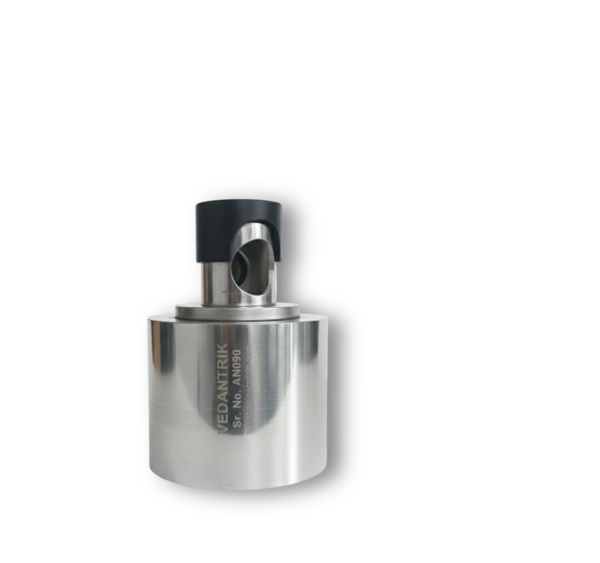
Calibration rod

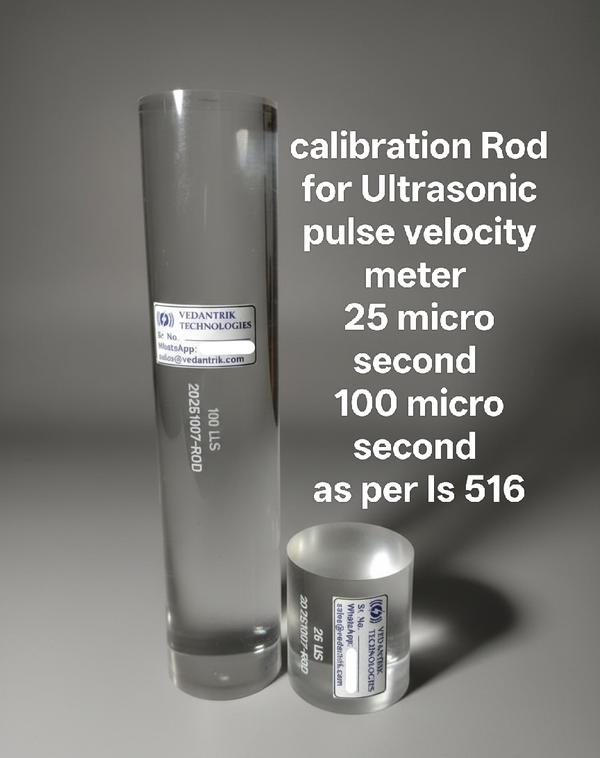
Calibration Rod for UPV: Calibration rods used in the Ultrasonic Pulse Velocity (UPV) test is a crucial tool to ensure that the readings obtained from concrete specimens are accurate and reliable. According to IS 516 (Part 5/Sec 1): 2018, the calibration of the UPV apparatus is performed using standard calibration rods of known lengths and material properties. These rods are made of a homogeneous, dense, and isotropic material, whose Ultrasonic pulse velocity values are well established. The calibration process generally involves the use of two standard rods, where the first rod labeled 25 μs, is used for initial calibration of the equipment. The second rod labeled 100 μs is then used to verify the accuracy of calibration. By checking the transit time through this 100 μs rod, engineers can confirm whether the equipment remains correctly calibrated across a wider range of travel time. During calibration, the transmitting and receiving transducers are placed at the two ends of the calibration rod using a coupling medium such as grease or petroleum jelly to remove any air pockets that may tamper with the actual results and to also ensure good acoustic contact. A pulse is then transmitted through the rod, and the transit time is recorded, this mode of operation is called through transmission mode. Furthermore, the time measurement is then verified with reference time labeled on the rods to confirm the calibration. This dual-rod system (25 μs and 100 μs) ensures that the UPV equipment is not only initially calibrated but also verified for linearity and consistency over different travel times. It confirms that the instrument’s internal timing circuit and transducers function correctly across the expected range of measurements. As per IS 516 (Part 5/Sec 1): 2018, such calibration and verification must be performed before and after each series of tests, or whenever there is any suspicion of instrument drift or malfunction. Purpose of Calibration Rod: a) To ensure measurement reliability – Calibration rods ensure that subsequent UPV readings on concrete are valid and dependable. b) To check equipment accuracy – Ensures the UPV apparatus gives correct time readings before testing concrete. c) To detect instrument errors – Identifies any malfunction or timing error in the transducers or electronic timer. Principle behind Calibration: The use of calibration rods in UPV testing is fundamentally based on the principle of elastic wave propagation through homogeneous and isotropic media. The calibration rod serves as an excellent reference medium, having well characterized elastic and geometric properties, which allows for consistent verification of accurate time measurement capability of the UPV instrument. They behave like an idealized medium for propagation, with minimal internal scattering, negligible attenuation, and uniform acoustic impedance. When an ultrasonic pulse is transmitted through the rod, the longitudinal wave propagates along a predictable path, and the received signal exhibits well-defined wavefront characteristics. Since the UPV technique determines the pulse velocity V from the ratio of the known path length L to the measured transit time T (i.e., V=L/T), the accuracy of velocity calculation critically depends on the precision of time measurement and the stability of the transducer–instrument system. Any systematic deviation in the time registration or transducer response will introduce errors in the final velocity calculation, which can lead to misinterpretation of concrete quality and durability. Therefore, the calibration rod provides a standard benchmark against which such instrumental deviations can be identified and corrected. Components: a) Reference Rod (25 μs): Used to establish a standard calibration range for the accuracy of time measurement in the UPV apparatus. b) Reference Rod (100 μs): Utilised to confirm the validity and consistency of calibration across a longer propagation path length. Standard Procedure: Overview 1) Inspect the UPV instrument, ensuring all components are functional. Select clean reference bars, typically short (25 µs) and long (100 µs), free of surface defects. 2) Apply an appropriate coupling agent (e.g., petroleum jelly or glycerol paste) to the transducer faces and bar surfaces to ensure efficient ultrasonic energy transfer and prevent signal distortion. 3) Place the transducers on the short reference bar and measure the transit time. Compare with the known value (25 µs); any deviation beyond ±0.5% indicates the need for adjustment. 4) Repeat the measurement on the long reference bar (100 µs) to confirm linearity and consistency across longer path lengths. 5) If both measurements fall within tolerances, the instrument is calibrated and ready for field testing. Any discrepancies must be corrected before concrete testing. Factors influencing the Calibration Process: 1) Instrument Accuracy and Stability: The electronic timing system, pulse transmitter and the receiver must be stable and precise. Any drift or noise in the electronics can affect the measured transit time,leading to calibration error. 2) Transducer performance: Variation in transducer sensitivity, frequency , or wear can influence pulse generation and reception, affecting the measured time. Calibration ensures these effects are accounted for. 3) Coupling Quality: The efficiency of energy transfer between transducer and calibration rod and uniformity of the coupling agent. Poor coupling can reduce signal amplitude or introduce timing errors. 4) Transducer Alignment and Pressure: Misalignment or inconsistent contact pressure can change the effective path of the pulse, introducing errors in timing measurement during calibration. Accurate calibration is the foundation for every reliable Ultrasonic Pulse Velocity test. Even minor errors in time measurement can lead to inaccurate interpretation of the concrete’s quality. Therefore, to ensure precision and repeatability, calibration must be carried out using a standard reference. Vedantrik Technologies provide high quality calibration rods, made from Poly-methyl Methacrylate, which behaves as an excellent medium, providing acoustic stability, homogeneity, with minimal internal scattering, negligible attenuation, and isotropic properties. These calibration rods are available in two standard configurations: a short rod (25 µs) for calibration and a long rod (100 µs) for verification and validating timing consistency over extended paths. By acting as trusted standard reference, Vedantrik Calibration rods help eliminate measurement error that may otherwise compromise the true results.For efficient and reliable UPV calibration rods in Mumbai, contact Vedantrik Technologies and ensure the highest standards of concrete quality. As a best Ultrasonic pulse velocity Meter calibration rod Manufacturer in India we have supplied in Mumbai, Pune, Nashik, Aurangabad, Surat, Vadodara, Ahmedabad, Indore, Bhopal, Nagpur, Jaipur, Ludhiana, Ghaziabad, Delhi, Lucknow, Kanpur, Prayagraj, Patna, Ranchi, Dhanbad, Bengaluru, Hyderabad, Chennai, Coimbatore, Madurai, Visakhapatnam, Kolkata, and Srinagar. Also we have supplied a range of products in Dubai, Abu Dhabi, the United Arab Emirates, Oman, Saudi Arabia, Kuwait, and Iran. We also serve clients in Singapore, Indonesia, Thailand, and other international locations.

6814772a5d263414004dd4a4 Card 2

product image
Ultra Sonic Pulse Velocity

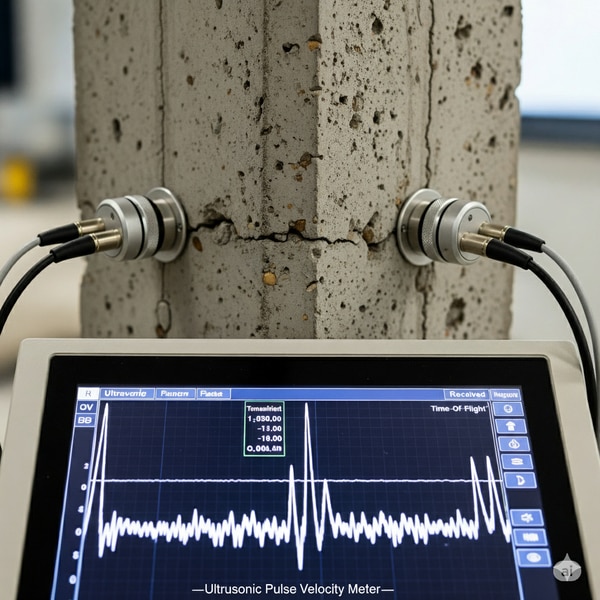
Ultrasonic Pulse Velocity Meter: The Ultrasonic Pulse Velocity (UPV) test is a widely used non-destructive testing method for assessing the quality, integrity, homogeneity and internal conditions of the concrete. The test is fundamentally based on measuring the velocity of the ultrasonic pulse as it travels through the concrete medium. The velocity of the sound waves in concrete depends on its density, homogeneity and internal continuity, therefore , any defects such as cracks, voids, and honeycombing will affect the travel time and thus the calculated velocity. In UPV an electroacoustical transducer produces a high frequency electrical pulse which is converted into mechanical wave (ultrasonic pulse),and this pulse propagates through the concrete and is detected by a receiver which converts it back into an electrical signal. The time of travel (t) of the pulse between the transducer and receiver is measured precisely using an electronic timer. The pulse velocity (v) is then calculated using a general formula v=l/t, and the result is expressed in kilometers per second (Km/s). The test can be conducted in three ways; direct, semi-direct and indirect transmission depending on the site accessibility. In direct transmission the emitter and receiver are placed on opposite faces of the concrete, allowing the pulse to travel directly through the material. Since the pulse travels the shortest distance, it gives the most accurate and consistent results. In a semi-direct method the emitter and receiver are placed at right angle or adjacent surfaces, where the pulse travels diagonally through the concrete. This method is particularly used when only two adjacent surfaces are available. Finally, in the indirect method both emitter and the receiver are placed on the same surface. Although this arrangement gives lower velocity value, it is still useful for locating cracks and defects when only one side is accessible. To ensure reliable readings, the contact surface between the transducers and the concrete must be applied with a couplant such as grease, petroleum jelly, other gel based materials to eliminate air gaps and improve the transmission of the ultrasound. Interpreting the UPV result involves comparing the calculated velocity with the standard reference values provided by IS 516 (Part 5/Sec 1): 2018 and ASTM C597. However, these values may vary depending on the mix design, aggregate type, and environmental conditions. Therefore the results of UPV must also be compared with other NDT methods , for evaluating uniformity, quality and deterioration in concrete. Purpose of Ultrasonic pulse velocity test: 1. To evaluate the quality and uniformity of the concrete. 2. To detect internal cracks, voids, honeycombing, or deterioration 3. Can be used to estimate the strength of concrete indirectly, when correlated with a compressive strength test. 4. Assess homogeneity between different parts of a structure. Principle of Ultrasonic pulse velocity test: The ultrasonic pulse velocity test works on the principle of elastic wave propagation through heterogeneous solid media and its correlation with the mechanical integrity, density,and homogeneity of concrete. It exploits the behaviour of longitudinal stress waves (P-waves) that transverse the material in response to a transient mechanical excitation of ultrasonic pulse frequency, typically ranging from 20 kHz to 150 kHz. The fundamental concept is that the velocity of propagation of these waves is intrinsically governed by the mass density of the medium, which are, in turn, influenced by the material's micro-structural composition, degree of compactness, presence of micro-cracks, elasticity, and the quality of the inter-facial transition zone between the aggregate and cement paste. In concrete, which is an inherently heterogeneous composite the relationship between composition, density and its elasticity becomes more complex due to scattering, reflection, refraction and mode of conversion effects that occur at the boundaries of different constituent phases. However, effective pulse velocity observed in concrete can still be regarded as a representative parameter of its overall stiffness and structural continuity. The propagation of ultrasonic pulses in concrete is strongly influenced by the acoustic impedance miss matches between the constituent materials. It dictates the degree of transmission and reflection of the wave at the phase boundary. When the ultrasonic pulse encounters an interface between the medium of differing impedance, part of the wave energy is reflected and the rest is transmitted. Hence, any discontinuity due to cracks, voids, or poorly bonded interface introduces additional reflection and scattering phenomena, effectively increasing the transmit time of the pulse between the two points and thereby reducing the apparent e recorded velocity. The upv therefore serves as a macroscopic indicator of the structural integrity of the concrete. The transmit time of the ultrasonic pulse depends on both the elastic property and path continuity. In a well hydrated cement matrix, the inter-granular complexes are continuous and stiff, giving higher elastic moduli which in turn yields higher pulse velocity. In contrast, micro-cracking due to shrinkage, thermal stress, or load-induced damage disrupts this continuity, effectively reducing the effective stiffness and thus the propagation velocity. In essence, the UPV test is an application of the relationship between the wave propagation velocity, elastic nature of the concrete which is dictated by micro-structural uniformity and continuity. Measurement of Ultrasonic Pulse Velocity test: The test is based on measuring the time taken (T) by an ultrasonic pulse velocity to travel through a known path length (L). The pulse velocity (V) depends on the elastic properties of the concrete, and is calculated by the following formula: V=L/T Where, V = Velocity of the pulse (m/s or km/s) L = Path length between the two Transducers (emitter and receiver) T = Transit time of the pulse (s) Components of Ultrasonic Pulse velocity test: The main components of an Ultrasonic Pulse Velocity testing system are: 1. Main Unit (UPV Tester): This is the central device that controls the entire test. It generates electrical pulses, measures the transit time of ultrasonic waves, and displays or records the pulse velocity. It also supplies power to the transducers and processes the received signals. Transducers (Transmitter and Receiver): The transmitter converts electrical pulses into ultrasonic waves, and the receiver converts the returning waves back into electrical signals. 2. Couplant: A gel, grease, or paste applied between the transducers and the concrete surface to ensure proper transmission of ultrasonic waves by removing air gaps. 3. Connecting Cables: Connect the transducers to the main unit, allowing transmission and reception of electrical signals. Standard Procedure for Ultrasonic Pulse Velocity (UPV) Test The Ultrasonic Pulse Velocity (UPV) test is carried out according to IS 516 (Part 5/Sec 1): 2018 or ASTM C597 to determine the quality, uniformity, and integrity of concrete. The following steps outline the standard testing procedure: 1. Application of Couplant on the surface A thin layer of Couplant, such as petroleum jelly, grease, or gel, is applied to the contact area between the transducers and the concrete surface. The Couplant eliminates air gaps and improves the transmission of ultrasonic pulse from the transducer into the concrete, ensuring more accurate reading. 2. Positioning of the transducer The transmitting and receiving transducers are positioned on the concrete using one of three arrangements depending on accessibility. In direct transmission the transducers (emitters and Receivers) are placed opposite faces of the concrete specimen, it is considered the most accurate method. In Semi-Direct transmission the transducers are placed on adjacent faces, while in indirect (Surface) transmission both transducers are placed on the same face (least accurate but useful when only one face is accessible). Proper alignment of the transducers ensures accurate measurement of pulse travel time. 3. Measurement of the Path length The distance between the center of the two transducers is measured carefully using a measuring tape or scale. This measured distance represents the path length (L) through which the ultrasonic pulse travels. 4. Recording the transit time The main unit of the UPV is switched on to generate an ultrasonic pulse through the transmitter. The pulse travels through the concrete and is received by the receiver. The time taken by the pulse to travel this distance, known as the transit time (T), is displayed on the device. Multiple readings are taken at each point, and the average value is used for accuracy. Result interpretation of Ultrasonic pulse velocity test: The velocity of ultrasonic pulses through concrete depends on its density and elastic properties. The quality of concrete can therefore be classified as follows (as per IS 516 (Part 5/Sec 1): 2018 and ASTM C597): The quality of concrete can be assessed using Pulse Velocity measurements in kilometers per second (km/s). Concrete with a pulse velocity >4.40 km/s is considered Excellent, indicating very good quality, dense, and uniform concrete. Pulse velocities in the range of 3.75 to 4.40 km/s correspond to Good concrete, which is of good quality with negligible voids or cracks. When the pulse velocity falls between 3.0 and 3.75 km/s, the concrete is rated as Medium, meaning it is of fair quality and may contain minor defects or variations. Concrete with a pulse velocity < 3.0 km/s is considered Doubtful, as it is likely weak, porous, or damaged. Factors Influencing Ultrasonic Pulse Velocity (UPV) Test Several factors can affect the accuracy and reliability of the UPV test results. These factors influence the speed at which ultrasonic waves travel through concrete: 1. Moisture content in the specimen: Concrete that has higher moisture content allows ultrasonic pulses to travel faster because water fills the pores, improving transmission. Whereas, dry concrete generally gives lower pulse velocity readings 2. Path length and Geometry: Very short path length or irregularly shaped specimens can lead to measurement inaccuracies, as the pulse may not travel uniformly through the material. 3. Concrete Mix and Density: Denser and more homogeneous concrete provides higher velocities, while concrete with voids, honeycombing, or poor compaction show lower velocities 4. Surface condition and Couplant application: Rough or uneven surfaces can cause poor contact between the transducers and the concrete. Hence, proper application of couplant is essential to ensure accurate readings. Sources of Errors in Ultrasonic Pulse Velocity (UPV) Test 1. Poor surface contact: Inadequate use of couplant or rough surface can lead to air gaps between the transducer and concrete, increasing signal loss and measurement errors. 2. Incorrect path length measurement: Errors in measuring the distance between transducers directly affect the calculated pulse velocity. 3. Equipment calibration errors: If the UPV testing device is not properly calibrated, the recorded transit times may be inaccurate. 4. Improper transducer placement: Misalignment or unstable positioning of transducers can cause inconsistent readings. 5. Electrical or signal interference: External vibrations, electrical noise, or poor signal connections can distort the received signal and lead to faulty timing measurements. The Ultrasonic Pulse velocity Meter by Vedantrik technologies is a non-destructive testing (NDT) instrument designed to evaluate the quality, uniformity and integrity of concrete. It works by sending the ultrasonic pulses through the concrete via transmitting transducers, the pulses travelling through the material are then detected by receiving transducers on the opposite or adjacent surface. The device measures the transit time of pulses, and displays the values on the digital screen. Using the path length between the transducer, the velocity of the pulses can be calculated, which directly reflects the homogeneity, and presence of defects such as voids, cracks and honeycombs in the concrete. Designed for field and laboratory use, the device is portable and capable of testing path length up to 3 meters. To further enhance the measurement reliability, it includes a burst mode feature, which averages multiple ultrasonic pulses to provide stable readings, and a freeze function, that locks the reading on the display for convenience during the testing. Additionally, the android mobile applications enable indirect-mode calculations, streamlining workflow for engineers and quality control personnel. Lightweight, portable, and robust with a plastic housing, the Vedantrik UPV meter combines modern features with practical usability, making it a versatile and cost-effective solution for structural health monitoring, concrete quality assessment, and non-destructive evaluation of construction elements. Key features: 1. Burst Mode for Stable Readings In Burst Mode, the device transmits multiple ultrasonic pulses over 5–6 seconds and automatically averages the readings. This process minimises fluctuations and ensures accurate, consistent results every time. 2. Reading Hold (Freeze Function) The instrument automatically freezes the reading on display even after the transducers are removed, allowing ample time for users to record or review data without losing results. 3. Android App Connectivity Comes with a dedicated Android application for easy indirect mode velocity calculation and graph plotting as per IS 516 standards. The app provides a user-friendly interface for data analysis, reporting, and sharing test results on the go. 4. High Storage Capacity Designed with a built-in record and storage facility for up to 1,000 readings, ensuring convenient data logging during large-scale testing operations or multiple project sites. 5. Long Operational Backup Powered by an in-built rechargeable battery, the device delivers extended operational backup, ensuring uninterrupted performance even in field conditions where power availability is limited. 6. Lightweight and Compact Design Housed in a durable ABS plastic enclosure, the unit is lightweight, compact, and easy to handle, making it ideal for both laboratory and on-site testing applications. Technical Specifications: a) Measurable path length: 3-4 meters in good quality concrete. b) Time measurement range: 0.1-9999.9 μs. c) Measurement parameters: Time and Velocity. d) Time base:- 10MHz Quartz. e) Frequency of Transducer: Standard 54KHz (Nominal). f) User interface: OLED Display, keypad and PC interface. g) PC Interface: Measurement log download. h) Operator Adjustment: Calibrating using Calibration rod. i) Battery Operating capacity: 8 Hrs. maximum. j)Operating Temperature range: 0-50 degreeC. k) Size: W-180mm x H-55mm x D-240mm. l) Weight: 1.90 Kg As a best Ultrasonic Pulse Velocity Meter Manufacturer in India we have supplied in Mumbai, Pune, Nashik, Aurangabad, Surat, Vadodara, Ahmedabad, Indore, Bhopal, Nagpur, Jaipur, Ludhiana, Ghaziabad, Delhi, Lucknow, Kanpur, Prayagraj, Patna, Ranchi, Dhanbad, Bengaluru, Hyderabad, Chennai, Coimbatore, Madurai, Visakhapatnam, Kolkata, and Srinagar. Also we have supplied a range of products in Dubai, Abu Dhabi, the United Arab Emirates, Oman, Saudi Arabia, Kuwait, and Iran. We also serve clients in Singapore, Indonesia, Thailand, and other international locations.

6814772a5d263414004dd4a4 Card 2

product image
Concrete Maturity meter

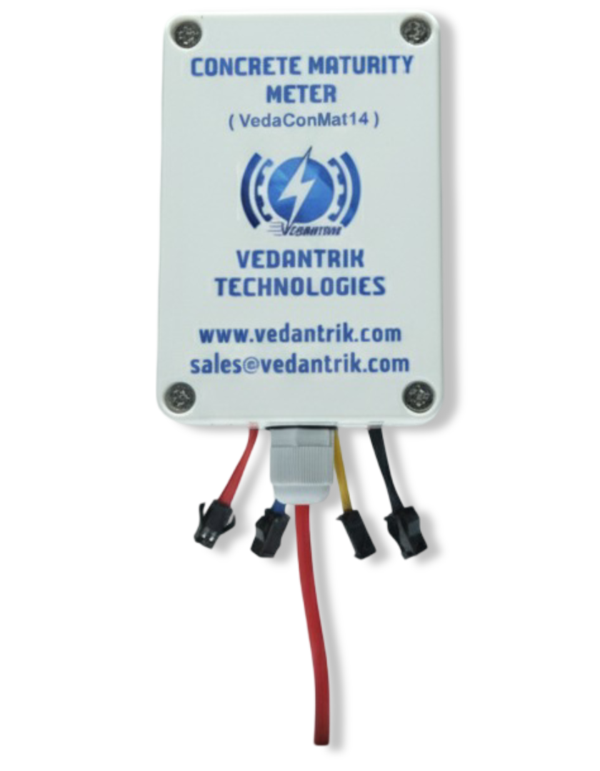
Concrete Maturity Meter: VedaConMat14 by Vedantrik Technologies is a device designed to accurately estimate the maturity of concrete using highly sensitive and precise temperature sensors. By measuring temperature variations within the concrete, the device calculates the maturity value, which is then correlated with strength to develop a reliable maturity index. This index is used to determine the in-situ compressive strength of concrete, enabling real-time monitoring of both precast and cast-in-place concrete. The device is equipped with four sensor ports, allowing connection of four temperature sensors simultaneously. These sensors are embedded into the concrete at the construction site to measure temperature continuously. The maturity value is then calculated based on the recorded temperature data and correlated with the concrete strength. This correlation must be established for the specific concrete mix design following ASTM C1074 standards and remains valid as long as the mix design does not change. VedaConMat14 logs temperature data every 30 minutes, averaging 60 individual readings collected at 30-second intervals to provide precise and stable temperature values over time. This continuous monitoring ensures a detailed temperature profile throughout the curing process. For seamless connectivity, VedaConMat14 features a built-in Wi-Fi Hotspot, allowing wireless connection from laptops, PCs, or mobile devices. Its web-based software interface provides real-time visualization of temperature, maturity, and strength data directly from the device. Furthermore, when connected to an office Wi-Fi network and synced with Google Drive, all logged data is automatically uploaded to the cloud. This allows remote access to the concrete maturity and strength information from anywhere in the world via Google Drive. Key features of Concrete Maturity Meter : VedConMat14 1. Temperature Sensing Range: 0 to 100°C with ±1°C Accuracy: VedaConMat14 can measure temperatures from freezing point (0°C) up to 100°C, covering the entire typical range for concrete curing. The sensors provide highly accurate readings, with a small possible error margin of just plus or minus one degree Celsius, ensuring reliable temperature data for maturity calculations. 2. Low-Cost Sacrificial Sensors, Reusable Measuring Unit: The temperature sensors used are designed to be low-cost and sacrificial, meaning they can be embedded directly into the concrete and disposed of after use. However, the main measuring unit, which collects and processes data from these sensors, is reusable for multiple projects, reducing overall costs. 3. Automatic Data Logging with User-Defined Intervals: The device automatically records temperature data at intervals set by the user. This flexibility allows adjusting the frequency of measurements based on project requirements—whether data is needed every few minutes or hours—making monitoring efficient and tailored. 4. Available in Multiple Channel Options VedaConMat14 supports different versions with varying numbers of sensor ports (channels). This allows monitoring temperature at multiple points within the concrete, which is especially useful for large pours where temperature can vary across the mass. 5. Web-Based Software for Data Logging and Report Download The system comes with easy-to-use web-based software accessible through any device connected to the VedaConMat14 Hotspot. This software allows viewing real-time data, managing logged data, and downloading detailed reports for record-keeping and analysis. 6. Graphical Representation The software provides clear graphical charts that plot temperature changes over time, Maturity vs. Time, Maturity vs. strength. These graphs help visualize the curing process, showing how temperature rises and falls during hydration. Such visual data assists engineers in quickly assessing whether concrete is curing done properly and supports making informed decisions about strength development and construction scheduling. Monitoring the strength development of concrete during early curing is essential for safe construction scheduling. The Concrete Maturity Meter provides real-time data on temperature history to estimate in-place strength, making it a crucial tool for project managers. In Mumbai’s high-rise and infrastructure projects, where deadlines are tight, maturity meters allow engineers to determine the right time for formwork removal, post-tensioning, or opening structures to service. Vedantrik Technologies offers advanced maturity meters that are easy to deploy and deliver accurate strength estimations. By using this device, contractors avoid unnecessary delays while ensuring safety. It reduces reliance on time-based curing estimates and instead relies on actual strength data, leading to better efficiency and reduced costs. For high-performance concrete maturity meters in Mumbai, connect with Vedantrik Technologies and achieve safer, smarter, and faster construction results. Concrete Maturity method is a fundamental concept that is used to estimate the early-strength development of concrete based on its time & temperature history. It follows the principle that the strength development of the concrete is directly influenced by both time and temperature. The maturity method as defined by ASTM C1074 provides a reliable, non-destructive way to assess the in-situ concrete strength development over time. This standard is widely used in structural monitoring, quality control, and construction scheduling where early-age strength prediction is critical. Concrete maturity refers to the cumulative effect of both temperature and time on strength development in concrete. The main objective behind the maturity method is that concrete does not gain strength based on age but rather how temperature has influenced its hydration process over time. The process of hydration is temperature dependent, where higher temperature accelerates the reaction and, in turn, the strength gain, while lower temperatures show an opposite effect. Hence maturity is also defined as a time-temperature factor or function. By integrating temperature over time, maturity index can be established, which is typically expressed in °C·hours or °C·days, that correlates with strength development. The co-relation between maturity and strength is empirical and must be established for each specific concrete design, as it is generally accepted that concrete of a specific mix design will develop the same compressive strength if it reaches the same maturity index, for example if a concrete mix (A) is achieving the maturity index of value Z 0C.hrs in X days at Y 0C , and there is a concrete mix (B) is also achieving the same maturity index that is of value Z 0C.hrs in P days at Q 0C still both will develop same compressive strength as the maturity indexes are same. This assumption enables project teams to assess strength development in real time, improving the quality control without the need of frequent destruction. Purpose of Concrete maturity method: 1. To determine in-situ concrete strength using the time-temperature history of the structure, in accordance with ASTM C1074. 2. Provides a non-destructive alternative to traditional testing methods. 3. Helps in improving the structural safety by ensuring that critical construction activities are performed only after the concrete has reached the required strength. 4. Enhance control over curing conditions by allowing for assessment of temperature related-effects on strength development. Supports mix design optimisation by allowing the study of variables like admixtures, cement types, or curing conditions effect on strength development. 5. Facilitate compliance with standards through data-driven, quantifiable verification of strength development. Principle behind Concrete Maturity Measurement Method: The concrete maturity method is an empirical technique employed to predict the development of strength in concrete as a function of its temperature-time history. The fundamental principle underlying this method is that the rate of cement hydration process, along with the consequential strength gain, is not only influenced by the age of the concrete since the time of casting, but primarily by the combined effect of time and temperature. In essence the maturity method is useful in quantifying the degree of hydration by integrating temperature over time, thereby allowing to estimate the strength of in-situ concrete with great accuracy, especially during the early stages of curing. Concrete strength gain is intrinsically linked to the kinetics of cement hydration, a complex exothermic reaction between water and cementitious materials such as tricalcium silicate, dicalcium silicate, tricalcium aluminate, and tetracalcium aluminoferrite that leads to formation of calcium-silicate-hydrate (C-S-H) gel and other reaction products that contribute materials structural integrity. The rate of these hydration reactions are temperature dependent, so elevation in temperature increases the rate, mainly because of reduced activation energy barrier, while lower temperatures affect it in the opposite manner. However, this same hydration process can result in excessive heat generation that has a direct effect on the morphology and distribution of the hydration products. Hence, it can lead to temperature induced changes in the micro-structures, porosity and micro-cracking due to differential thermal gradients, especially in mass concrete. Furthermore elevated temperature can also affect the natural evolution of the micro-structures in the concrete, thereby affecting the structural and mechanical properties beyond that could be assessed by the maturity method. Measurement of Maturity and strength: Nurse-Saul function is the widely used method, which assumes that there is a linear relationship between temperature and the rate of hydration. The general formula is expressed in the form given below: M(t) = ∑ (Ta - T0) * Δt Where : M(t) = the temperature-time factor at age t, degree-days or degree-hours, Δt = time interval, days or hours, Ta = average concrete temperature during time interval, Δt, °C, and To = datum temperature, °C. After calculating the maturity values for each of the specified curing days and determining the corresponding compressive strengths from the CTM (Compression Testing Machine) results, plot a graph of maturity index versus compressive strength. Fit a trend-line to the data to identify the best-fit relationship, typically a logarithmic regression provides a good representation of the strength development in relation to maturity. Fc = a + b * log10 (M) Components of Concrete Maturity Method: 1. Temperature Monitoring Equipment - Devices to measure and record concrete temperature over time. 2. Concrete Strength Testing - Standard strength tests (e.g., ASTM C39 – Compressive strength of cylindrical concrete specimens). 3. Reference Temperature - A specific temperature used in maturity calculations. For Nurse–Saul, the typical reference is 0°C (32°F) unless otherwise specified. 4. Concrete Mix Design Information - The maturity method is mix-specific; a separate calibration curve is required for each mix. 5. Data Collection and Analysis Tools - Software or spreadsheets to calculate maturity and estimate strength. Ensures real-time tracking and reporting. Standard procedure: Overview (as per ASTM C1074) 1. Objective of Maturity Method Calibration The primary objective of the calibration process in ASTM C1074 is to establish a reliable relationship between concrete maturity and its compressive strength for a specific concrete mix. This relationship—called the strength–maturity curve—enables users to estimate in-place concrete strength based on temperature history rather than destructive testing. Since the maturity method is mix-specific, each unique concrete mixture requires its own calibration. 2. Selection and Preparation of Concrete Mix The calibration begins by selecting the specific concrete mix that will be used in the field. This includes confirming the materials, proportions, and mixing procedure. Fresh concrete from this mix is then used to cast a set of standard specimens depending on the project requirements, which will be cured and tested over time to develop the strength–maturity relationship. 3. Temperature Monitoring of Specimens To track the maturity development, thermocouples or temperature sensors are embedded in at least two of the cylinders immediately after casting. These sensors record the internal temperature of the specimens continuously over time. The temperature data is used to calculate the maturity index using either the Nurse–Saul function or the Arrhenius function, as specified in ASTM C1074. 4. Curing and Strength Testing Schedule The concrete specimens are cured under standard laboratory conditions, and are tested for compressive strength at multiple time intervals; for example, at 1, 3, 7, 14, and 28 days. The specific times should span the range of expected strengths during field monitoring. At each test age, the corresponding maturity index is calculated based on the recorded temperature history. 5. Developing the Strength–Maturity Relationship After collecting the strength and maturity data at each age, the results are plotted with concrete strength on the y-axis and maturity index on the x-axis. A best-fit curve (usually exponential or logarithmic) is applied to the data points to define the strength–maturity relationship for the given concrete mix. This curve becomes the foundation for estimating in-place strength based on measured maturity in the field. Result Interpretation of Concrete Maturity Method: Result interpretation in the maturity method involves comparing the maturity index (°C·hours or °C·days) calculated from the in-situ concrete to a previously developed calibration curve that relates maturity to compressive strength. By identifying the maturity value measured in the field and locating that point on the calibration curve, the corresponding compressive strength can be estimated. This allows for a reliable prediction of the in-place concrete strength at any given time, provided the conditions match those used during calibration. Factor influencing Concrete Maturity Method: 1. Temperature Measurement Accuracy: Proper placement and calibration of temperature sensors are crucial. Incorrect readings due to poor installation or equipment issues can lead to inaccurate maturity and strength estimates. 2. Calibration Curve Quality: The maturity-strength relationship must be based on accurate, consistent lab testing. Any errors in sample preparation, curing, or testing can compromise the validity of field results. 3. Mix Design Consistency: Variations in concrete mix (e.g., cement type, water content, admixtures) between the lab and field can affect strength development, making maturity estimates unreliable if not properly accounted for. 4. Curing and Environmental Conditions: While temperature is monitored, factors like moisture loss and poor curing practices can slow strength gain, leading to overestimated strength if maturity is used alone. 5. Data Recording Frequency: Infrequent or interrupted temperature logging can distort the maturity calculation. ASTM recommends frequent intervals (e.g., every 30 minutes) for accurate tracking. 6. Thermal Gradients in Large Sections: In large pours or mass concrete, different parts of the element may heat and cool at different rates. A single sensor may not represent the entire structure, leading to localised over- or underestimation of strength. As a best Concrete Maturity Meter Manufacturer in India we have supplied in Mumbai, Pune, Nashik, Aurangabad, Surat, Vadodara, Ahmedabad, Indore, Bhopal, Nagpur, Jaipur, Ludhiana, Ghaziabad, Delhi, Lucknow, Kanpur, Prayagraj, Patna, Ranchi, Dhanbad, Bengaluru, Hyderabad, Chennai, Coimbatore, Madurai, Visakhapatnam, Kolkata, and Srinagar. Also we have supplied a range of products in Dubai, Abu Dhabi, the United Arab Emirates, Oman, Saudi Arabia, Kuwait, and Iran. We also serve clients in Singapore, Indonesia, Thailand, and other international locations.

6814772a5d263414004dd4a4 Card 2

product image
Rebound Hammer

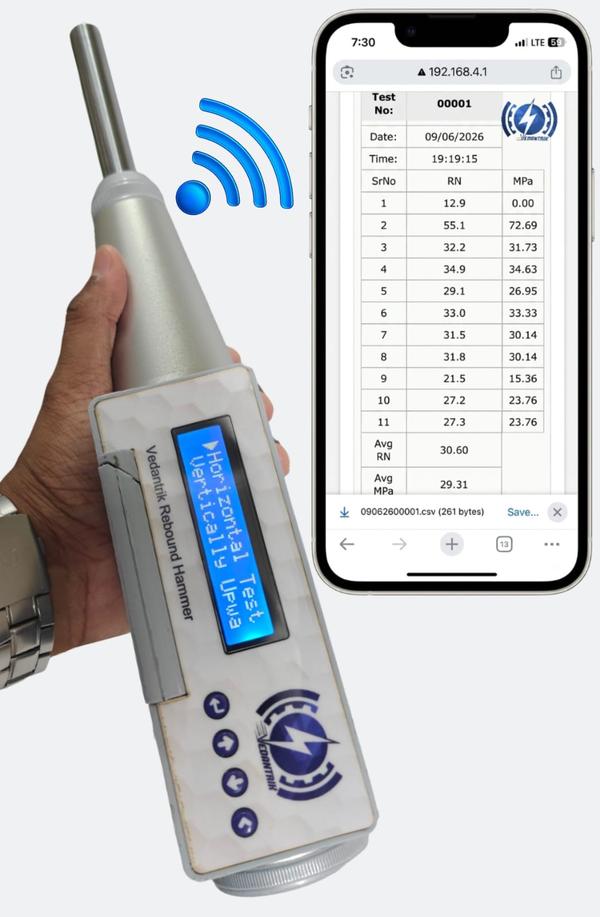
Rebound Hammer Based on the Schmidt mechanism, Vedantrik technologies has developed a compact, durable, and user friendly Rebound Hammer for reliable on-site concrete strength estimation. The instrument complies with various national and international standards like IS-516, ASTM C805, DIN 1048, and BS1881 to ensure consistent and accurate results. The Rebound Hammer is used for non-destructive assessment of concrete quality and uniformity. During the test, the plunger of the hammer is pressed against the surface of the concrete, releasing the spring controlled mass that impacts the surface. The extent of rebound, measured as the rebound number, is directly related to the surface hardness of the concrete. Hence a higher rebound number indicates a harder and stronger concrete. Each hammer is calibrated to ensure the rebound number accurately represents the stiffness of the spring and hardness of the concrete surface. The compressive strength of the concrete can be determined by correlating the average rebound number with the standard graph provided with the hammer. This enables engineers and site professionals to perform quick, reliable, and non-destructive evaluation of concrete strength directly on-site, helping in quality control and uniformity checks across structures. About Rebound Hammer Test: The rebound hammer test, also known as Schmidt hammer test, is a non-destructive testing (NDT) used to assess the compressive strength and surface hardness of the concrete. It was first developed by Ernst Schmidt in the 1950s and has since become one of the most common and widely used tests for compressive strength evaluation of concrete. The main instrument consists of a spring-controlled mass called a plunger that slides on a calibrated scale within the main body. When the plunger of the main body is pressed against a solid surface such as concrete, the spring loaded mass is released, striking the steel plunger in contact with the concrete surface. The mass then rebounds with a consistent and reproducible velocity, and the extent of the rebound is measured on the scale to get the rebound number. This rebound number is then empirically correlated to the compressive strength of the concrete, which is obtained using standard calibration charts or curves provided by National & International standards IS-516, ASTM C805, DIN 1048, and BS1881. The working of the rebound hammer test is based on the elastic rebound of the surface, which depends on the hardness and stiffness of the material being tested. A harder surface will cause greater rebounds, indicating the stronger and denser nature of the concrete, while lower rebounds indicate the opposite. The test is performed by holding the hammer perpendicular to the surface of concrete, ensuring good contact between the plunger and the surface. Multiple readings (usually 9-10 readings) are taken at different points on the same area, to get the average rebound value,for strength estimation. This practice minimises the error and improves the accuracy of the process. However it must be taken into consideration that the test primarily measures the surface hardness, which can be influenced by a variety of factors, and therefore, is an indirect method that requires correlation with laboratory test results. The rebound hammer test can be used in both horizontal and vertical positions, but corrections must be applied depending on the orientation of the hammer, since the gravitational force influences the rebound reading. Furthermore, the calibration of the rebound hammer is also essential before testing to ensure accuracy and consistency in results. The calibration is typically done using a standard steel anvil. The interpretation of the test result is done using standard guidelines given by IS-516, ASTM C805, DIN 1048, and BS1881. Purpose of Rebound Hammer test: 1. To estimate the compressive strength of the concrete without damaging the structure. 2. Helps identify variations in concrete quality across different areas. 3. To estimate the surface hardness of the concrete. 4. Allows comparison between old and new concrete structures for maintenance and repairs. Principle of Rebound Hammer Test: The rebound hammer test or Schmidt hammer test is fundamentally based on the principle of surface hardness measurement and the correlation between the elastic properties of concrete and its compressive strength. The underlying mechanism involves the kinetic interaction between a standardised mass, which is propelled by a calibrated spring mechanism, and the concrete surface. The extent to which this mass rebounds after the impact is quantified as rebound number, which serves as an indirect indicator of the materials elastic stiffness and surface hardness. These surface mechanical properties are directly linked to the concrete’s density, degree of compaction, and the continuity of the cementitious matrix, all of which in conjunction influence the compressive strength. When the impact energy is applied on the surface of the concrete surface, a portion of this energy is absorbed within the near-surface zone, resulting in micro-elastic deformation and localised stress wave propagation. The remaining portion of the impact energy is restored as rebound energy, which propels the hammer backward. The magnitude of the rebound energy is controlled by the concrete’s capacity to elastically store and release strain energy. In denser and more homogeneous concrete, with well hydrated cementitious matrix and strong inter-facial transition zone, the deformation is majorly elastic and reversible leading to higher rebound value. In addition, the local stiffness of the impact region determines the proportion of impact energy that is elastically returned. The relationship can be conceptually linked to the material’s stress-strain response under short duration. Although the rebound process does not represent the true static compression, the local stress distribution beneath the contact point momentarily reaches the magnitude approach the true compressive strength of the surface layer. Consequently, the rebound number acts as an indirect measurement of the mechanical integrity, particularly within the depth of 10-20 mm at the contact surface. The rebound value is sensitive to cementitious matrix, aggregate characteristics, along with hardness, angularity and gradation. Hence, the stress wave generated during the impact propagates through the heterogeneous micro-structures, encountering reflection and attenuation at the materials interface. Moreover the materials surface condition and moisture state, affects the damping characteristics of the concrete. Therefore, a dry concrete, due to reduced capillary saturation and higher stiffness at the inter-facial zones yield higher rebound number. Whereas a saturated concrete surface facilitates localised energy absorption at the damped regions lowering stiffness at the inter-facial zones yielding a lower rebound number. As such, the estimation of strength of concrete by rebound hammer method cannot be held to be very accurate and probable accuracy of prediction of concrete strength in a structure is ± 25 percent. Measurement of rebound Hammer test: The measurement in a rebound hammer test is taken in terms of the rebound number, which indicates the hardness of the concrete surface. Multiple readings (usually 10 to 12) are taken on a selected area of the concrete surface. The average rebound number is then calculated after discarding any unusually high or low readings. This average value represents the surface hardness of the concrete and is later correlated with compressive strength using a calibration chart or curve provided by the hammer manufacturer or established as per IS 13311 (Part 2):1992. Corrections are applied for the angle of testing (horizontal, upward, or downward), surface condition, and moisture content before interpreting the final result. Components of rebound hammer 1. Rebound Hammer (Schmidt Hammer): The main testing instrument contains a spring-loaded mass and plunger used to impact the concrete surface and measure the rebound number. 2. Concrete Surface (Test Area): The prepared surface of the concrete member (wall, slab, beam, or column) on which the test is conducted. 3. Calibration Anvil: A standard steel anvil used for periodic calibration of the rebound hammer to ensure accuracy and consistency of readings. 4. Correction Charts / Graphs: Reference charts (provided by the manufacturer or as per IS 13311) used to adjust rebound numbers for testing angle (horizontal, vertical upward/downward) and surface condition, and to correlate them with compressive strength. Standard procedure: Overview 1. Surface Preparation The concrete surface should be clean, smooth, and free from dust, loose particles, or plaster. Rough or uneven areas should be leveled to ensure accurate readings. 2. Positioning the Hammer Hold the rebound hammer perpendicular to the test surface. Note the orientation whether it's horizontal, vertical upward, or vertical downward as it affects the reading. 3. Taking Readings Press the hammer plunger against the surface and release it to impact the concrete. Record the rebound number from the scale or digital display. Take at least 10–12 readings in the test area and discard unusually high or low values. 4. Calculating the Average Rebound Number Compute the average of the obtained readings to represent the surface hardness of the concrete. 5. Applying Corrections Adjust the average rebound number for testing angle, surface condition, and moisture content using correction charts provided in the code or by the manufacturer. Result interpretation of the rebound hammer test: The average rebound number, after taking multiple readings and applying necessary corrections for testing angle, surface condition, and moisture content, is compared with a calibration chart provided by the manufacturer or various Standards to estimate the compressive strength. It is important to note that this method gives only an approximate value of concrete strength and is not absolute; the results can have an accuracy variation of ± 25% (as mentioned in IS 13311 (Part 2):1992), depending on factors such as concrete type, surface smoothness, and testing conditions. For critical assessments, rebound hammer results should be verified with core tests (IS 516). Factors influencing the Rebound hammer test: 1. Concrete Age: Younger concrete is softer, giving lower rebound numbers. 2. Concrete Mix and Aggregate Type: Hard aggregates increase rebound; lightweight or soft aggregates reduce it. 3. Surface Hardness and Carbonation: Carbonated or overly hard surfaces give higher rebound values than the actual strength. 4. Moisture Content of Concrete: Dry surfaces produce higher readings than wet surfaces. 5. Testing Angle/Orientation: Upward, downward, or horizontal testing affects readings due to gravity. 6. Curing Conditions: Poor curing may reduce surface strength, affecting the rebound number. Source of error in Rebound hammer test: These are mistakes or procedural issues during testing that can lead to inaccurate readings: 1. Improper Surface Preparation: Dust, dirt, or uneven surfaces can distort results. 2. Incorrect Hammer Handling: Wrong angle, inconsistent pressure, or movement during impact. 3. Instrument Calibration Errors: Using a hammer that is not calibrated to the standard reference anvil. 4. Inconsistent Reading Locations: Testing over cracks, voids, or edges instead of a representative area. 5. Operator Error: Misreading the scale, recording errors, or insufficient number of impacts. Technical Specification: Range: 10N/mm2 - 70N/mm2 Standard Impact Energy: 2.207 J Least Count: 2 rebound number Weight (mass): 800g approximately. Dimension: Dia 60mm, length 1 feet approximately. As a best Rebound Hammer Manufacturer in India we have supplied in Mumbai, Pune, Nashik, Aurangabad, Surat, Vadodara, Ahmedabad, Indore, Bhopal, Nagpur, Jaipur, Ludhiana, Ghaziabad, Delhi, Lucknow, Kanpur, Prayagraj, Patna, Ranchi, Dhanbad, Bengaluru, Hyderabad, Chennai, Coimbatore, Madurai, Visakhapatnam, Kolkata, and Srinagar. Also we have supplied a range of products in Dubai, Abu Dhabi, the United Arab Emirates, Oman, Saudi Arabia, Kuwait, and Iran. We also serve clients in Singapore, Indonesia, Thailand, and other international locations.

6814772a5d263414004dd4a4 Card 2

product image
Curing Tank Temperature Controller

Curing Tank Temperature Controller to Maintain 27 +/-2 with immersion Heater & Chiller: Automatic curing tank temperature controller developed by Vedantrik technologies will help to maintain 27 +/- 2 degree Celsius, in the curing tank where concrete cubes are kept for the curing . When it comes to larger infrastructure projects and construction sites, the concrete cubes are casted on site in large numbers, then the curing tanks have limitation of size hence there is a need of onsite concrete curing tanks where concrete cubes are kept for curing. the large number of cubes that require proper water curing to ensure strength and durability. A critical aspect of proper curing is maintaining a consistent water temperature of 27 ± 2 degree C (I.e., between 25 to 29 degree C), which becomes increasingly difficult in an uncontrolled environment. To tackle this issue, the main controller is equipped with a 2 and 4 channel temperature controller, paired with a waterproof and shockproof stainless steel heater, specifically designed for immersion in curing tanks. The main unit also comes with waterproof temperature sensors that continuously monitor the curing tank temperature and provide real-time feedback to the controller. The automatic controller ensures that the heater is turned ON when the temperature in the tank falls below 25 degree C and OFF when it exceeds 29 degree C, thus maintaining the optimal temperature for curing, without the need for manual intervention. The stainless steel immersion heater has a temperature handling capacity ranging from 0 to 100°C, making it suitable for a variety of environments and use cases. The system's automatic ON/OFF control mechanism ensures energy efficiency, safety, and consistent temperature regulation, which is vital for maintaining the integrity of concrete test specimens. Its shock proof and protection against shock and earth leakage makes it very useful for onsite applications. Key features: 1. Precise Temperature Control (25°C to 29°C Range): The controller is designed to maintain water temperature within the optimal curing range of 27 ± 2°C, as specified in IS 516. It automatically activates the heater when the temperature drops below 25°C and cuts it off once it exceeds 29°C. This ensures consistent curing conditions crucial for accurate concrete strength testing. 2. Multi Channel Operation: The system features a Multi channel controller, allowing it to manage the multiple heater and temperature sensor simultaneously. This Multi channel setup enhances reliability, especially useful for larger curing tanks or setups with varying thermal loads or two different channels can be used for two different tanks if the water capacity is within range. 3. Waterproof and Shockproof Design: all the immersion heater and temperature sensor are designed to be fully waterproof and shockproof, ensuring safe operation in wet environments. This is especially important for construction sites where durability and safety are top priorities. 4. Stainless Steel Immersion Heater: The heater is made from high-grade stainless steel, offering resistance to corrosion and extended durability. It supports a wide operating temperature range (0°C to 100°C ± 1°C) and is suitable for long-term immersion in curing tanks without degrading. 5. Automatic On/Off Mechanism: The controller uses an automated switching system that turns the heater on or off based on real-time temperature feedback. This not only simplifies operation but also improves energy efficiency and prevents overheating or under-curing of concrete specimens. 6. High-Capacity Support: The controller supports immersion heaters up to 3000 Watts (3 kW), making it ideal for large curing tanks that require faster and more efficient heating. A curing tank temperature controller is an essential component in maintaining the ideal temperature environment required for curing of concrete samples. The device ensures that the curing takes place under controlled thermal conditions, which is essential for achieving optimal material properties like strength , durability, and structural integrity over time. As mentioned by IS 516 code, the ideal temperature for concrete curing is 27 ± 2 degree C, at which the concrete achieves optimal development. Hence, the controllers are specifically designed to regulate and stabilise the water’s temperature within the curing tank, maintaining it around 27 ± 2 degree C as per the standard requirement. Unlike general purpose thermostats, curing tank temperature controllers are specifically designed for laboratory and industrial settings where minor temperature fluctuations can significantly affect the curing process. The temperature controller continuously monitors the water temperature using highly temperature sensors, typically thermocouples or resistance temperature detectors (RTDs) which provide real-time feedback. This temperature value is used to dynamically adjust the heater placed in the curing tank, to ensure that the temperature remains within the tolerance range. Additionally, some construction materials are particularly sensitive to curing conditions. The hydration reaction of the cement, which is fundamental to the development of strength and integrity in concrete, is exothermic and highly influenced by surrounding temperature. Too low temperature can slow down the reaction and result in underdeveloped mechanical properties, while excessive heat may lead to rapid evaporation, shrinkage or micro-cracking. Therefore the role of curing tank temperature becomes pivotal in preserving the homogeneity and reproducibility of curing conditions, especially in quality control laboratories, research institutions, and construction testing facilities. Purpose of curing tank temperature controller: 1. Essential for maintaining a constant temperature to ensure curing water stays at a stable temperature (27 ± 20C) for consistent curing. 2. Ensures proper cement hydration, providing ideal conditions for the hydration of cement, leading to proper strength development in concrete specimens. 3. To prevent over-heating or under-heating or any temperature fluctuations that can negatively affect the curing process and compromise concrete quality. 4. Enables automatic temperature regulation and continuous monitoring, reducing the need for manual intervention. Principle of Curing: The effectiveness of concrete curing is fundamentally governed by the physicochemical and thermodynamic conditions to which the cementitious matrix is exposed during the early stages of hydration. The curing environment particularly in immersion based systems such as curing tanks plays a pivotal role in regulating the moisture availability, temperature equilibrium, ionic mobility, and phase development within the hydrated cement paste. At the core, curing tank functionality is primarily important to sustain a saturated aqueous environment that ensures uninterrupted progression of cement hydration reaction. Concrete strength gain is intrinsically linked to the kinetics of cement hydration, a complex exothermic reaction between water and cementitious materials such as tricalcium silicate, dicalcium silicate, tricalcium aluminate, and tetracalcium aluminoferrite , which requires continuous availability of water. In the absence of adequate moisture, endogenous shrinkage may halt the hydration process prematurely that may lead sub-optimal development of calcium-silicate-hydrate (C-S-H) gel and other reaction products that contribute materials structural integrity. However, the immersion curing via a water tank mitigates this risk by establishing a thermodynamically stable water-rich boundary at the concrete surface. This condition then eliminates formation of moisture gradient and suppressive evaporation, thereby preserving the internal humidity at 95% , which is critical for advancements of later-stage hydration. Additionally, water also provides a medium for heat dissipation of heat and ionic species, which in turn maintains the thermal homogeneity and equilibrium phase distribution across the concrete mix. Therefore, temperature regulation within the curing tank is equally important, as the rate and the extent of hydration is temperature-sensitive. At temperatures below the optimal range the rate of hydration process is significantly lower, resulting in reduced early-stage strength, and potential issues with delayed ettringite formation (DEF). Conversely, curing at elevated temperatures can accelerate the early hydration, promoting rapid calcium-silicate-hydrate (C-S-H) gel precipitation near the cement surface. This can lead to formation of diffusion limiting shells, which impedes inward diffusion of water and ions, thereby disturbing the long-term strength development in concrete. As per IS 516, the standard temperature for curing recommended is 27 ± 2 degree C, as this range provides an optimal balance between kinetics and structural integrity of the hydration products. This is particularly critical in the formation of porosity, high durability matrix. The solubility equilibrium of calcium hydroxide (Ca(OH)2), which is one of the major byproducts of hydration, is also temperature dependent. Higher temperatures can decrease the solubility of Ca(OH)2, which may lead to supersaturation and premature precipitation, which then influences the availability of calcium ions, necessary for polymerisation of silicate chains in C-H-S. Therefore the role of curing tank temperature becomes significantly important in preserving the homogeneity and micro-structural integrity of concrete mix during the curing process. Formula to find the Power, Heat, Time required to maintain the temperature of Water 27+/-2 degree celsius in a Curing Tank Step1: Calculate the mass of water by calculating the volume of your tank. For example the Tank Size is 3x2x0.6 meter Volume of water if tank is fully filled = 3x2x0.6 = 3.6 (Meter Cube) Mass of water = density of water * Volume of water= 1000*3.6= 3600Kg Step2: Calculate the heat required Formula : Q= m*Cp*(t2-t1) Q= heat Required in Joules . (J) m= Mass of Water in kg Cp= Specific capacity of heat for water (4184 j/kg.k rounded to 4200) t2= The final temperature which need to be achieved t1= Lower temperature or ambient temperature Let’s consider temperature of your city or ambient temperature is 20 degree Celsius and temperature required to maintain is minimum 25 degree Celsius. Q= m*Cp*(t2-t1) = 3600*4200*(25-20)= 75,600,000 Joules or 75,600 KJ So if we consider to supply 75,600KJ of heat Per second then that becomes a power as power is P=(Q/T) hence P= 75,600KW In practicality the available heaters are of 3KW which mean heater will supply 3KJ of heat per second, hence to supply 75,600 KJ of Heat using a heater of capacity 3KW it will require (75600/3)=25200 seconds , Means 7 hours (assuming No Heat Loss) will be required which is high response time, hence the Number of heater need to be increased based on the required response time or the size of tank. For the above case if we use 4 Heaters of 3KW capacity, it will take 1 hour and 45minutes to raise the temperature of water from 20 to 25 degree celsius, with the given tank size and assuming no heat loss and the tank is fully filled. Key Considerations 1. Consistency of Units:Ensure your units are consistent. If using Celsius for ΔT, use the specific heat capacity for J/kg·°C or J/kg·K. 2. Heating Time: Be specific about how quickly you need the water to reach the target temperature. A shorter time requires more power. 3. Heat Losses: These calculations provide a minimum theoretical power. In reality, some heat will be lost to the surroundings, so you may need to account for that Main components of curing tank temperature controller: 1. Temperature Controller Unit: To continuously monitor and regulate the temperature condition during the curing process. 2. Temperature sensors: RTD or thermocouples that measure the water temperature inside the curing tank. 3. Heater: An electric immersion heater to raise the water temperature as needed. Typically activated by the controller to maintain the desired curing temperature. 4. Display interface: Allows the to set and monitor temperature in real-time. 5. Chiller: Required in summer Standard Procedure: Overview 1. Filling the Tank with Water Fill the tank with clean, preferably distilled or potable water to the required level. The water should cover specimens completely during curing. Impurities in water can affect all sensor performance and specimen quality. 2. Installing the Temperature Probe or Sensor The temperature probe or sensor should be securely placed inside the tank, typically at mid-depth, to monitor the water temperature accurately. It must be fully submerged and away from the heating or cooling element to avoid false readings. Ensure that the sensor cable is routed safely to avoid kinks, tension, or contact with hot surfaces. 3. Connecting Heater Place and connect the heater (and cooling system, if applicable), after immersing the heater should be positioned low in the tank, fully submerged, and spaced away from the tank walls and sensors. Improper installation can lead to inconsistent temperature or damage to the components. 4. Connecting the Controller Connect the controller to the sensor and heating/cooling system. Use appropriate terminals and ensure secure electrical connections. Plug into a grounded power source and power on the system to begin monitoring temperature. Factors Influencing Curing Tank Temperature Controller a) Ambient Temperature External environmental conditions can significantly impact the tank’s internal temperature. High ambient temperatures can cause overheating, while low surroundings may strain the controller to maintain the desired range. b) Thermostat Sensitivity The responsiveness and calibration of the thermostat directly affect temperature accuracy. Poorly calibrated thermostats may lead to under- or over-heating of the curing water. c) Water Circulation Inadequate or uneven water circulation can lead to temperature stratification, where some parts of the tank are hotter or cooler than others. Proper circulation ensures uniform curing. d) Heater Efficiency The efficiency and capacity of the heater to determine how quickly and evenly the water reaches and maintains the set temperature. Aging or faulty heaters may lead to slow or inconsistent heating. e) Insulation Quality Good insulation helps maintain a stable internal temperature by reducing heat loss to the environment. Poor insulation increases energy use and makes the system more prone to fluctuations. Proper curing is essential to achieve the intended strength and durability of concrete. The Curing Tank Temperature Controller ensures that curing tanks maintain precise temperature levels for specimen preparation and testing. Vedantrik Technologies manufactures reliable curing tank temperature controllers and heaters that comply with testing standards. In Mumbai, where construction labs handle large numbers of samples daily, these devices help maintain consistent curing conditions, ensuring accuracy in strength tests. By using advanced temperature controllers, engineers can eliminate variations that compromise test results. This leads to more dependable data, ultimately supporting better material selection and structural performance. For efficient curing tank temperature controllers, contact Vedantrik Technologies and ensure consistent accuracy in your concrete testing process. Technical Specifications: Unit A: Controller 1. Universal Power: 230V AC, Single Phase. For 2 channel system 2. Three Phase AC For 4 channel system 3. Max Current Handling Capacity 32Amps Unit B: Temperature Sensor 1. Temperature Range 0 - 100 degree celcius. 2. Wirelength 5meters Unit C: Heater 1.Single Phase for two channel system 2. Three Phase for Four channel system 3. Capacity Per Heater 3KW As a best Curing Tank Temperature Controller system Manufacturer in India we have supplied in Mumbai, Pune, Nashik, Aurangabad, Surat, Vadodara, Ahmedabad, Indore, Bhopal, Nagpur, Jaipur, Ludhiana, Ghaziabad, Delhi, Lucknow, Kanpur, Prayagraj, Patna, Ranchi, Dhanbad, Bengaluru, Hyderabad, Chennai, Coimbatore, Madurai, Visakhapatnam, Kolkata, and Srinagar. Also we have supplied a range of products in Dubai, Abu Dhabi, the United Arab Emirates, Oman, Saudi Arabia, Kuwait, and Iran. We also serve clients in Singapore, Indonesia, Thailand, and other international locations.

6814772a5d263414004dd4a4 Card 2

product image
Anvil

Anvil for Rebound Hammer Calibration Anvil is used as a certified reference Material to verify the Rebound Hammer calibration, Generally Rebound Hammer should give 80+/-2 on standard Anvil, having Rockwell Hardness HRC 66+/-2 as per IS 516 if the rebound hammer is functionally in good and calibrated condition. Its primary purpose is to provide a standardised and consistent reference for checking and calibration of the accuracy of the rebound hammer (also known as Schmidt Hammer), which is widely used to assess the surface hardness and estimate the compressive strength of concrete structures. Over time, the mechanical components of the rebound hammer, such as the spring, plunger, and the impact mass can undergo wear and tear, leading to deviations in the rebound readings. The steel anvil allows it to identify such errors, so that they are corrected before the hammer is used on the actual concrete surface. The calibration anvil is constructed from high-grade alloy, hardened, and tempered to achieve surface uniformity and mechanical strength, ensuring that energy losses due to vibration or movement are minimised. The impact surface of the anvil has a Rockwell hardness of approximately HRC 66 ± 2 as per IS 516, which provides a very dense surface similar to an idealised standard. This ensures that when the rebound hammer’s plunger strikes the anvil, the resulting rebound number depends solely on the impact energy and hammer’s internal mechanism and not on surface inconsistency. During the calibration process, the rebound hammer is held perpendicular to the anvil’s surface, and multiple test impacts, usually between 6 - 8 strokes performed. The average rebound number is compared to the standard reference values, which should be generally 80 ± 2, and if the reading falls within this range, the hammer is considered properly calibrated. However, if significant deviation is observed, it indicates that the hammer may need Repair, or mechanical servicing is required to restore its accuracy. Hence using a properly calibrated rebound hammer on Anvil guarantees that subsequent concrete test Rebound Hammer is accurate. Purpose of Anvil: 1. To ensure that the rebound hammer gives a consistent and accurate rebound number. 2. Useful for verifying the rebound hammer performance. 3. Calibration on the anvil helps to identify wear and tear, spring weakness, or other faults in the hammer. 4. Using Anvil ensures the hammer meets requirements of different standards like IS 516, ASTM C805. Principle of Anvil: The calibration of a rebound hammer fundamentally depends on the interaction between the hammer’s plunger and a reference material with well characterised mechanical properties. The Anvil is employed as this reference due to its near-ideal elastic behaviour, uniform density, and negligible energy loss under impact. Unlike concrete, which is heterogeneous and can exhibit variable mechanical responses, steel anvil provides a highly consistent and predictable surface for the hammer to strike. Its high elastic modulus, along with high strength, ensure that the contact between the hammer’s plunger and the steel surface remains almost entirely elastic, with minimum permanent deformation. This consistency allows the rebound hammer to give reproducible rebound readings, which serves as a benchmark for instrument calibration. The principle behind this process is rooted in its basic mechanics, where the rebound hammer’s plunger strikes the surface with defined velocity, and part of its kinetic energy is returned as it rebounds. The amount of energy returned, and hence the rebound distance or reading, depends on the hardness and elasticity of the surface. When the hammer strikes the plunger in contact with the anvil’s surface, it absorbs virtually no energy through plastic deformation, and rebounds with a velocity close to its theoretical maximum for a perfectly elastic collision. This makes the steel anvil ideal standard, providing a reference rebound value that is consistent and unaffected by the natural variability present in materials like concrete. Additionally,by providing a stable reference, it allows for the detection of systemic errors, verification of the internal plunger and spring mechanism, and identification of any calibration drift over time. Components: 1. Anvil: A solid, hardened steel block with a flat, polished surface used to calibrate rebound hammers. As per IS 516 anvil should have Rockwell hardness of approximately HRC 66 ± 2. Standard Procedure for Rebound Hammer Calibration: Overview 1. Preparation of the Anvil: Place the steel anvil of a rigid surface, and ensure the top surface is clean, to get accurate and repeatable impact measurements. 2. Positioning the Rebound hammer: Hold the rebound hammer perpendicular to the anvil surface. Take readings: Press the hammer against the anvil until the plunger releases, then record the rebound reading. Repeat the measurement at least five times. 3. Checking the calibration: Compare the average rebound value with the standard reference values, and if the reading falls within the range, the hammer is considered properly calibrated. Deviations indicate that the hammer may need re-calibration or maintenance. Result interpretation: For calibration, the rebound hammer is held vertically downward and pressed against the surface of the anvil until the plunger is released, then the rebound number is recorded. This step is performed multiple times and the average rebound value is calculated. The average rebound number is compared to the standard reference values, which is 80 ± 2, and if the reading falls within this range, the hammer is considered properly calibrated. Factors Influencing the Anvil Calibration of Rebound Hammer: 1. Surface Hardness and Condition of the Anvil: The reference anvil must have a standardised hardness (HRC 66 ± 2). Any wear, dents, or corrosion on its surface can change the rebound energy , leading to inaccurate calibration results. 2. Operator’s Technique: Variations in holding and pressing positions can affect the readings. Difference in impact angle, pressure, or positioning on the anvil can introduce inconsistencies. 3. Condition and Type of Rebound Hammer: The internal spring strength, plunger smoothness, and general wear of the hammer components affect its performance. 4. Calibration Frequency and Equipment Age: Over time, repeated use can cause mechanical fatigue or loss of spring tension. Regular calibration at recommended intervals ensures reliable performance and compensates for gradual changes. Sources of Errors During the Anvil Calibration of Rebound Hammer 1. Misalignment During Impact: If the hammer is not held perpendicular to the anvil surface, some of the impact energy is lost laterally, giving an incorrect rebound number. 2. Unstable Anvil Setup: The anvil must be placed on a solid, vibration-free base. Any instability or movement during impact can absorb energy and cause calibration errors. 3. Inconsistent Impact Force or Handling: Variability in how the hammer is pressed against the anvil or triggered can cause fluctuations in results. Calibration requires uniform and controlled impacts. 4. Human Reading or Recording Errors: Misreading the rebound index or incorrectly recording data can result in false calibration outcomes. Double-checking readings can minimize this error. Anvil by Vedantrik technologies Accurate testing of concrete strength begins with properly calibrated instruments. One of the most critical tools in this process is the Rebound Hammer, widely used for non-destructive testing (NDT) of concrete surfaces. To ensure that the rebound hammer provides consistent and reliable readings, regular calibration against a standard reference surface such as the Rebound Hammer Calibration Anvil is essential. Vedantrik Technologies offer high-precision Steel Anvils specifically designed for the calibration of rebound hammers. These anvils are manufactured in accordance with both national and international standards, ensuring dependable performance and long-term durability. As per IS 516, the standard hardness of the calibration anvil must be HRC 66 ± 2, and when tested, the average rebound number obtained on such anvils should fall within 80 ± 2. If the rebound readings fall within this specified range, the hammer is considered properly calibrated and ready for accurate field use. Without proper calibration, rebound hammer readings can be inconsistent or misleading, leading to incorrect assessments of concrete strength and potential structural safety concerns. Using a standardised calibration anvil ensures that every reading taken is backed by precision, reliability, and confidence. By routinely calibrating rebound hammers, engineers maintain accuracy in strength evaluations and avoid potential errors in quality checks. It is an essential practice for laboratories, consultants, and contractors committed to delivering reliable results. For calibration anvils in Mumbai, connect with Vedantrik Technologies and ensure precision in your rebound hammer testing. As a best Anvil Manufacturer in India we have supplied in Mumbai, Pune, Nashik, Aurangabad, Surat, Vadodara, Ahmedabad, Indore, Bhopal, Nagpur, Jaipur, Ludhiana, Ghaziabad, Delhi, Lucknow, Kanpur, Prayagraj, Patna, Ranchi, Dhanbad, Bengaluru, Hyderabad, Chennai, Coimbatore, Madurai, Visakhapatnam, Kolkata, and Srinagar. Also we have supplied a range of products in Dubai, Abu Dhabi, the United Arab Emirates, Oman, Saudi Arabia, Kuwait, and Iran. We also serve clients in Singapore, Indonesia, Thailand, and other international locations.

6814772a5d263414004dd4a4 Card 2

product image
Mass Concrete Temperature monitoring

Mass Concrete temperature Monitoring system Mass concrete temperature monitoring device developed by Vedantrik technologies is an advanced temperature monitoring and data logging system specifically designed for mass concrete applications like raft, foundations, hot blocks and other mass concretes to prevent thermal stresses and micro cracking. Wire-length Challenges in Mass Concrete Temperature Monitoring In mass concrete applications, temperature sensors are typically embedded at multiple levels — the top, middle, and bottom of the pour — to accurately monitor temperature differentials during curing. However, in high-rise building foundations, the raft thickness can reach up to 3 meters or more, creating significant wire-length challenges. As the sensors are placed deeper within the concrete, the distance between the sensors and the data loggers (which are usually installed at a controlled, accessible location) can exceed 5 meters. This extended wire-length can lead to inaccurate or higher temperature readings. The commonly used RTD (Resistance Temperature Detector) thermocouples in concrete temperature monitoring are typically accurate only up to a cable length of approximately 5 meters. Beyond this distance, the increase in lead resistance can result in elevated or higher temperature readings. This is particularly problematic because the lead resistance is non-linear and not directly proportional to the cable length, making it difficult to apply standardised correction factors. Consequently, extended cable lengths introduce a significant source of error in temperature measurements. But the device developed by Vedantrik technologies for mass concrete temperature monitoring can give accurate temperature readings even if wire-lengths are above 100 meters with accuracy of +/- 1 degree Celsius. The device logs temperature data at user-defined intervals, with a standard recording interval of 30 minutes. The system utilises high accuracy sensors, which are embedded in the concrete, during casting and remain in place throughout the curing process. These sensors feed temperature data to the device’s internal storage, which can be accessed later wirelessly using mobile phone or laptop via wifi, the device supports Wi-Fi connectivity, allowing users to access and monitor data in real time through a PC, laptop, or mobile device. By providing accurate and timely temperature data, the system supports informed decisions regarding concrete strength development, enabling optimised construction schedules, timely formwork removal, and improved quality control in mass concrete applications. Key Features: 1. Wide Temperature Sensing Range with High Accuracy The device is equipped with high-precision sensors capable of measuring temperatures from the time of concrete casting through the entire curing period. The system accurately captures internal temperatures during the critical heat of hydration phase, providing essential data for quality control and structural safety. The sensors offer reliable performance, ensuring accurate temperature readings necessary for maturity-based strength estimation. 2. Automatic Logging with 30-Minute Interval (User-Defined Options) The device records temperature data automatically at regular intervals, by default set to 30 minutes that can be configured to suit specific project requirements. This flexibility allows engineers to tailor the data collection frequency based on the concrete mix, ambient conditions, and structure type, optimising both storage and monitoring needs.. 3. Multiple Sensor Channel Options for Mass Concrete The device comes with 16 channels, each can be connected to a different temperature sensor, allowing temperature monitoring at several points within a single pour. This is especially beneficial in mass concrete applications, where thermal gradients and differential heating can impact structural performance and cracking risk. 4. Onboard Storage and Wireless Data Access Temperature data is stored locally on the device and can be retrieved via memory card. In addition, this device features built-in Wi-Fi connectivity, enabling users to connect through laptops, PCs, or smartphones to view real-time data, manage sensor inputs, and download detailed reports for documentation and compliance. Concrete temperature directly affects hydration, setting, and strength development. Concrete Temperature Monitoring Devices help engineers track temperature changes during curing, ensuring optimal conditions are maintained. In Mumbai’s climate, with varying temperatures and humidity levels, monitoring concrete temperature becomes vital. Vedantrik Technologies provides advanced monitoring systems that record accurate data, helping project managers maintain curing consistency. By tracking temperature variations, contractors prevent issues such as thermal cracking, improper hydration, or delayed strength gain. These devices support better decision-making and improve the long-term durability of structures. For precision concrete temperature monitoring devices in Mumbai, trust Vedantrik Technologies and enhance the quality of your construction projects. Concrete temperature monitoring is a critical process in ensuring the structural integrity and long term durability of large concrete placements. Mass concrete refers to large volumes of concrete that require specific measures to deal with the excessive generation of heat from hydration and change in volume associated to minimise micro-cracking due to thermal stress. In large scale projects continuous temperature monitoring becomes essential at the early stages after the placement, where thermal gradient and excessive heat can alter the development of micro-structures in concrete causing thermal cracks which are detrimental to the structural integrity of the concrete. In the evolution of concrete from different phases, an exothermic reaction occurs between the cement and water which results in generation of heat called as heat of hydration. The amount of heat generated primarily depends on the composition of the concrete mix design. In mass concrete, this heat is not able to dissipate quickly due to low surface area- to -volume ratio, resulting in the significant increase in internal temperature, sometimes exceeding 70°C. This can become concerning because the difference in between the hot internal and cooler external surface can create a thermal gradient that can induce tensile stresses, potentially leading to thermal crack development. Monitoring the temperature during these initial phases of development is crucial for quality control and compliance with various regulatory codes. As per the guidelines of ACI 301 and ACI 207.1R, the maximum temperature limit allowance ranges from 65°C to 70°C for internal temperatures and the difference between the ambient and internal temperature must not exceed or be less than 20°C. For continuous temperature monitoring, temperature sensors or thermocouples are embedded at different depths and locations within the concrete. The data is logged into a temperature monitoring device which allows the engineers to take immediate necessary actions if the temperature exceeds the safe limit. In addition the maturity method, as defined in ASTM C1074, can be used in parallel with temperature monitoring to estimate in-place strength gain. Since strength development is temperature-dependent, combining maturity and temperature data offers a comprehensive view of both thermal and structural performance. In extreme cases or during hot weather concreting, pre-cooling (cooling the materials before mixing), post-cooling (using embedded cooling pipes through which chilled water is circulated), and surface insulation are employed to manage temperature rise. These methods aim to control the rate of temperature development and limit differential temperatures between the core and surface, thereby reducing thermal stresses. Purpose of temperature monitoring in mass concrete: 1. Monitoring ensures concrete cures within the ideal temperature range. Too cold slows hydration, delaying strength gain; too hot accelerates it, reducing final strength and durability. 2. Temperature data helps estimate how quickly concrete is gaining strength. This guides safe timing for formwork removal, loading, or post-tensioning. 3. In mass pours, temperature differences between the core and surface can cause cracking. Monitoring helps manage cooling rates to reduce this risk. 4. In low temperatures, monitoring ensures concrete doesn't freeze before setting. It supports the use of heating or insulation when needed. 5. High heat can cause rapid moisture loss and shrinkage cracks. Monitoring allows for cooling methods or mix adjustments to maintain quality. 6. Real-time temperature data supports timely decision-making, helping avoid delays while ensuring the concrete has reached required strength. Principle of Concrete temperature monitoring: The thermal behaviour of mass concrete is governed by the exothermic hydration reaction, low thermal diffusion, low surface area-to-mass ratio, which in conjunction can lead to thermal cracking and long-term durability impairment, if not regulated with great concern. Temperature monitoring in mass concrete, therefore, becomes the base on understanding the thermal gradient induced during the hydration process, in conjunction with thermal & structural interaction that occurs due to differential thermal strain in between internal and external zones of the concrete mass. The primary heat generation is derived from the exothermic hydration of portland cement phases, primarily tricalcium silicate, dicalcium silicate, since their heat evolution profiles are temporally variant and sensitive to mixture proportions, ambient temperatures, and presences of cementitious materials. The volumetric heat generation within the matrix leads to progressive elevation of internal temperature, which can rise beyond 65°C to 70°C in high cement contents while the outer exposed surface dissipates heat more efficiently via conduction, convection and by radiation, resulting in formation of a thermal gradient. The resulting thermal gradient then induces differential change within the concrete mass. Internally, the concrete goes under thermal expansion during the peak hydration, whereas the outer surface being cooler, may undergo regional contraction, this creates difference in the hardness at various points in concrete. Upon the subsequent cooling, the core begins to shrink, but the surrounding hardened shell resists this contraction, preventing the volumetric movement, thereby imparting tensile stresses in the interior zone. These internal tensile stresses can significantly lower the development of compressive strength, leading to the formation of thermal induced cracks. The concrete's natural low diffusivity contributes to slow temperature equalisation across the cross-section, thus sustaining high temperature differentials over extended duration. Another critical aspect for temperature monitoring is the time-dependent nature of materials in concrete. Since the thermal strains are governed by both temperature changes and time-dependent mechanical properties, the process of temperature monitoring becomes essential in understanding the viscoelastic nature of the concrete. Accurate temperature data, therefore, becomes essential to capture the real-time behaviour of the concrete to predict its stress-strain response under thermal loading. Furthermore, especially in mass concrete systems incorporating additives such as fly ash, slag, or silica fumes, kinetics of the hydration often get modified, contributing to prolonged heat evolution. Temperature monitoring in such systems must account for the synergistic thermal contribution of secondary reactions. Hence, concrete temperature monitoring becomes an important tool in the process of concrete strength development throughout the curing phase. Components of Concrete temperature monitoring 1. Temperature Sensors: Embedded in the concrete to measure internal temperatures during curing. Common types include thermocouples, and digital sensors, all designed to withstand harsh construction environments. 2. Data Loggers: Records the temperature readings from sensors at regular intervals and logs the data in internal memory. 3. Wireless connectivity: System can connect with Mobile phone laptop PC using Wifi. Standard procedure: Overview 1. Sensor Installation Sensors are securely positioned within the reinforcement cage or attached to the formwork at pre-identified locations. Proper spacing and orientation are ensured to prevent sensor displacement during concrete placement. All wiring is routed through protective conduits or sleeves to safeguard against mechanical damage, moisture ingress, or interference during pouring and compaction operations. The integrity of the sensor installation is verified prior to the pour. 2. Concrete Placement and Monitoring Activation Once the concrete is placed, the monitoring system is activated. Data loggers or wireless transmitters begin recording temperature at set intervals. The initial temperature readings immediately after placement help establish baseline values for curing analysis and thermal control. 3. Real-Time or Periodic Data Collection Depending on the monitoring system employed, temperature data is downloaded wirelessly . 4. Data Analysis and Interpretation Engineers interpret the temperature data in accordance with project-specific thermal control plans, ACI guidelines (e.g., ACI 301 for mass concrete), or maturity method standards (e.g., ASTM C1074). Data is evaluated to ensure curing temperatures remain within acceptable limits. If deviations are identified such as excessive thermal gradients or temperature peaks, corrective measures (e.g., insulating blankets, surface cooling, delayed formwork removal) are implemented. Result Interpretation of Concrete Temperature Monitoring The interpretation of concrete temperature monitoring data is critical to ensuring the structural integrity, durability, and safety of a concrete element, particularly in applications involving mass concrete, cold weather concreting, or accelerated construction schedules. The data obtained from embedded sensors must be systematically analysed to assess compliance with design and curing requirements. Below are the key aspects considered during result interpretation: 1. Peak Temperature Evaluation The maximum internal temperature recorded within the concrete mass is reviewed to ensure it remains within allowable limits, typically not exceeding 70°C (158°F) for most mixes, unless specifically engineered otherwise. Excessive peak temperatures may lead to deleterious effects such as Delayed Ettringite Formation (DEF), which can compromise long-term durability, and accelerated hydration, increasing the risk of early-age thermal cracking. 2. Temperature Differential Assessment The temperature gradient between the core and surface of the concrete element is analysed to identify the potential for thermal cracking. A commonly accepted threshold is a differential of 20°C (36°F); however, project-specific limits may vary based on structural geometry, restraint conditions, and material properties 3. Minimum Temperature Verification Minimum recorded temperatures are reviewed to ensure they meet the threshold for proper cement hydration, especially in cold weather concreting. Typically, concrete must be maintained above 5°C (41°F) for standard mixes, unless modified with accelerators or heated curing methods. Temperatures below this threshold may cause delayed strength development, or result in incomplete hydration , compromising final performance. 4. Time-Temperature Curve Analysis Time-temperature curves are plotted to visualise temperature evolution over time. These curves help determine the curing trends, such as rate of temperature rise and fall,timing of exothermic peak, which typically occurs within 24–48 hours, and the rate of cooling, which should be controlled to avoid thermal stress buildup. Analysis of these curves supports engineering decisions regarding the timing of further construction operations. 5. Compliance Verification All interpreted results are compared against the project’s thermal control plan or governing specifications (e.g., ACI 301, ACI 207.1R, CSA A23.1). Any deviations from specified temperature ranges or curing conditions must be documented, and appropriate corrective actions should be recommended and implemented. Factors Influencing Concrete Temperature Monitoring Several variables influence the accuracy, reliability, and interpretation of concrete temperature monitoring. Understanding these factors is essential for implementing an effective monitoring system and ensuring valid data collection during the curing process. a. Mix Design Characteristics : The type of cement, water-to-cement ratio, use of supplementary cementitious materials (SCMs), and presence of chemical admixtures significantly affect the rate and magnitude of temperature development in concrete. High-performance or mass concrete mixes, in particular, exhibit elevated heat of hydration, which requires close thermal management. b. Ambient and Weather Conditions : External temperature, wind, and humidity influence both the surface and internal temperatures of concrete. In cold weather, the risk of freezing during early curing stages is critical, while in hot weather, rapid surface drying or heat accumulation can lead to thermal gradients and cracking. c. Element Size and Geometry: Larger or thicker concrete sections (e.g., footings, piers, or mat foundations) retain more heat due to lower surface-to-volume ratios, which results in slower heat dissipation and higher internal temperatures. Conversely, thin sections cool more rapidly, increasing the risk of thermal differentials. d. Sensor Type and Quality: The accuracy and sensitivity of the sensors used (e.g., thermocouples, fiber-optic sensors, or wireless maturity sensors) influence the precision of temperature readings. e. Sensor Placement and Depth: Improper placement of sensors can lead to unrepresentative or misleading data. Sensors must be strategically installed at different depths (core vs. surface) and locations within the structure to capture thermal gradients and localized heating. Inconsistent or shallow placement may fail to reflect internal thermal conditions. f. Insulation and Formwork Conditions: The presence of insulation materials, thermal blankets, or sealed formwork can slow down heat loss from the concrete, affecting its thermal profile. These protective measures are especially relevant in extreme weather but must be considered when interpreting the resulting temperature curves. Technical Specifications: a) Temperature Sensing range: 0 °C to 100 °C b) Temperature Accuracy: ± 1 °C c) Number of Channels: Up to 16 channels, allowing multiple sensor connections. d) Maximum Sensor Lead Length: more than 100 meters with accurate readings. e) Report Generation: Automatic reports with temperature logs; download/export into your device. f) Sensor : High-precision Temperature sensor for long-cable applications. As a best Mass concrete temperature monitoring system Manufacturer in India we have supplied in Mumbai, Pune, Nashik, Aurangabad, Surat, Vadodara, Ahmedabad, Indore, Bhopal, Nagpur, Jaipur, Ludhiana, Ghaziabad, Delhi, Lucknow, Kanpur, Prayagraj, Patna, Ranchi, Dhanbad, Bengaluru, Hyderabad, Chennai, Coimbatore, Madurai, Visakhapatnam, Kolkata, and Srinagar. Also we have supplied our Mass concrete temperature monitoring system including Dubai, Abu Dhabi, the United Arab Emirates, Oman, Saudi Arabia, Kuwait, and Iran. We also serve clients in Singapore, Indonesia, Thailand, and other international locations.

6814772a5d263414004dd4a4 Card 2

product image
RCPT

Rapid Chloride Penetration Test (RCPT) The RCPT Rapid Chloride penetration test is one of the concrete durability tests and is a standard test for civil engineering that measures the electrical conductance of concrete specimens. This provides an electrical indication of the concrete's ability to resist the penetration of chloride ions. The Rapid Chloride Permeability Test (RCPT) is used to determine how well your concrete is resisting chloride ions against the penetration over decades. In RCPT test chloride ions are rapidly passed through the concrete to understand the effect over decades, within 6hrs in the laboratory. RCPT Sample conditioning requires vacuum pumps and desiccator setup with vacuum creation of less than 50 mm of Hg from the atmospheric pressure to remove the entrapped air from concrete sample to provide accurate results. For RCPT sample preparation a concrete core of 100 mm dia and 50 mm thickness is taken and placed between RCPT assembly of two chambers containing sodium chloride (NaCl) and sodium hydroxide (NaOH) solutions. RCPT solution preparation requires 3% Sodium Chloride (NaCl) solution for one reservoir (catholyte) and a 0.3N Sodium Hydroxide (NaOH) solution for the other reservoir (anolyte). RCPT test Procedure involves 60 volts dc constant electrical potential for 6 hours, and current passing through the concrete is recorded with interval of 30 minutes, and total of 13 readings are logged in 6 hrs considering the initial reading as per ASTM C 1202 These values are then used to calculate the total charges passed in coulombs as per ASTM C1202. Purpose of RCPT in Concrete testing: The results are crucial for: 1. Assessing concrete’s ability to resist permeability of chloride ions, which is critical for concrete durability. 2. Assessing the long-term durability and predicting the service life of concrete structures, especially in environments with high chloride exposure, like coastal regions. 3. Evaluating and ensuring the quality of concrete mixes during construction. 4. Studying the effectiveness of different concrete mix designs and admixtures. 5. Quality control tool for comparing different mix designs in terms of durability. 6. Helps in optimising concrete mix for structures exposed to aggressive environments. Principle of RCPT test: The principle behind Rapid Chloride Permeability Test (RCPT), as mentioned in ASTM C 1202, is based on the correlation between the chloride ion transport through the concrete, under applied voltage potential, to concrete’s porosity, which directly influences its durability performance over decades, particularly in terms of chloride induced corrosion of the embedded steel reinforcements (Rebar). The resistivity of a concrete mix design against chloride ion penetration measured within a 6-hour test, serves as a rapid method to predict long-term durability of concrete. The magnitude of charge passed acts as an indirect indicator of chloride ion permeability through concrete specimens. The durability and porosity of the concrete are inversely co-related, where higher charge mobility indicates high chloride permeability, consequently higher porous structure which is associated with poor durability of the concrete and vice versa. However, it is important to note that the test does not measure the total chloride diffusion or its rate, rather the total ionic conductance through the concrete, which could be affected by different factors such as temperature, degree of saturation, sample conditioning, presence of conductive materials in the mix design. Though RCPT provides a rapid and practical method for assessing the relative resistance of the concrete to chloride penetration, its result must be interpreted with caution, when comparing the concrete specimen of different concrete mix or curing histories. Measurement of RCPT: The final result of the RCPT test is generally expressed in coulombs, which is the SI unit of charge, and is calculated by integrating current (in Ampere) over time (in seconds). The formula is expressed in the following way: Charge (Q) = It . dt However, in the actual test the current is measured at 30 minutes interval as per ASTM C1202, and total charge is often approximated numerically using a trapezoidal rule, and is used with an electronic calculator to perform the integration: Q = 900 (Io + 2I30 + 2I60 + …… + 2I300 + I360) Where: Q = charge passed (coulombs), Io = current (amperes) immediately after voltage is applied, and It = current (amperes) at t sec after voltage is applied. Components of RCPT: a) RCPT Cell (Test Cell): Holds the concrete specimen and creates chambers for NaCl and NaOH solutions. b) Concrete Specimen: The sample to be tested for chloride ion permeability. Cylindrical core of standard dimension 100 mm diameter and 50 mm thickness. c) 3% Sodium Chloride (NaCl) Solution: Placed in the cathode chamber; source of chloride ions. d) 0.3 N Sodium Hydroxide (NaOH) Solution: Placed in the anode chamber; completes the electrical circuit. e) Power Supply (DC Voltage Source): Provides constant 60V across the specimen during the test. f) Ammeter (Current Meter): Measures the current passing through the specimen to calculate charge passed. g) Sealing Gaskets / Stainless steel O-rings: Ensure leak-proof sealing between the specimen and the chambers. h) Electrodes: Transfer electrical current into the solutions. i) Data Logger / Computer Interface: Records current over time to compute total charge passed (in coulombs). Standard procedure: Overview (as per ASTM C1202) 1. Sample Conditioning (Vacuum Saturation): Before testing, the concrete specimen (typically a 100 mm diameter × 50 mm thick cylinder) must be fully saturated to ensure accurate ion transport measurements. This is done by placing the specimen under vacuum, pressure less than 50mm of Hg from the atmospheric pressure for a specified duration (usually 3 hours) followed by immersion in de-aerated water under vacuum for at least 1 hour, then atmospheric pressure soaking for 18 ± 2 hours. 2. Cell Assembly and Electrolyte Setup: The saturated specimen is mounted in a split test cell where one side of the specimen (anode side) is in contact with a 0.3 N sodium hydroxide (NaOH) solution. The other side (cathode side) is in contact with a 3.0% sodium chloride (NaCl) solution. Each chamber is equipped with a non-reactive electrode (usually stainless steel or brass), ensuring proper electrical contact with the electrolyte solution. 3. Electrical Testing Procedure: A constant direct current (DC) voltage of 60 volts is applied across the specimen for a total duration of 6 hours. The initial current is recorded immediately after voltage application. Current readings are then taken at a 30 minutes interval throughout the test, generating a total of 13 readings. The current flow is due to the movement of chloride ions through the pore structure of the concrete. 4. Calculation of Total Charge Passed: The total charge (in coulombs) is calculated by integrating the current over the 6-hour period using the trapezoidal rule. This charge represents the electrical indication of the concrete's ability to resist chloride ion penetration. RCPT result interpretation: The RCPT result interpretation are based on the total charge passed through the concrete specimen. The final values are obtained in coulombs which reflects the resistivity of the concrete to chloride ion transport, which is directly associated with concrete’s durability. How to interpret the RCPT table: The chloride ion penetrability of concrete can be evaluated based on the charge passed in coulombs. If the charge passed is >4000 C, the concrete is rated as High penetrability. A charge between 2000 and 4000 C indicates Moderate penetrability. Charges in the range of 1000 to 2000 C correspond to Low penetrability, while a charge between 100 and 1000 C is classified as Very Low penetrability. If the charge passed is <100 C, the concrete has Negligible chloride ion penetrability.. Factors influencing RCPT results: 1. Influence of Moisture Content: The test results are highly affected by the moisture content, and may lead to current fluctuations ultimately skewing the final results of the test. 2. Temperature rise: The flow of the current causes internal heating of the specimen. This may increase ion permeability and change the final results by making a concrete sample appear more permeable than it really is. 3. Influence of other ions: The presence of ions other than chloride can contribute to the total charge passed, leading to false results. 4.Effect of Admixtures: Use of chemical or supplementary cementitious materials (SCMs) like silica fume, fly ash may reduce the pore size of the concrete sample, increasing the resistance to movement of chloride ion. Rapid Chloride Penetration Test (RCPT) Apparatus by Vedantrik Technologies: Ensuring the durability of concrete structures has always been a major challenge in modern construction. One of the most reliable ways to assess durability is through the Rapid Chloride Penetration Test (RCPT). This test helps measure how easily chloride ions can penetrate into concrete, which is a crucial indicator of its long-term performance. By detecting permeability levels, engineers can predict how resistant a structure will be against corrosion, especially in coastal regions or environments where exposure to salt and moisture is high. The Rapid Chloride Penetration Test (RCPT) Apparatus by Vedantrik Technologies is designed to evaluate the electrical indication of concrete’s ability to resist chloride ion penetration and to determine the chloride diffusion coefficient. It is used for predicting structural integrity, long-term durability and quality control of concrete structures. The device features internal data logging systems through which it automatically logs the data in every 30 minutes along with automatic calculation, and report generation with graphical representation of current vs. time. It displays real-time readings from all three channels simultaneously during the test. A key feature is its automatic shutdown after 6 hours, allowing tests to run unattended, making it ideal for overnight operation. Data is stored in internal memory or on a USB drive. The apparatus includes an in-built Wi-Fi hot-spot, enabling wireless access to logged data from any PC, laptop, Android device, or iPhone, regardless of the operating system. It complies with national and international standards, including ASTM C1202, and offers a reliable and user-friendly solution for RCPT testing. The RCPT Apparatus comes with different channels 3, 4, 6, 8, 12. Key Features of Vedantrik RCPT Apparatus 1. Automatic data logging at 30-minute intervals: Vedantrik RCPT apparatus is fully automated and logs the test data at every 30 minutes (also provides user defined interval option). The data is saved to internal memory. 2. Automatic calculation and report generation: Vedantrik RCPT system automatically performs the necessary calculations after the 6-hour test and can generate reports based on the logged data. 3. Graphical representation of current vs. time: Vedantrik RCPT Apparatus plots a graph of current versus time, which is a key part of the RCPT analysis. This gives a visual representation of the concrete's permeability over the test duration. 4. Uninterrupted wireless connectivity: Vedantrik RCPT equipment features wireless connectivity, typically via in-built Hotspot, which allows for remote data access. 5. Multi-device compatibility: Vedantrik RCPT wireless feature is compatible with a range of devices, including PCs, laptops, Android mobile phones, and iPhones, ensuring that users can access and share data regardless of their operating system. 6. Web-based software: Vedantrik RCPT comes with powerful web-based software that can be accessed with a range of devices, including PCs, laptops, Android mobile phones, and iPhones to access the data in real time. 7. In-built data acquisition system: Vedantrik RCPT features in-built data acquisition system that captures and stores all the test data, without the need for internet connection. 8. Stable Voltage Supply: Vedantrik RCPT is independent of input voltage, always provides stable required output voltage (60V dc for RCPT with accuracy of +/- 0.1 Volts As per ASTM C 1202) 9. Highly accurate Current measurement: Vedantrik RCPT apparatus is with accuracy of +/- 1 mA. 10. Protection: Vedantrik RCPT apparatus provides short circuit and over current over voltage protection. 11. RCPT cell Assembly: It’s easy RCPT cell assembly made up of clear transparent acrylic in two halves with flexible silicon gasket makes it seal proof and avoids use of silicon sealant. 12. RCPT Result Interpretation: RCPT result interpretation in coulombs by generating the automating result in excel sheet. At Vedantrik Technologies in Mumbai, advanced RCPT equipment is designed for accuracy, reliability, and ease of use. Builders, consultants, and quality control labs rely on this test to ensure that concrete meets international durability standards. Since chloride-induced corrosion is one of the leading causes of structural damage, using RCPT at the right stage ensures reduced maintenance costs and extended service life of buildings, bridges, and infrastructure projects. With a focus on innovation, Vedantrik Technologies provides testing instruments that not only deliver precise results but also support faster decision-making on construction sites. For projects that demand higher resilience and performance, RCPT becomes an essential quality control step that safeguards structural investments. Looking for high-quality RCPT equipment in Mumbai? Contact Vedantrik Technologies today and take the first step towards stronger, more durable concrete structures. Technical Specifications: a) Voltage: 60V DC ± 0.1V. b) Current measurement accuracy: ± 1mA. c) Voltage Cell: Symmetrical poly (methyl methacrylate) Chamber suitable for NaCl and NaOH to conduct RCPT as per ASTM C1202. d) Ambient Temperature: 20-25°C. e) Temperature sensing with individual sensor accuracy ± 1°C. f) Current measuring range: 1mA - 1000mA. g) Input Voltage: 230V-265V. As a best RCPT Rapid Chloride Penetration test system Manufacturer in India we have supplied in Mumbai, Pune, Nashik, Aurangabad, Surat, Vadodara, Ahmedabad, Indore, Bhopal, Nagpur, Jaipur, Ludhiana, Ghaziabad, Delhi, Lucknow, Kanpur, Prayagraj, Patna, Ranchi, Dhanbad, Bengaluru, Hyderabad, Chennai, Coimbatore, Madurai, Visakhapatnam, Kolkata, and Srinagar. Also we have supplied our RCPT Rapid Chloride Penetration Test system including Dubai, Abu Dhabi, the United Arab Emirates, Oman, Saudi Arabia, Kuwait, and Iran. We also serve clients in Singapore, Indonesia, Thailand, and other international locations. We also have Installed our RCPT Rapid Chloride Penetration Test system in IIT Mandi (Himachal Pradesh), IIT Jodhpur (Rajasthan), IIT (BHU) Varanasi (Uttar Pradesh), IIT RAM, Maninagar, Ahmedabad (Gujarat),IIT Guwahati (Assam), Nirma University, Ahmedabad (Gujarat), Veermata Jijabai Technological Institute (VJTI), Mumbai (Maharashtra), and the College of Military Engineering (CME), Pune (Maharashtra), along with various National Institutes of Technology (NITs) and government engineering colleges across multiple states in India. Various Construction company like Larsen & Toubro (L&T), Ashoka Buildcon Limited, Adani Realty Limited, Kalpataru Limited, NCC Limited , National Council for Cement NCCBM, Quality Council of India (QCI), Megha Engineering and Infrastructure Limited (MEIL), TCR Engineering Services, Global Lab.

6814772a5d263414004dd4a4 Card 2

product image
Rapid Chloride Migration Test Apparatus

Rapid Migration Penetration Test (RCMT) When it comes to assessing the durability of reinforced concrete, the Rapid Chloride Migration Test (RCMT) has become a preferred method across engineering projects. Unlike RCPT, which measures electrical charge passing through concrete, RCMT evaluates chloride migration under an applied electric field. This approach provides faster and more reliable results, making it a valuable tool for both research laboratories and quality control departments. Rapid chloride migration test (RCMT) is a test performed for determination of the chloride migration Coefficient in concrete, mortar or cement-based repair Materials from non steady-state migration experiments. A concrete core of 100 mm diameter and 50 mm thickness is placed inside a rubber sleeve, which separates two compartments, one side is filled with sodium chloride (NaCl) solution (connected to the anode) and the other with sodium hydroxide (NaOH) solution (connected to the cathode). The sample is placed such that the bottom is in contact with the NaCl solution, and the top is in contact with the NaOH solution. An initial voltage of 30V is applied, and the initial current is recorded. Based on this value the RCMT apparatus recommends the next voltage and test duration as per NT BUILD 492. At the end of the test, the final temperature of the system is logged. The concrete sample is then split, and the internal surface is sprayed with silver nitrate. This reacts with the chloride ions to form a white precipitate, marking the depth of chloride penetration. This depth is used to calculate the chloride migration coefficient, which helps determine the concrete’s ability to resist chloride-induced corrosion. Purpose of RCMT in Concrete testing: The results are crucial for: 1. Assessing concrete’s ability to resist migration of chloride ions, which is critical for concrete durability. 2. Assessing the long-term durability and predicting the service life of concrete structures, especially in environments with high chloride exposure, like coastal regions. 3. Provides a standardised method to evaluate concrete’s transport properties, making it useful for both research and construction application. 4. Evaluating and ensuring the quality of concrete mixes during construction. 5. Studying the effectiveness of different concrete mix designs and admixtures. 6. Quality control tool for comparing different mix designs in terms of durability. 7. Helps in optimising concrete mix for structures exposed to aggressive environments. Principle of RCMT: The Rapid Chloride Migration Test (RCMT), developed under Nordic Concrete Research Framework and standardised as NT BUILD 492, is an electrochemical cell test design conducted to determine the chloride ion migration coefficient of the concrete. The main principle behind this test is the establishment of external applied voltage potential across the specimen which causes the migration of chloride ions through the saturated pore structure of the concrete, which is directly associated with its durability performance in log-term, specially in relation to the chloride induced corrosion of the embedded steel reinforcements (Rebar). The electrical potential induces a non- steady state migration condition, where the chloride ion transport is primarily by the migration rate rather than concentration driven steady state diffusion. The test is conducted for a fixed duration typically ranging from 6 to 96 hours. After the test completion the specimen is axially slit, and the internal surface is sprayed by 0.1 M silver nitrate (AgNO3) solution. The silver nitrate reacts with the chloride ions to form silver chloride (AgCl) which appears as a white precipitate marking the penetration depth of chloride. This depth is measured at multiple radial points to calculate the average penetration depth (Xd). The average penetration depth obtained is used in conjunction with other parameters such as applied voltage, initial current, initial and final temperature, and test duration to calculate the non-steady state chloride migration coefficient (Dnssm) as per NT BUILD 492. The test assumes negligible ion interaction and linear electric potential drop across the specimen. However, other ions may participate in charge transport, although differences in their mobility add negligible interference as the chloride determination is due to selective precipitation reaction between chloride and AgNO3. This way the RCMT provides a quantifiable and reproducible measurement of chloride ion migration, serving as method for performance based evaluation of different concrete mixes, especially those incorporating supplementary cement materials (SCMs), chemical admixture, or concrete specimens subjected to different curing conditions. The derived migration coefficient serves as an indicator for concrete’s long-term chloride diffusion behaviour to predict durability of concrete over decades. Measurement of RCMT: The final calculation combines the average penetration depth with other parameters such as applied voltage, initial current, initial and final temperature, and test duration to calculate the non-steady state chloride migration coefficient (Dnssm) as per NT BUILD 492. The formula to calculate the non-steady state migration coefficient (as per NT BUILD 492) is given below. Dnssm = (0.0239 ∗ (273 + T) ∗ L/ (U−2)t) * (xd −0.0238 ∗ √(273 + T)∗ L∗ Xd / √U−2 ) Where: Dnssm: non-steady-state migration coefficient, m2/s; z: absolute value of ion valence, for chloride, z = 1; F: Faraday constant, F = 9.648 ×10⁴ J/(V·mol); U: absolute value of the applied voltage, V; R: gas constant, R = 8.314 J/(K·mol); T: average value of the initial and final temperatures in the anolyte solution, K; L: thickness of the specimen, m; Xd: average value of the penetration depths, m; t: test duration in hours Components of RCMT: 1. Vacuum desiccator and pump: For vacuum saturation of the specimen (<50 mm of Hg). 2. RCMT test Chamber: Holds the concrete specimen and creates chambers for NaCl and NaOH solutions. 3. Concrete Specimen: The sample to be tested for chloride ion permeability. Cylindrical core of standard dimension 100 mm diameter and 50 mm thickness. 4. 10% Sodium Chloride (NaCl) Solution: Placed in the chamber; source of chloride ions. 5. 0.3 N Sodium Hydroxide (NaOH) Solution: Placed to above specimen in sleeve; completes the electrical circuit. 6. Silver nitrate, AgNO₃: Used to spray split specimen surface for chloride penetration detection. 7. Silicone rubber sleeve: Covers specimen sides; inner/outer diameter. 8. Stainless steel clamp: Secures sleeve and specimen, prevents leakage. 9. Electrodes: Transfer electrical current into the solutions. 10. Power Supply (DC Voltage Source): Provides constant 0-60V across the specimen during the test. 11. Temperature sensor/ thermocouples: To monitor temperature, accuracy ±1 °C. 12. Ammeter (Current Meter): Measures the current passing through the specimen to calculate charge passed. 13. Data Acquisition system: Records current over time to compute total charge passed (in coulombs). Standard procedure: Overview (as per NT BUILD 492) 1. Sample Preparation Concrete specimens are prepared by cutting or coring cylindrical samples of 100 mm diameter and 50 mm thickness (±2 mm). These are typically taken from cast cubes, cylinders, or field cores. The side surfaces are sealed using rubber sleeves, epoxy, or similar material to ensure that chloride can only enter the concrete from the exposed circular faces. Specimens should be cured for a minimum of 28 days, and surface carbonation or contamination should be removed before testing. 2. Preconditioning / Saturation To ensure accurate and repeatable results, the specimen must be fully saturated. This is done using a vacuum saturation method where the specimens are placed in a container filled with saturated calcium hydroxide [Ca(OH)₂] solution. A vacuum (≤ 50 mm of Hg) is applied for 3 hours to remove air from the concrete pores. After the vacuum is released, the specimens remain submerged in the solution for an additional 18 ± 2 hours. This step ensures the pore system is completely filled with liquid, simulating worst-case chloride ingress conditions. 3. Test Assembly The saturated specimen is mounted in a migration cell, with its ends exposed to two different solutions, Cathode chamber (negative side) is filled with 10% NaCl (sodium chloride) solution. The Anode chamber (positive side) is filled with 0.3 N NaOH (sodium hydroxide) solution. Each chamber contains a stainless steel electrode (plate or mesh), and the entire setup is sealed to prevent leakage. The arrangement ensures unidirectional ion movement through the concrete. 4. Applying the Electric Field Initially 30 volts DC is applied across the specimen using an external power supply. The test duration ranges from 6 to 96 hours, depending on initial current value. The electric field forces chloride ions to migrate from the catholyte (NaCl) into the concrete. During the test, the initial current, temperature, and voltage are recorded. 5. Splitting and Chloride Detection After the test completion, the specimen is removed and split axially to expose the internal surface. The freshly split face is sprayed with 0.1 M silver nitrate (AgNO₃) solution. This reacts with any chlorides present, forming a white precipitate of silver chloride, clearly showing the depth of chloride penetration. 6. Measurement of Chloride Migration Using a scale, the depth of the white chloride front is measured at ten evenly spaced points across the diameter of the specimen. The average penetration depth (Xd) is calculated from these readings, which serves as a basis for computing the chloride migration coefficient. 7. Calculation of Migration Coefficient The chloride migration coefficient (Dnssm) is calculated using a standard equation provided in NT BUILD 492. The formula uses inputs such as the average penetration depth, test voltage, duration, specimen thickness, and temperature. This coefficient quantifies the rate of chloride migration under test conditions and serves as a key indicator of concrete durability. Result Interpretation of RCMT: The main results of the RCMT is the chloride migration coefficient (Dnssm), which is expressed in: x * 10-12 m2/s Lower values represent better resistance to chloride penetration, which corresponds to higher durability. While NT BUILD 492 provides the procedure and the formula for calculating the non-steady state chloride migration coefficient (Dnssm), it does not define specific limits for durability classification. Therefore, the interpretation of the results must be done by referring to relevant research literature or guidelines provided by other institutions. Factors influencing RCMT results: 1. Influence of Moisture Content: The test results are highly affected by the moisture content, and may lead to current fluctuations ultimately skewing the final results of the test. 2. Effect of Admixtures: Use of chemical or supplementary cementitious materials (SCMs) like silica fume, fly ash may reduce the pore size of the concrete sample, increasing the resistance to movement of chloride ion. 3. Pore structure and connectivity: The size , distribution, and inter connectivity of pores determine how easily chloride ions can move through the concrete. 4. Temperature effect: Rise in temperature increases the diffusion rate of the chloride ions, leading to higher measured migration of the chloride ions. It also affects the micro-structures in the concrete changing the final result, leading to false interpretation. Rapid Chloride Migration Test (RCMT) Apparatus by Vedantrik Technologies Durability of concrete depends on its resistance to chloride ingress, and the Rapid Chloride Migration Test (RCMT) is one of the most effective methods to measure it. Unlike traditional long-duration permeability tests, RCMT delivers quicker results by monitoring the migration of chloride ions under an applied electric field. This makes it a practical choice for both research laboratories and on-site quality control. Rapid chloride migration test (RCMT) apparatus by Vedantrik Technologies is laboratory device specially made for determination of the chloride migration Coefficient in concrete, mortar or cement- based repair Materials from non-steady-state migration experiments. A concrete core of 100 mm diameter and 50 mm thickness is placed inside a rubber sleeve, which separates two compartments, one side is filled with sodium chloride (NaCl) solution (connected to the anode) and the other with sodium hydroxide (NaOH) solution (connected to the cathode). The sample is placed such that the bottom is in contact with the NaCl solution, and the top is in contact with the NaOH solution. An initial voltage of 30V is applied, and the initial current is recorded. Based on this value the RCMT apparatus automatically recommends the next voltage and test duration as per NT BUILD 492 At the end of the test, the machine logs the final temperature of the system. The concrete sample is then split, and the internal surface is sprayed with silver nitrate. This reacts with the chloride ions to form a white precipitate, marking the depth of chloride penetration. This depth is used to calculate the chloride migration coefficient, which helps determine the concrete’s ability to resist chloride-induced corrosion. The RCMT machine is available in different channel options—3, 4, 6, 8, or 12—to allow multiple samples to be tested simultaneously. Key Features of Vedantrik RCPT Apparatus 1. Protection against power cut: Any power interruption during the test can affect the results. However, Vedantrik RCMT is equipped with an intelligent power recovery system that automatically tracks the progress and resumes the test from the exact point of interruption. 2. Automated voltage & test duration recommendation: Based on the initial current value the Vedantrick RCMT automatically calculates and recommends the next voltage along with total test duration. 3. Automatic final temperature capture: In RCMT both the initial and final temperature are required in the final calculation. To simplify the process Vedantrik RCMT apparatus automatically logs the final temperature value at the conclusion of each test. 4. In-built voltage stabiliser: Vedantrik RCMT features an advanced micro-controller based power electronics for precise voltage regulation. 5. Uninterrupted wireless connectivity: Vedantrik RCPT equipment features wireless connectivity, typically via in-built Hot-Spot, which allows for remote data access. 6. Multi-device compatibility: Vedantrik RCPT wireless feature is compatible with a range of devices, including PCs, laptops, Android mobile phones, and iPhones, ensuring that users can access and share data regardless of their operating system. 7. Protection: Vedantrik RCPT apparatus provides short circuit and over current over voltage protection. 8. Web-based software: Vedantrik RCMT comes with powerful web-based software that can be accessed by connecting via Hot-Spot with a range of devices, including PCs, laptops, Android mobile phones, and iPhones to access the data in real time. 9. In-built data acquisition system: Vedantrik RCMT features in-built data acquisition system that captures and stores all the test data, without the need for internet connection. In Mumbai’s construction industry, where large-scale infrastructure projects require high standards of durability, RCMT helps ensure concrete can withstand aggressive environments. At Vedantrik Technologies, advanced RCMT testing equipment is developed to support engineers in achieving accurate results that comply with global standards. With user-friendly interfaces, precise control systems, and dependable output, their instruments have become a trusted choice for builders and testing labs. RCMT plays a vital role in evaluating how effectively supplementary cementitious materials and admixtures improve resistance to chloride penetration. By integrating RCMT in routine quality checks, engineers can make informed decisions about mix design, durability enhancement, and long-term cost savings. For reliable RCMT equipment in Mumbai, partner with Vedantrik Technologies. Get in touch today to explore solutions that ensure your concrete structures remain strong and corrosion-resistant for decades. Technical Specifications: a) Voltage: 0-80V DC ± 0.1V b) Current measurement accuracy: ± 1mA c) Tank suitable for NaCl and NaOH to conduct RCMT as per NT Build 492. d) Ambient Temperature: 20-25°C. e) Temperature sensing with individual sensor slot accuracy ± 1°C. f) Input Voltage: 230V-265V. As a best RCMT Rapid Chloride Migration test system Manufacturer in India we have supplied in Mumbai, Pune, Nashik, Aurangabad, Surat, Vadodara, Ahmedabad, Indore, Bhopal, Nagpur, Jaipur, Ludhiana, Ghaziabad, Delhi, Lucknow, Kanpur, Prayagraj, Patna, Ranchi, Dhanbad, Bengaluru, Hyderabad, Chennai, Coimbatore, Madurai, Visakhapatnam, Kolkata, and Srinagar. Also we have supplied our RCMT Rapid Chloride Migration Test system including Dubai, Abu Dhabi, the United Arab Emirates, Oman, Saudi Arabia, Kuwait, and Iran. We also serve clients in Singapore, Indonesia, Thailand, and other international locations.

6814772a5d263414004dd4a4 Card 2

product image
Corrosion Potential Meter

About Half cell potential test: The half cell potential test is a widely utilised, non-destructive electrochemical technique used primarily for assessing the likelihood of the corrosion activity in steel reinforcement. It is especially designed to evaluate the electrochemical potential of steel reinforcement embedded in concrete by comparing it to the reference electrode placed on the surface. The test serves as an indirect method of estimating the corrosion activity, without physically damaging the structure or extracting reinforcing bar (rebar). When the steel corrodes in concrete, it undergoes oxidation reaction, releasing electrons. These electrochemical processes generate a measurable potential difference between the embedded steel and the reference electrode. In a half cell test, a high impedance voltmeter is used to measure this potential difference , which reflects the electrochemical state of the steel. The reference electrode, typically a copper/copper sulfate (Cu/CuSO4) or a silver/silver chloride (Ag/AgCl), provides a stable known potential against which the steel’s potential can be compared. The steel reinforcement, if corroding, will show negative potential due to the anodic reactions taking place on its surface. For analysis of the obtained value it becomes necessary to understand the significance of the measured potential. According to the standards like ASTM C876, a potential value measurement that is more negative than -350 mV generally indicates high probability of corrosion activity occurring at the time of measurement. It is important to note that the test only reflects the potential of corrosion at the time of testing and does not quantify the rate and the extent of corrosion damage. Several factors can influence the test accuracy and its interpretation. Moisture content plays an important role, as higher moisture content naturally increases the ionic conductivity of the concrete. Surface conditions, such as coatings or contaminants can affect electrical conductance or measurement accuracy. Purpose of half cell potential test: 1. To detect whether corrosion activity of the steel reinforcement is actively occurring. 2. To assess the probability of corrosion in the steel reinforcement. 3. To locate corrosion prone areas across the concrete surface 4. Monitor the effectiveness of protection measures. Principle of half cell potential test: The half-cell potential test is based on the principle that the steel reinforcement embedded within the concrete matrix behaves as an electrochemical phase capable of participating in redox processes at the steel-concrete-pore solution interface. When a metallic electrode such as reinforced steel is immersed in a conductive medium an equilibrium is established between the metallic iron phase and its ionic species (Fe2+, Fe3+) present in the adjacent pore solution. This equilibrium gives rise to measurable potential difference, referred as half-cell potential, which reflects the thermodynamic tendency of the embedded steel to undergo oxidation or reduction. The underlying principle lies in the distribution of electrochemical potential at the interface between the embedded steel and the electrolyte contained within the concrete's pore structure. Concrete contains a microscopic network of interconnected pores filled with an aqueous ionic solution consisting of hydroxyl ions, alkali metals cations (Na+, K+), and dissolved oxygen and carbonates. The equilibrium potential near the steel depends on the redox state of the steel surface, ionic composition of the pore solution, and physicochemical properties of the surrounding medium. When the steel reinforcement surface is under a high alkaline environment with pH values above 12.5, the surface of the steel is covered by a thin, adherent, and protective oxide film, primarily composed of Fe2O3 or Fe3O4. This protective layer drastically reduces the rate of anodic dissolution of the iron , and the steel's potential stabilizes at a relatively nominal value (I.e., less negative value). Conversely when aggressive species such as chloride ions penetrate the concrete cover or when carbonation lowers the local pH below the threshold of passivity, this protective film becomes thermodynamically unstable. The destruction of the protective film exposes the metallic surface of the steel to direct electrochemical interaction with the pore solution, initiating the active corrosion processes characterized by the anodic dissolution of the iron into Fe2+ and Fe3+ ions. In the context of reinforced concrete, the steel does not exist as an isolated bar; rather, it constitutes a distributed electrochemical network within heterogeneous electrolytes in the concrete. The electrical continuity of the rebar and ionic conductivity of the pore solution enables establishment of galvanic cells across the concrete structure. Within such systems, spatial variations in moisture content, oxygen availability, chloride concentration and pH give rise to localized anodic and cathodic regions. Hence the half-cell potential represents the mixed potential resulting from these competing electrochemical reactions, primarily the oxidation of iron at the anodic sites and reduction of water or oxygen at cathodic sites. When measuring the electrochemical potential difference between the rebar and reference electrode which is typically as copper/copper sulfate or silver/silver chloride electrode, the concrete acts as an ionic conductor that facilitates the charge transport between the steel and the reference electrode. The measured potential is therefore an indirect reflection of the thermodynamic force for corrosion reaction occurring at the steel surface. A more negative potential corresponds to a greater tendency of anodic dissolution (i.e., active corrosion). The heterogeneous nature of concrete adds further electrochemical intricacy. Variations in pore structure, degree of saturation, and electrical resistivity across the concrete matrix causes the spatial potential gradients that are not solely attributed to corrosion activity but also the transport properties of the medium. The resistivity of the concrete governs the internal potential drop between the steel and the surface, the moisture and temperature affects the mobility of the ionic species. Hence the half-cell potential shows an integrated electrochemical response encompassing thermodynamic equilibrium, inter-facial kinetics, and ion transport across the phase. Measurement of Half-cell potential test: Measurements are generally taken on a grid pattern with spacing between 0.25m and 1.0m, depending on the required mapping resolution. The concrete surface should be moist to ensure proper electric contact, which is maintained using a wet sponge or conductive gel under the electrode. The value of potential difference (E) measured is expressed in Volts (V), more commonly recorded in millivolt with respect to reference electrodes. Components of Half-cell potential test: 1. Reference Electrode: Provides a stable, known potential for comparison. Common types include Cu/CuSO₄ for soil and Ag/AgCl for concrete. It ensures accurate and consistent readings of corrosion activity. 2. Connecting Leads: Insulated wires that connect the reference electrode and voltmeter to the metal structure. They must be low-resistance and corrosion-resistant for reliable measurements. 3. Voltmeter : Measures the potential difference between the reference electrode and the metal. A high-impedance voltmeter (over 10 MΩ) prevents current flow that could affect the true potential. 4.. Testing connection on rebar: The location on the metal (e.g., rebar or pipeline) where the measurement is taken. A clean, firm electrical connection ensures accuracy. 5. Contact Solution or Surface Preparation: A wet sponge or conductive gel is used to improve contact between the electrode and the surface, ensuring stable and accurate potential measurements. Standard Procedure: overview (As per ASTM C876, IS 516) The Half-Cell Potential Test is a non-destructive method used to assess the likelihood of corrosion activity in reinforced concrete structures. The following procedure outlines the standard method for performing the test in the field. Step 1: Surface Preparation and Grid Marking Clean the concrete surface thoroughly to remove dust, coatings, grease, or any contaminants that could hinder electrical contact. Establish a testing grid with points typically spaced between 0.5 m and 1.0 m, and clearly mark each location to ensure systematic data collection. Step 2: Exposure and Connection to Reinforcement Expose a small section of reinforcement at an appropriate location to serve as the electrical connection point. Clean the steel surface using a wire brush or sandpaper to achieve a sound metallic contact. Connect the negative terminal of a high-impedance voltmeter to the reinforcement and the positive terminal to the half-cell electrode. Step 3: Conditioning of the Test Surface If the concrete surface is dry, lightly moisten it with a damp sponge or cloth to improve electrical conductivity between the half-cell electrode and the concrete surface. Avoid excess water accumulation that could affect readings. Step 4: Placement of the Half-Cell Electrode Position the half-cell electrode (commonly copper–copper sulfate or silver–silver chloride) firmly on the first grid point, ensuring good contact with the moistened concrete surface. Maintain steady placement during the reading to ensure accuracy. Step 5: Measurement and Data Collection Record the potential difference displayed on the voltmeter once the reading stabilises. Continue moving the electrode across all marked grid points, repeating the measurement process to obtain a complete set of potential readings across the test area. Step 6: Data Interpretation and Reporting Interpret the data in accordance with ASTM C876 or other applicable standards. Areas showing more negative potentials indicate a higher probability of active corrosion, assisting in identifying zones requiring further investigation or remediation. Result interpretation of half-cell potential test: ASTM C876 and IS 516 provide guidance on conducting half-cell potential measurements and on correlating the measured potentials with the likelihood of reinforcement corrosion. The results are interpreted qualitatively using a copper sulfate electrode (CSE). The corrosion probability of reinforced concrete can be assessed using the half-cell potential measured against a copper/copper sulfate (Cu/CuSO₄) reference electrode. When the half-cell potential is more positive than -200 mV, the probability of active corrosion is less than 10%, indicating a very low corrosion risk. Potentials in the range of -200 mV to -350 mV correspond to an uncertain probability of corrosion (10–90%), representing a moderate or uncertain corrosion risk. If the half-cell potential is more negative than -350 mV, there is a greater than 90% probability of active corrosion, signifying a high corrosion risk. Factors influencing half cell potential test: a) Concrete Moisture Content: The amount of moisture in concrete significantly affects half-cell potential readings. Dry concrete can produce less negative (more positive) potentials, giving the false impression of low corrosion risk, whereas properly moist concrete provides more accurate readings. b) Type, Condition, and Coverage of Steel Reinforcement: The nature of the steel, its coating (if any), and the thickness of the concrete cover influence potential measurements. Well-protected or deeply embedded steel may show less negative potential even when corrosion is present. c) Temperature and Environmental Conditions: Temperature variations and environmental factors such as humidity can alter the electrochemical behaviour of steel and concrete, affecting potential readings. d) Surface Preparation and Contaminants: Proper surface cleaning is necessary for good electrical contact. Dust, chlorides, or other surface contaminants can interfere with electrode connection and distort results. Half-Cell potentiometer by Vedantrik technologies: Assessing the likelihood of corrosion in reinforced concrete is crucial for long-term durability. The half cell potentiometer by Vedantrik technologies is a specialised equipment designed to evaluate the likelihood of the corrosion of the steel reinforcement embedded in the concrete structures, using a non-destructive electrochemical method. The device works on half-cell potential principle, where the difference in the potential at steel reinforcement and the reference electrode indicates the probability of corrosion. The main unit includes copper/copper sulfate (Cu/CuSO₄) electrode as the reference which is placed on the exposed surface of the concrete, and connected to the multi-meter, which is in turn connected to the rebar. The meter measures the voltage generated due to the natural electrochemical process occurring at the steel surface. More negative potential measured generally indicates higher risk of corrosion, while positive potential suggests that the steel is majorly passive and protected.The device is fully compliant with ASTM C876 and IS 516, and allows systematic mapping of corrosion-prone areas, providing data for employing preventive measures, maintenance, and structural durability assessment. The Half Cell Potentiometer test measures the electrical potential difference to indicate whether steel reinforcement is at risk of corrosion. In Mumbai, where marine exposure and humidity are common, this test is particularly valuable. Vedantrik Technologies provides advanced half-cell potentiometer systems that deliver precise, reliable, and easy-to-interpret results. Widely used in research, maintenance, and quality control, these devices help engineers make informed decisions on repair and rehabilitation. By identifying corrosion activity at an early stage, the half-cell test prevents costly repairs and ensures structural longevity. It is a preferred choice for bridge inspections, marine structures, and high-rise developments. For dependable half-cell potentiometers in Mumbai, contact Vedantrik Technologies and safeguard your structures against premature corrosion. Specification and Key features: 1. Voltage Range: -999mV to +999Mv 2. Temperature Measurement range 0-100 deg Celsius (Temperature sensor given as per IS 516) 3. Accuracy: +/- 1mV 4. Power Supply: pencil cell 5. Operating Temp: 0 deg Cels to 50 deg Cels 6. Auto power cut-off to save battery 7. Back light display to use in dark 8. Hold function for stable reading 9. Removable copper assembly with two side caps to improve Life of copper rod and less consumption of copper sulphate. 10. NABL calibration certificate As a best Half Cell Corrosion Potentiometer Manufacturer in India we have supplied in Mumbai, Pune, Nashik, Aurangabad, Surat, Vadodara, Ahmedabad, Indore, Bhopal, Nagpur, Jaipur, Ludhiana, Ghaziabad, Delhi, Lucknow, Kanpur, Prayagraj, Patna, Ranchi, Dhanbad, Bengaluru, Hyderabad, Chennai, Coimbatore, Madurai, Visakhapatnam, Kolkata, and Srinagar. Also we have supplied our Range Of Products in Dubai, Abu Dhabi, the United Arab Emirates, Oman, Saudi Arabia, Kuwait, and Iran. We also serve clients in Singapore, Indonesia, Thailand, and other international locations.

Subcategory Tags

Anvil For Rebound Hammer Calibration in India Anvil For Rebound Hammer Calibration Manufacturer in India Anvil For Rebound Hammer Calibration Manufacturer in Mumbai Half-Cell Corrosion Potential Meter Manufacturer in India Half-Cell Corrosion Potential Meter manufacturer in Mumbai Half Cell Corrosion Potentiomete Concrete Half Cell Corrosion Tester Concrete Corrosion Potentiometer Half Cell Potential Tester Concrete Corrosion Measurement Device Concrete Rebar Corrosion Tester Concrete Corrosion Monitoring Equipment Concrete Corrosion Testing Instrument Copper Sulfate Half Cell Electrode Concrete Corrosion Potential Meter Concrete Durability Tester Concrete Corrosion Detection Device Reinforcement Corrosion Tester Concrete Half Cell Testing Equipment Concrete Corrosion Monitoring System Concrete Corrosion Analyzer Concrete Rebar Corrosion Measurement Equipment Concrete Structure Corrosion Tester Concrete Corrosion Evaluation Device Concrete Half Cell Potential Tester Concrete Rebar Potential Measurement Device Half Cell Potential Measurement Instrument Concrete Corrosion Analysis Equipment Concrete Durability Testing Equipment Concrete Half Cell Measurement System Concrete Potential Measurement Device Concrete Electrochemical Testing Equipment Concrete Steel Corrosion Tester Concrete Half Cell Electrode Tester Concrete Rebar Corrosion Analyzer Concrete Corrosion Inspection Instrument Reinforcement Corrosion Monitoring Equipment Concrete Surface Potential Measurement Device Concrete Corrosion Detection Instrument Concrete Corrosion Monitoring Device Half Cell Corrosion Measurement Kit Concrete Half Cell Potential Measurement System Concrete Rebar Corrosion Mapping Equipment Concrete Corrosion Evaluation Instrument Concrete Rebar Corrosion Detection Tester Concrete Corrosion Mapping Device Concrete Structure Corrosion Analyzer Concrete Electrical Potential Tester Half Cell Potential Measurement Device Concrete Rebar Potential Mapping Instrument Concrete Non Destructive Corrosion Tester Concrete Corrosion Control Equipment Concrete Half Cell Reference Electrode Concrete Rebar Corrosion Assessment Device Concrete Corrosion Measurement System Rapid Chloride Migration Test (RCMT) Apparatus Manufacturer in India Rapid Chloride Migration Test (RCMT) Apparatus Manufacturer in Mumbai Rapid Chloride Migration Test Chloride Ion Penetration Tester Concrete Chloride Tester Chloride Diffusion Test Concrete Ion Migration Tester Chloride Ion Migration Analyzer Concrete Chloride Analyzer Concrete Chloride Diffusion Tester Concrete Chloride Permeability Meter Chloride Ion Diffusion Test Equipment Concrete Durability Analyzer Rapid Chloride Diffusion Test Concrete Permeability Analyzer Chloride Ion Test Machine Concrete Ion Transport Tester Concrete Resistance Tester Concrete Electrical Conductivity Tester Concrete Durability Measurement Chloride Ion Penetration Analyzer Rapid Chloride Test Machine Concrete Ion Migration Analyzer Concrete Resistance Measurement Device Concrete Durability Evaluation System Concrete Permeability Measuring Instrument Chloride Penetration Measurement Device Concrete Diffusion Analyzer Concrete Durability Test Apparatus Cement Durability Testing Equipment Chloride Ion Resistance Tester Concrete Transport Property Tester Chloride Ion Diffusion Analyzer Concrete Durability Evaluation Tester Concrete Electrical Resistivity Tester Rapid Chloride Analyzer Chloride Ion Migration Measurement Concrete Permeability Measurement Device Cement Chloride Analyzer Concrete Ion Transport Analyzer Concrete Chloride Penetration Test Rapid Chloride Penetration Test (RCPT) Apparatus Manufacturer in India RCPT Apparatus Concrete Durability RCPT test Procedure RCPT Manufacturer RCPT calibration services RCPT result interpretation RCPT testing charges RCPT testing Services Concrete Resistivity meter RCPT manufacturer in Mumbai rcpt manual rcpt limit Rapid Chloride Penetration Test RCPT Test Equipment Concrete Chloride Penetration Tester Concrete Permeability Tester Chloride Ion Diffusion Test Concrete Ion Penetration Analyzer Chloride Permeability Test Equipment Rapid Chloride Permeability Tester Concrete Durability Testing Machine Concrete Electrical Resistance Tester Concrete Resistivity Tester Concrete Durability Measurement Device Concrete Corrosion Resistance Tester Concrete Durability Evaluation Equipment Chloride Ion Migration Test Concrete Penetration Resistance Tester Concrete Permeability Measurement Concrete Diffusion Test Apparatus Concrete Electrical Conductivity Meter Concrete Durability Test Machine RCPT Testing Apparatus Concrete Permeability Test Apparatus Concrete Durability Test Equipment Chloride Ion Diffusion Measurement Concrete Permeability Measurement System Concrete Durability Testing Instrument Concrete Chloride Resistance Tester Concrete Ion Diffusion Tester Concrete Temperature monitoring for Concrete Maturity meter Manufacturer in India Concrete Temperature monitoring for Concrete Maturity meter Manufacturer in Mumbai Mass concrete temperature Monitoring services ACI 305 Concrete curing—Cure concrete in accordance with ACI 308.1. Protection period Acceptable protection materials to prevent excessive temperature drop Maximum allowable concrete temperature Limit the maximum allowable fresh concrete temperature to 35 °C (95 °F) concrete mixture Mass Concrete Temperature Monitoring Concrete Temperature Sensor Concrete Temperature Monitoring System Concrete Curing Temperature Sensor Concrete Temperature Logger Concrete Temperature Data Logger Concrete Thermal Monitoring System Concrete Temperature Recorder Mass Concrete Temperature Sensor Concrete Curing Temperature Logger Concrete Thermal Sensor Concrete Temperature Measurement Device Concrete Temperature Monitoring Device Wireless Concrete Temperature Sensor Smart Concrete Temperature Sensor Concrete Pour Temperature Monitoring Concrete Temperature Monitoring Equipment Concrete Curing Monitoring System Concrete Internal Temperature Sensor Concrete Structure Temperature Sensor Concrete Thermal Monitoring Device Concrete Temperature Testing Equipment Concrete Heat Monitoring System Concrete Thermal Control System Concrete Temperature Tracking Device Mass Concrete Temperature Logger Concrete Heat Measurement Device Concrete Curing Data Logger Concrete Temperature Control System Concrete Temperature Measuring Instrument Concrete Pour Monitoring System Concrete Thermal Analysis Sensor Concrete Monitoring Data Logger Construction Temperature Monitoring System Concrete Maturity Temperature Sensor Concrete Temperature Recording Device Concrete Curing Temperature Monitoring Wireless Temperature Monitoring For Concrete Concrete Thermal Performance Sensor Concrete Temperature Control Logger Concrete Temperature Analysis Equipment Concrete Curing Heat Sensor Concrete Hydration Temperature Sensor Concrete Temperature Measurement System Concrete Curing Thermal Logger Concrete Internal Heat Monitoring Device Smart Temperature Sensor For Concrete Rebound hammer anvil Calibration anvil for rebound hammer Standard steel anvil rebound hammer Anvil HRC 66 Test anvil for rebound hammer India Anvil For Rebound Hammer Calibration Rebound Hammer Calibration Anvil Concrete Test Hammer Anvil Schmidt Hammer Calibration Anvil Rebound Hammer Calibration Equipment Concrete Rebound Hammer Calibration Tool Concrete Test Hammer Calibration Device Calibration Anvil For Rebound Hammer Rebound Hammer Calibration Apparatus Concrete Rebound Hammer Testing Equipment Concrete Strength Tester Calibration Anvil Concrete Hardness Tester Calibration Tool Concrete Testing Equipment Rebound Hammer Testing Anvil Concrete Hammer Calibration Device Concrete Testing Instrument Calibration Equipment For Rebound Hammer Concrete Test Anvil Standard Calibration Anvil Laboratory Calibration Anvil Concrete Rebound Test Anvil Rebound Hammer Accessory Concrete Testing Calibration Device Rebound Hammer Calibration Kit Concrete Surface Testing Equipment Concrete Strength Testing Equipment Concrete Hammer Calibration Block Concrete Impact Testing Equipment Concrete Calibration Equipment Concrete Test Hammer Accessories High Precision Calibration Anvil Concrete Laboratory Equipment Construction Material Testing Equipment Rebound Hammer Calibration Standard Concrete Test Hammer Standard Anvil Concrete Testing Calibration Instrument Rebound Hammer Calibration Machine Concrete Strength Measurement Equipment Concrete Hardness Testing Device Concrete Test Equipment For Calibration Cement Testing Calibration Anvil Concrete Hammer Calibration Standard Concrete Rebound Hammer Calibration Block Testing Anvil For Schmidt Hammer Concrete Quality Testing Equipment Rebound Hammer Test Calibration Tool Concrete Testing Calibration Tool Construction Testing Calibration Equipment Concrete Test Hammer Calibration Accessory Laboratory Concrete Calibration Equipment Curing Tank Temperature Controller Concrete Curing, IS 516 Curing Tank Temperature Monitoring Temperature Monitoring Controller Smart Temperature Controller Device Temperature Controller in India Curing Tank Heater Controller Concrete Curing Tank Cement Curing Tank Concrete Curing Equipment Laboratory Curing Tank Digital Curing Tank Concrete Curing Tank Controller Water Bath Temperature Controller Concrete Curing System Cement Testing Equipment Concrete Curing Temperature Controller Concrete Water Tank Concrete Curing Bath Automatic Curing Tank Thermostatic Curing Tank Concrete Temperature Controller Digital Temperature Controller Cement Curing Equipment Concrete Curing Temperature Control System Water Tank Temperature Controller Laboratory Water Bath Controlled Temperature Curing Tank Cement Curing Water Bath Concrete Curing Tank With Heater Concrete Testing Water Bath Concrete Temperature Control Unit Digital Concrete Curing System Concrete Test Curing Tank Concrete Sample Curing Tank Concrete Specimen Curing Tank Thermostatic Water Bath For Concrete Concrete Curing Device Concrete Curing Temperature Regulation System Concrete Curing Bath Controller Concrete Temperature Regulation Equipment Laboratory Temperature Controller Concrete Test Equipment For Curing Automatic Temperature Controlled Tank Concrete Testing Bath Controller Concrete Curing Temperature Equipment Concrete Temperature Maintenance System Concrete Temperature Control Machine Concrete Curing Water Bath Controller Rebound Hammer Schmidt Hammer Concrete rebound hammer Non-destructive test concrete Rebound hammer in India Rebound hammer in Mumbai Concrete Strength Rebound Hammer Schmidt Rebound Hammer Concrete Test Hammer Concrete Strength Tester Concrete Hardness Tester Concrete Surface Hardness Tester Concrete Strength Testing Hammer Concrete Quality Tester Concrete Hardness Testing Tool Building Material Tester Concrete Strength Measurement Tool Concrete Surface Tester Portable Rebound Hammer Manual Rebound Hammer Digital Concrete Hammer Concrete Hardness Measuring Device Civil Engineering Testing Equipment Construction Material Tester Concrete Compressive Strength Tester Concrete Hardness Measuring Instrument High Precision Rebound Hammer Non Destructive Concrete Tester Concrete Strength Measuring Device Concrete Surface Hardness Meter Civil Engineering Test Instrument Concrete Testing Machine Cement Structure Tester Digital Concrete Rebound Hammer Concrete Strength Analyzer Concrete Strength Evaluation Tool Portable Concrete Tester Construction Quality Testing Tool Concrete Material Testing Equipment Concrete Non Destructive Testing Tool Concrete Strength Inspection Device Concrete Quality Measurement Tool Concrete Surface Impact Tester Concrete Strength Evaluation Equipment Concrete Hardness Measurement Equipment Concrete Maturity Meter Concrete Maturity Monitoring System Concrete Maturity Device in India Concrete Maturity Device in Mumbai Real Time Concrete Maturity Monitoring Maturity In Mass Concrete Concrete Strength Maturity Curve Concrete Maturity Testing Digital Maturity Meter Wireless Concrete Sensor Concrete Curing Monitor Smart Concrete Sensor Concrete Maturity System Concrete Strength Monitor Concrete Monitoring Device Concrete Data Logger Concrete Strength Estimator Concrete Quality Sensor Concrete Maturity Logger Real Time Concrete Sensor Wireless Maturity Meter Concrete Temperature Meter Concrete Maturity Device Concrete Maturity Indicator Concrete Maturity Equipment Concrete Strength Measurement Smart Maturity Sensor Concrete Quality Monitor Concrete Strength Tracking Concrete Hardening Sensor Concrete Temperature Tracking Concrete Performance Monitor Concrete Test Equipment Civil Engineering Sensor Concrete Curing Measurement Concrete Curing Analyzer Concrete Strength Sensor Concrete Curing Data System Cement Maturity Meter Concrete Maturity Technology Concrete Maturity Analyzer Concrete Curing Control System Ultrasonic Pulse Velocity Test Ultrasonic Pulse Velocity Device UPV Concrete Test UPV Non‐destructive Testing Concrete UPV Device in Mumbai UPV Testing Machine Portable Ultrasonic Pulse Meter Ultrasonic Pulse Velocity Equipment Ultrasonic Pulse Velocity in India Ultrasonic Pulse Velocity in Mumbai Ultrasonic Pulse Velocity Meter Concrete Ultrasonic Tester Ultrasonic Concrete Tester Concrete Pulse Velocity Tester Concrete Ultrasonic Pulse Velocity Tester Ultrasonic Concrete Testing Equipment Concrete Non Destructive Tester Ultrasonic Pulse Velocity Testing Machine Ultrasonic Concrete Testing Instrument Ultrasonic Non Destructive Testing Equipment Ultrasonic Pulse Velocity Analyzer Concrete Velocity Measurement Device Ultrasonic Concrete Testing Device Concrete Structure Testing Equipment Concrete Quality Testing Instrument Ultrasonic Pulse Velocity Apparatus Concrete Integrity Tester Ultrasonic Concrete Analyzer Concrete Evaluation Equipment Concrete Crack Detection Tester Ultrasonic Testing For Concrete Concrete Non Destructive Testing Instrument Concrete Defect Detection Equipment Concrete Strength Evaluation Device Ultrasonic Wave Tester For Concrete Ultrasonic Concrete Measuring Instrument Concrete Condition Monitoring Device Concrete Ultrasonic Measurement Equipment Portable Ultrasonic Pulse Velocity Tester Digital Ultrasonic Pulse Velocity Meter Concrete Pulse Velocity Measuring Instrument Concrete Quality Measurement Equipment Concrete NDT Testing Equipment Concrete Crack Analyzer Ultrasonic Pulse Velocity Testing Instrument Concrete Integrity Measurement Device Ultrasonic Concrete Test Meter Concrete Non Destructive Test Device Ultrasonic Concrete Pulse Analyzer Concrete Wave Velocity Tester Calibration rod for UPV UPV calibration rod UPV equipment calibration standard rod UPV calibration rod in India UPV calibration rod in Mumbai Calibration Rod For Ultrasonic Pulse Velocity Meter Ultrasonic Pulse Velocity Meter Calibration Rod Concrete Ultrasonic Tester Calibration Rod Ultrasonic Testing Calibration Rod Concrete Testing Equipment Calibration Rod Ultrasonic Concrete Calibration Rod Concrete Pulse Velocity Tester Calibration Rod Ultrasonic Pulse Velocity Tester Calibration Rod Concrete Non Destructive Tester Calibration Rod Ultrasonic Pulse Velocity Testing Equipment Calibration Rod Concrete Ultrasonic Pulse Velocity Calibration Rod Ultrasonic Testing Equipment Calibration Rod Concrete Quality Tester Calibration Rod Concrete Strength Tester Calibration Rod Ultrasonic Pulse Velocity Analyzer Calibration Rod Concrete Velocity Measurement Calibration Rod Ultrasonic Concrete Testing Device Calibration Rod Concrete Structure Testing Calibration Rod Ultrasonic Tester Calibration Rod For Concrete Concrete Integrity Tester Calibration Rod Concrete Crack Detection Calibration Rod Concrete Non Destructive Testing Equipment Calibration Rod Concrete Homogeneity Tester Calibration Rod Concrete Defect Detection Calibration Rod Concrete Strength Evaluation Device Calibration Rod Ultrasonic Wave Tester Calibration Rod Concrete Testing Machine Calibration Rod Ultrasonic Concrete Measuring Instrument Calibration Rod Concrete Condition Monitoring Device Calibration Rod Concrete Ultrasonic Measurement Equipment Calibration Rod Portable Ultrasonic Pulse Velocity Tester Calibration Rod Concrete Pulse Velocity Measuring Instrument Calibration Rod Concrete Quality Measurement Equipment Calibration Rod Concrete NDT Testing Equipment Calibration Rod Concrete Crack Analyzer Calibration Rod Ultrasonic Pulse Velocity Testing Instrument Calibration Rod Concrete Durability Tester Calibration Rod Concrete Integrity Measurement Device Calibration Rod Construction Material Testing Equipment Calibration Rod Civil Engineering Test Equipment Calibration Rod Ultrasonic Concrete Test Meter Calibration Rod Ultrasonic Concrete Pulse Analyzer Calibration Rod Concrete Structural Evaluation Tester Calibration Rod Concrete Wave Velocity Tester Calibration Rod Digital Concrete Ultrasonic Tester Calibration Rod Concrete Ultrasonic Test Equipment Calibration Rod Concrete Structural Integrity Calibration Rod Ultrasonic NDT Calibration Rod For Concrete Concrete Maturity Concrete Maturity Method Concrete Maturity Testing, Maturity Method Concrete Strength Maturity Sensor for Concrete Nurse-Saul Maturity Formula Temperature & Time Factor Method Concrete Maturity How To Calibrate Concrete Maturity Weighted Maturity Function Concrete ASTM C1074 Maturity Method Datum Temperature Concrete Maturity Temperature Sensor in Concrete Maturity Real Time Concrete Maturity Monitoring, Maturity In Mass Concrete Concrete Strength Monitoring using concrete maturity meter Mass concrete temperature monitoring Nurse Saul Maturity Arrhenius maturity method Equivalent age what is concrete maturity how calibrate concrete maturity meter how to use concrete maturity meter can maturity meter reduce cube Dependency Curing tank temperature control system Concrete laboratory curing equipment Three phase curing tank heater Single phase curing tank heater SS316 immersion heater for curing tank Concrete curing tank heater NABL curing tank temperature controller Concrete cube curing tank controller Curing tank temperature controller
Phone Number

Email Address sales@vedantrik.com

Mon-Thu: 10 AM - 2 PM • Fri: 3 PM - 7AM

Other Website Visit our other website
Address 311, Sagar Industrial Estate, Western Express Hwy, opp. Dahisar toll Naka, Diamond Industrial Estate, Dahisar East, Mumbai, Maharashtra 400068, India

Mumbai, India, 400068