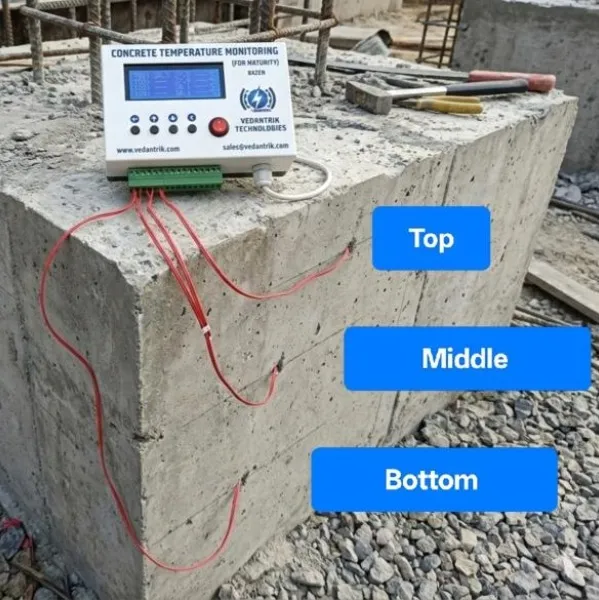
Mass concrete refers to large volumes of concrete where heat generated from cement hydration followed by the temperature rise and volume change must be managed carefully to avoid development of thermal stress and cracking.
According to ACI, mass concrete is defined as “any volume of concrete with dimensions large enough to require that measures be taken to cope with generation of heat from hydration and attendant volume change to minimize cracking.”
Applications of mass concrete generally include large foundations such as mat slabs, retaining walls, thick bridge piers or columns, dams, and heavy footings essentially any structural component whose section size, volume-surface ratio, or geometry could lead to slow heat dissipation and internal heat buildup.
Hence identifying and understanding that a particular pour qualifies as mass concrete is the first step in regulating the thermal behavior, it also signals that standard curing and monitoring methods may not be sufficient to prevent any possible thermal gradient formation, and special measures such as temperature monitoring, cooling pipes, insulation, or staged pours must be necessary implications.
As concrete cures, the core tends to expand due to heat development, but the surface remains constrained and may contract or resist expansion primarily due to cooling. This conflicting behavior introduces internal tensile stresses, particularly at or near the surface, which oftentimes are the weakest part during early age.
If the tensile stresses exceed the early-age tensile capacity of the concrete, surface or internal cracking is bound to occur. So to prevent this, codes and guidelines recommend monitoring both core and surface temperatures.
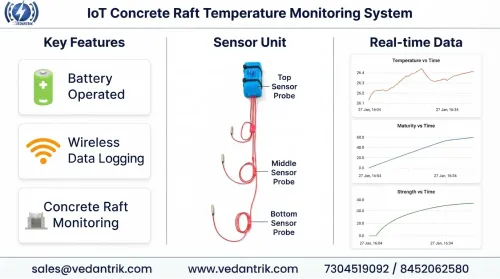
Embedded sensors (thermocouples or digital loggers) placed at typical depths e.g. near center, top and bottom, allow tracking of temperature evolution and gradients over time. ACI 207.1R-05 mentions the importance of instrumentation for mass concrete to help plan for cooling, insulation, or staged placement if necessary.
By understanding core-surface temperature behavior, engineers and site personnel can make informed decisions all aimed at minimizing the risk of thermal stress preserving structural performance and service life.
Keywords