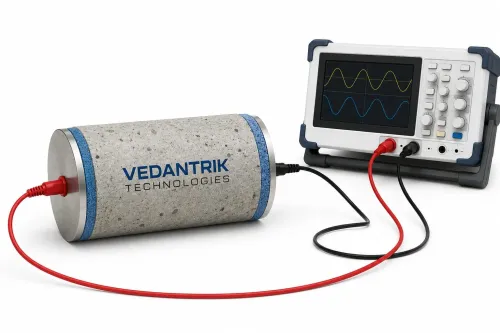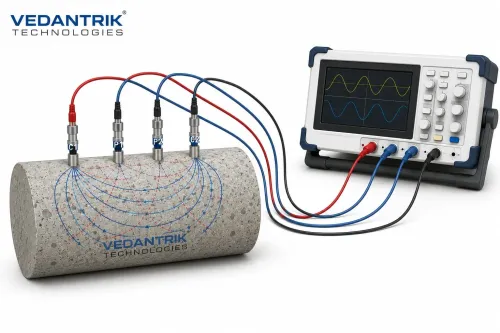
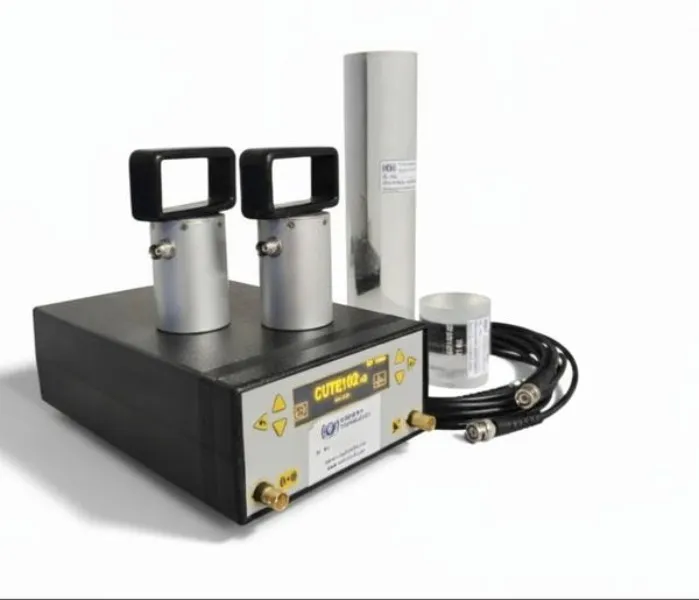
Moisture content inside the concrete can greatly affect the transmission of waves, altering the final velocity calculations in UPV testing. Therefore, understanding how moisture content inside the concrete pores affect the wave propagation becomes essential.
Since concrete is a porous material, most pores are often interconnected and form capillaries and void, and water inside them provides a uniform and continuous medium for waves to propagate.
In contrast, when pores contain air, the wave is partially absorbed or scattered, resulting in lower velocities.
This means that concrete saturated with water often shows higher UPV values than dry concrete, even if the material quality is the same.
Presence of moisture can also interfere with the detection of micro cracks inside the concrete. In dry concrete, micro cracks significantly slow down wave travel, but when the concrete is saturated these micro cracks may fill with water and allow faster transmission.
Another thing to consider is how evenly the moisture is distributed across the structure. A partially saturated concrete structure can produce inconsistent readings depending on the testing position.
If field moisture varies, corrections or calibration curves may be needed. Ideally, comparisons should be made between elements with similar exposure histories.
Ultimately, moisture content is a critical variable in UPV testing.
Accurate interpretation requires recognizing the influence of moisture, and taking necessary measures to avoid errors in the test conducted
Keywords