The “heat of hydration” is the thermal energy released when cement reacts chemically with water during the hydration process. This exothermic reaction is fundamental to the hardening and strength gain of concrete.
In small concrete samples like cube, this heat is quickly dispersed into the surrounding environment, preventing significant temperature rise.
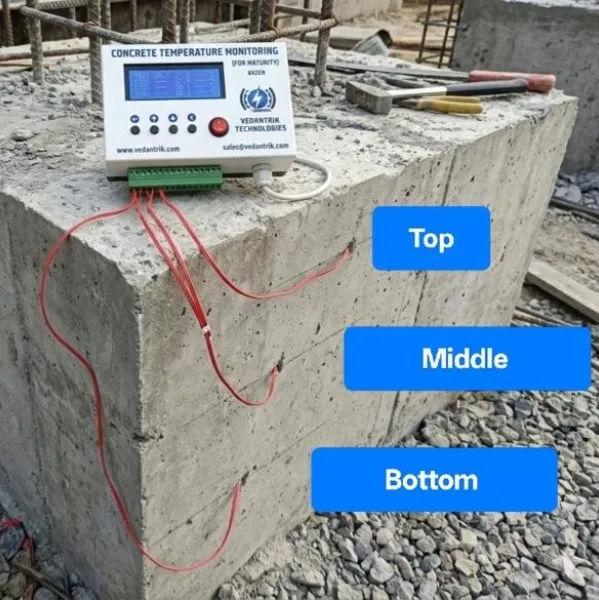
However in mass concrete, the volume is large enough that the generated heat accumulates internally and gets entrapped, unable to escape the internal region, causing the core temperature of the concrete to rise, sometimes significantly above surface temperature.
As the time progresses the temperature in the core continues to increase, while the outer surface remains relatively cooler (or cools faster), a temperature differential or gradient develops between core and surface.
This gradient can trigger tensile stresses because the inner concrete expands upon heating while the surface remains constrained or contracts.
This difference in the expansion leads to the formation of the thermal cracks. The acceptable temperature difference between the interior and exterior of mass concrete is typically limited to a range of 19°C to 25°C. The specific limit can vary depending on the standards like ACI, Indian Standard Code, or aggregate type, and specific project requirements.
As per ACI 207.1R-05, mixture proportioning (cement content, use of supplementary cementitious materials, water-cement ratio), choice of aggregates, and admixtures are critical to moderating the heat of hydration and thereby controlling temperature rise.
For engineers, understanding the heat of hydration helps in anticipating peak internal temperatures, planning cooling or insulation strategies (pre-cooling, embedded cooling pipes, controlled curing), and selecting appropriate mix proportions to prevent thermal gradients and resulting thermal stress.
Keywords