As concrete cures, the core tends to expand due to heat development, but the surface remains constrained and may contract or resist expansion primarily due to cooling. This conflicting behavior introduces internal tensile stresses, particularly at or near the surface, which oftentimes are the weakest part during early age.
As the time progresses the temperature in the core continues to increase, while the outer surface remains relatively cooler (or cools faster), a temperature differential or gradient develops between core and surface.
This gradient can trigger tensile stresses because the inner concrete expands upon heating while the surface remains constrained or contracts.
This difference in the expansion leads to the formation of the thermal cracks.The acceptable temperature difference between the interior and exterior of mass concrete is typically limited to a range of 19°C to 25°C. The specific limit can vary depending on the standards like ACI, Indian Standard Code, or aggregate type, and specific project requirements.
If the tensile stresses exceed the early-age tensile capacity of the concrete, surface or internal cracking is bound to occur. So to prevent this, codes and guidelines recommend monitoring both core and surface temperatures.
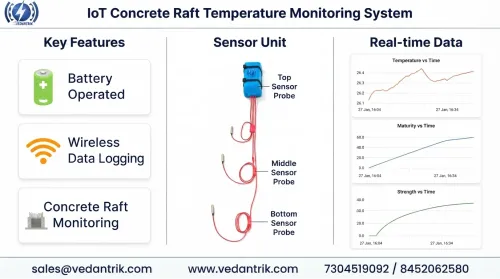
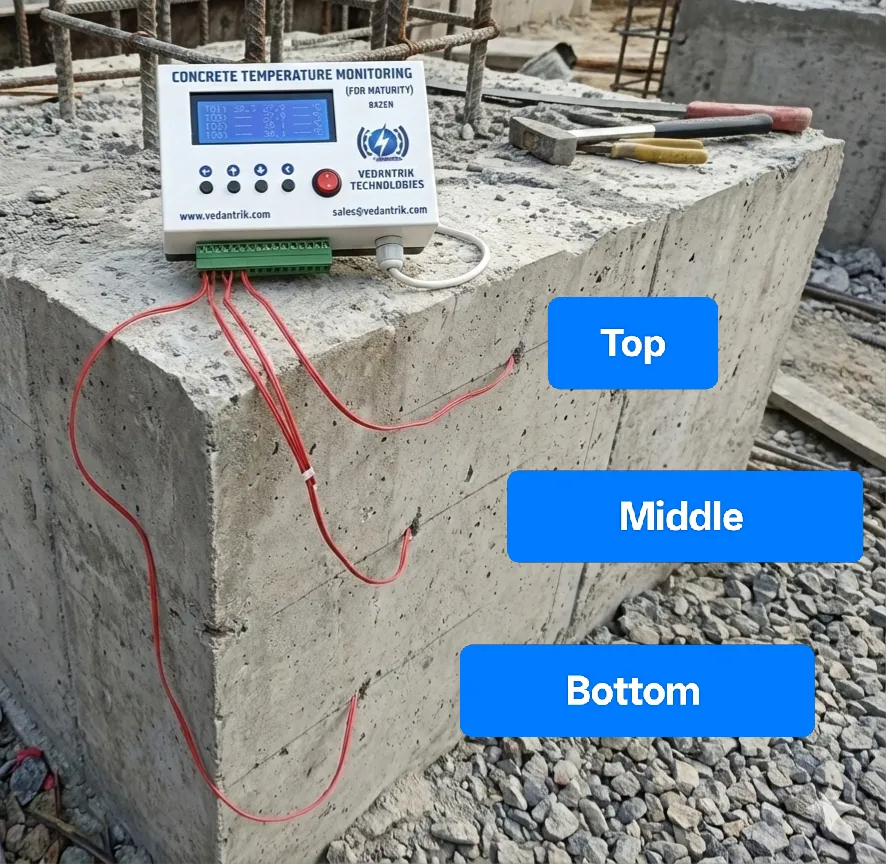
Embedded sensors (thermocouples or digital loggers) placed at typical depths e.g. near center, top and bottom, allow tracking of temperature evolution and gradients over time. ACI 207.1R-05 mentions the importance of instrumentation for mass concrete to help plan for cooling, insulation, or staged placement if necessary.
As per ACI 207.1R-05, mixture proportioning (cement content, use of supplementary cementitious materials, water-cement ratio), choice of aggregates, and admixtures are critical to moderating the heat of hydration and thereby controlling temperature rise.
By understanding core-surface temperature behavior, engineers and site personnel can make informed decisions all aimed at minimizing the risk of thermal stress preserving structural performance and service life.
Keywords