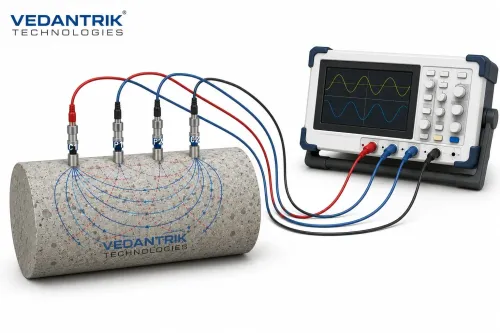
Standard UPV testing can be done using three different arrangements: direct, semi-direct, and indirect (surface) transmission. Each method has unique advantages, limitations, and applications depending on accessibility and structure of the concrete.
Among the three suggested methods, direct transmission is the most accurate and preferred method. In direct transmission, the two transducers, the emitter and the receiver are placed on the opposite ends of the concrete, and the wave travels a straight path which is also the shortest.
Because the wave travels the shortest path and encounters minimal surface distortion, direct transmission provides the highest velocity and the most reliable result.
Direct transmission method excels in quality control, uniformity testing, and defect detection. However, it also requires access to both sides of the concrete structure, which is sometimes not possible for thick walls, foundations, or existing structures.
Semi-direct transmission involves placing transducers on adjacent sides of the concrete structure element, making a diagonal path for wave transmission. The semi-direct method is useful when opposite faces cannot be accessed, but the adjacent face is available for measurement.
Semi-direct mode is slightly less accurate than direct, and generally provides intermediate accuracy. The velocity calculated is slightly lower than the direct method, since the waver travels a longer and more complex path.
However, Semi-direct results are still effective for detecting large voids or assessing uniformity in large concrete structures.
Indirect or surface transmission method is performed when only a single surface of the concrete structure is available. In this method both the transducers are placed on the same surface, with waves traveling horizontally along the surface.
However, this method has the lowest accuracy because the surface condition plays an important role in wave transmission. Concrete near the surface is often more porous, cracked, or carbonated compared to interior material, which greatly influences the wave transmission and shows low velocity values.
Additionally, presence of steel reinforcement, irregular surface, and poor placement increases the error of the test.
Despite its limitations, indirect transmission still is widely used for mapping surface conditions or identifying shallow defects.
When comparing the accuracy, direct transmission should always be prioritized when possible. Semi-direct is a practical compromise, while indirect is more of a supplementary tool for deep defect analysis.
Keywords