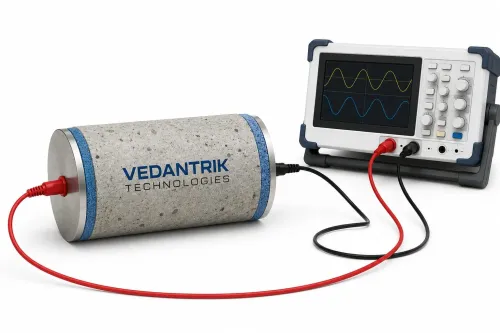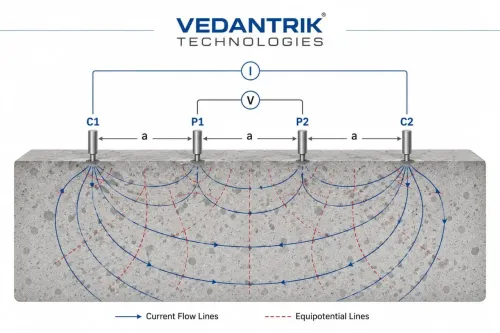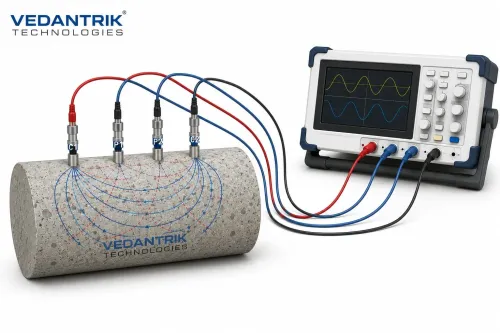
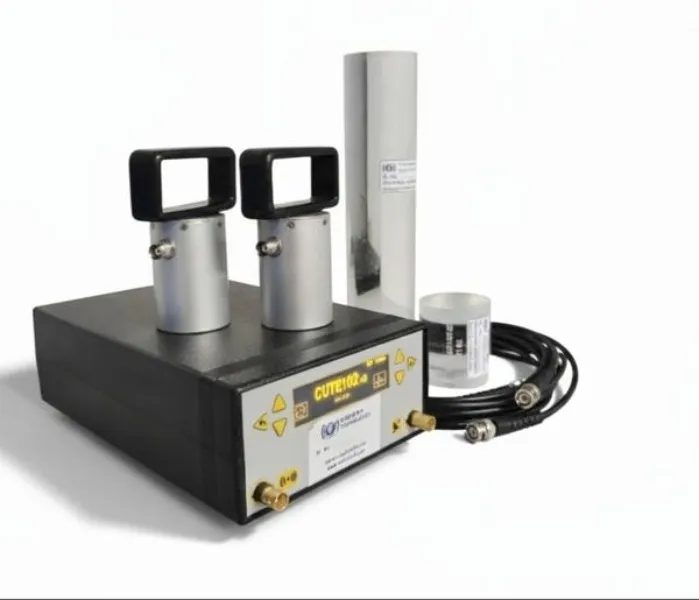
Ultrasonic Pulse Velocity is a non-destructive testing method performed for detecting internal defects such as voids, honeycombing, cracks, and delamination within concrete structures.
The basic principle behind the method is that the ultrasonic waves travel more slowly through a non-homogeneous medium compared to a solid, well-bonded, compact homogeneous material. The test allows analyzing the variations in pulse velocity across a structure, to identify abnormal areas within the concrete structure.
While propagating through the concrete medium, if the sound waves encounter any defect like void or cracks its path changes and becomes scattered. This lowers the velocity of the wave and increases the traveling time, and in some severe cases the sound waves never reach the receiving transducer.
For example, a honeycombed region often contains lots of air pockets that absorb and scatter sound energy. A significant reduction in UPV in such areas is a strong indicator of compromised structural integrity.
Cracks also behave in a similar fashion. A wide crack that spans a larger area acts as a barrier to the ultrasonic waves. However partially closed cracks that are filled with moisture may transmit waves with some distortion.
Hence performing tests along different directions, allows engineers to determine crack depth and orientation. Vertical cracks often show low velocities in direct paths, whereas horizontal cracks may be detected through indirect transmission tests.
One of the strengths of UPV is its ability to compare readings across a grid or between similar elements. By creating a velocity contour map, engineers can easily identify anomalies. A region with consistently lower values relative to adjacent areas likely contains defects.
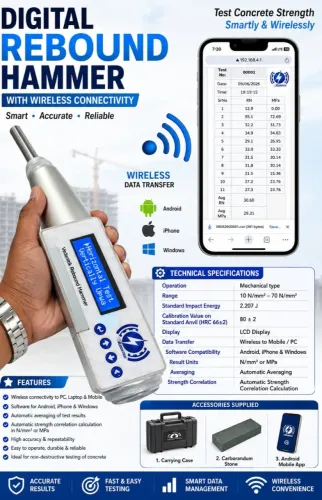
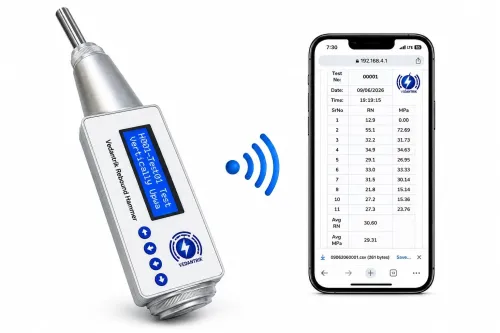
However, UPV is not a standalone tool. While it can identify areas of concern, it does not specify the exact nature of the defect. Therefore, UPV results are often combined with other methods such as rebound hammer testing, core sampling to confirm findings.
Ultimately, UPV provides a fast, safe, and reliable method for detecting internal defects early, allowing engineers to address problems before they escalate into structural failures.
Keywords