Hot weather conditions during the summer time can accelerate the rate of concrete hydration because of the elevated ambient temperature.
This allows for early age strength development, but can also result in non-uniform development of micro-structure during the curing process.
While this elevated temperature condition increases the maturity accumulation, the resulting strength development may not be proportional to the maturity at later stages.
Fast early hydration can create coarser micro-structure with higher porosity, potentially reducing long-term strength despite high maturity index.
During summer the thermal behavior of the concrete is altered due to many factors, and in extreme heat the temperature inside the concrete can exceed the optimum range, introducing thermal gradients across different areas.
Temperature gradients generally result in differential expansion in concrete causing thermal stress to accumulate at various points, which if increased beyond the early age tensile strength can result in micro-cracking.
In addition, rapid rise in the temperature can increase the rate of evaporation from the concrete surface, causing plastic shrinkage cracks, negatively affecting the surface durability.
Elevated temperatures can also influence the rate of hydration and may lead to uneven micro-structure development due to accelerated curing, affecting the gradual development of strength, elastic properties, and overall durability.
When establishing the maturity-strength co-relation, high temperature can affect the accuracy of the Nurse–Saul method, which assumes a linear relationship between temperature and hydration, and this assumption becomes increasingly inaccurate as hydration kinetics follow a nonlinear exponential curve.
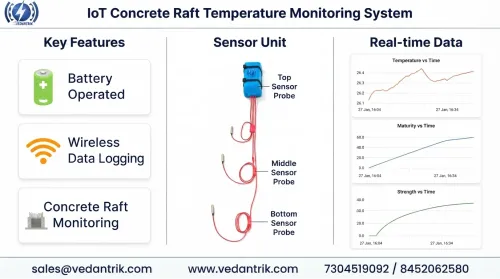
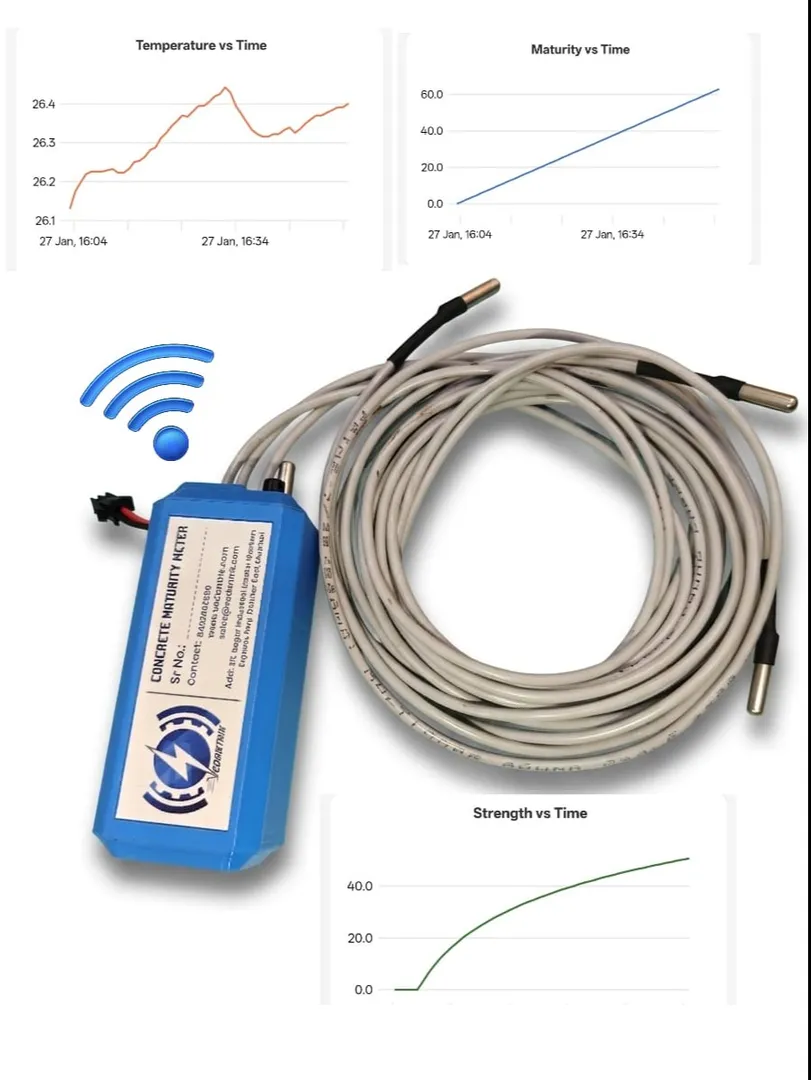
High-temperature curing may increase early strength gain, but it accelerates hydration reactions in a way that limits the later-age refinement of C-S-H micro-structure. Continuous temperature monitoring becomes vital to ensure that internal temperatures remain within acceptable limits.
Ultimately, summer heat enhances early maturity development but introduces risks related to micro-structure, durability, and long-term strength. Effective temperature control, correct choice of maturity model, and vigilant curing are essential to harness the benefits of accelerated hydration without compromising structural integrity.
Keywords