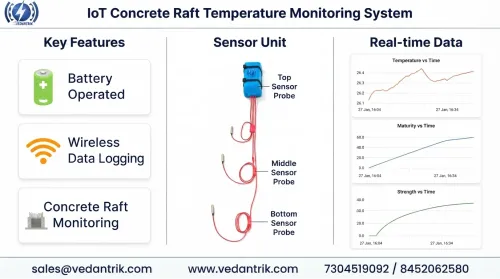
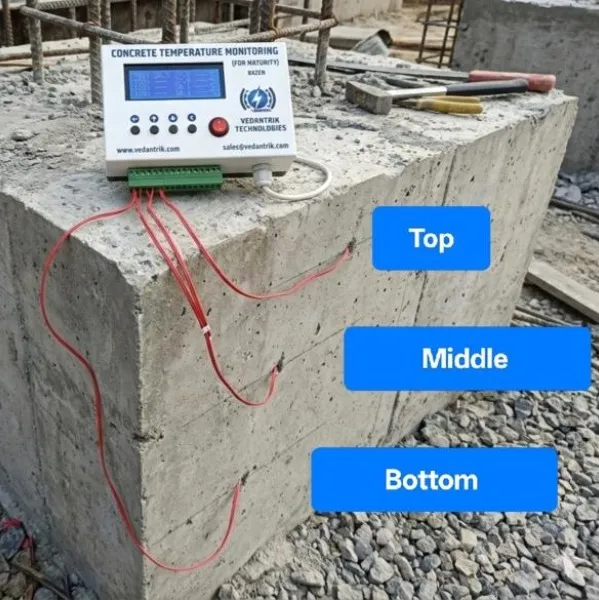
Temperature history during the whole curing process, including peak temperature, temperature gradients, and rate of cooling, has a direct effect on the concrete’s long-term strength, durability, and its resistance to cracking.
In mass concrete, because of internal heat development, the overall hydration process can be accelerated, potentially leading to higher early-age strength development.
However, this also introduces other issues which are difficult to efficiently regulate. If temperature inside the core rises too quickly or reaches very high peak levels, it can lead to internal thermal stresses from differential expansion, as described above.
If the surface is cooling rapidly and contracts, tensile stresses form which can cause micro cracks or visible cracks.
These cracks, even if initially smaller, can increase in size and depth due to loads, environmental cycles, or ingress of moisture and aggressive agents, compromising durability, and reinforcement protection.
In addition to that, very high peak temperatures if remains sustained and not regulated, increase the risk of Delayed Ettringite Formation (DEF), a chemical expansion process that can degrade concrete over years.
To mitigate this, ACI and other codes recommend limiting peak temperature in mass concrete, commonly to about 70 °C.
Therefore appropriate temperature control plays a crucial role in ensuring structural longevity: by controlled hydration, avoiding thermal stress, and preventing cracking or long-term degradation, mass concrete achieves intended strength and durability. It preserves the lifespan of structures, reduces maintenance costs, and ensures safety.
Hence, temperature is not just a construction parameter it is a key determinant of performance, durability, and structural safety for mass concrete.
Keywords