1. Human Maturity
When people talk about a “mature” human being, the first thing they often reference is age. While age provides a rough indication of where someone might be in life, it does not define maturity on its own.
Human maturity is shaped by:
Cognitive development – the ability to think critically, reason, and understand complex concepts.
Decision-making ability – judging situations, evaluating consequences, and choosing what’s right.
Education and learning – acquiring knowledge that shapes understanding.
Experiences – real-world challenges, interactions, and exposure to diverse situations.
Emotional intelligence – empathy, self-control, communication, and social awareness.
So while age sets a timeline, true maturity is a combination of intellectual, emotional, and experiential growth. Two individuals of the same age can be vastly different in their maturity levels.
2. Concrete Maturity
Concrete has a similar story. People often associate concrete strength simply with its age (e.g., “28-day strength”). But like humans, concrete maturity isn’t just about how long it has been sitting.
Concrete maturity depends on:
Hydration process – the chemical reaction between cement and water.
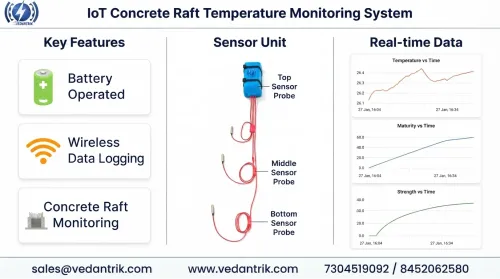
Temperature history – heat affects the speed of hydration.
Bond formation – internal crystal structures linking and strengthening.
Cohesion and micro-structure development – how densely the particles pack and bond.
Strength gain rate – not linear, and influenced by curing conditions.
Thus, concrete maturity is essentially a numerical index that reflects its internal progress, not just the number of days since pouring.
Even if two concrete slabs are both 7 days old, their maturity may differ greatly depending on curing conditions and temperature. Like humans, concrete can “age” without truly “maturing.”
Keywords