Concrete curing in cold weather conditions presents new challenges, since low temperatures can slow down the cement hydration within the concrete.
In colder environments heat is quickly lost from the water to the surrounding which rapidly cools the water, lowering the temperature.
Low temperatures affect the hydration kinetics of the concrete during the curing process, since the cooler water also allows for quick dispersion of heat from the concrete core.
This lowers the rate of hydration process and can even halt it if the temperature approaches freezing.
Hydration is an exothermic reaction, but when concrete is exposed to temperatures below 5–10°C during the first 24 to 48 hours, the cement hydration reaction rate is hindered, delaying early age strength gains
As per IS 516 standards recommendation, maintaining curing tank temperature within the 27+/- 2°C range is crucial to ensure optimal cement hydration and strength gain.
However in laboratory curing tanks, maintaining the water temperature at the standard range of 27+/- 2°C is not always simple during cold conditions.
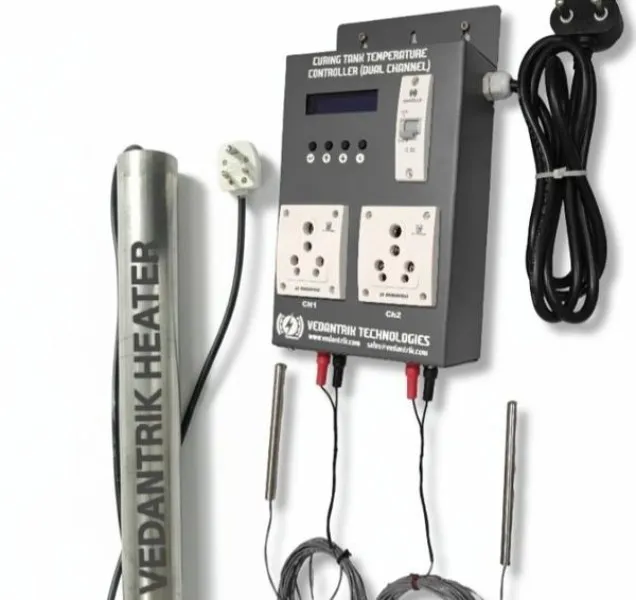
Hence, effective temperature management requires installation of automatic curing tank controller systems with high capacity heating elements, that maintain the curing tank temperature within the standard range.
In some cases, water circulation systems are particularly important, as stagnant water can create localized cold spots that hinders hydration in certain areas of the specimen.
Maintaining optimum temperature is also important for ideal concrete durability.
Low-temperature curing not only delays the strength gain, but also affects the durability of the concrete by increasing permeability and reducing surface hardness.
Maintaining a controlled temperature environment ensures the formation of a dense, uniform micro structure, reduces micro cracking, and enhances resistance to environmental stressors.
Effective cold-weather curing is therefore a combination of maintaining temperature, continuous monitoring, and taking necessary actions to safeguard concrete integrity.
Keywords