Crack and strength loss in concrete is the direct result of improper curing temperatures, which makes the temperature monitoring during the curing process essential.
Although it’s a common notion that curing is done to maintain ideal moisture content, which facilitates the hydration process, temperature also plays an important role and often decides the effectiveness of the curing process.
In industrial and laboratory curing tanks, improper water temperatures can either promote or hinder the hydration process locally, which can cause differential expansion of the concrete.
These differences create internal stresses that accumulate, leading to micro- cracks, which increases the porosity of the structure, decreasing its density and resistance to chemical attacks.
Standards like IS 516 have outlined the optimum temperature range 27 +/- 2°C for concrete curing to prevent these issues, ensuring that laboratory test specimens develop strength uniformly and reliably.
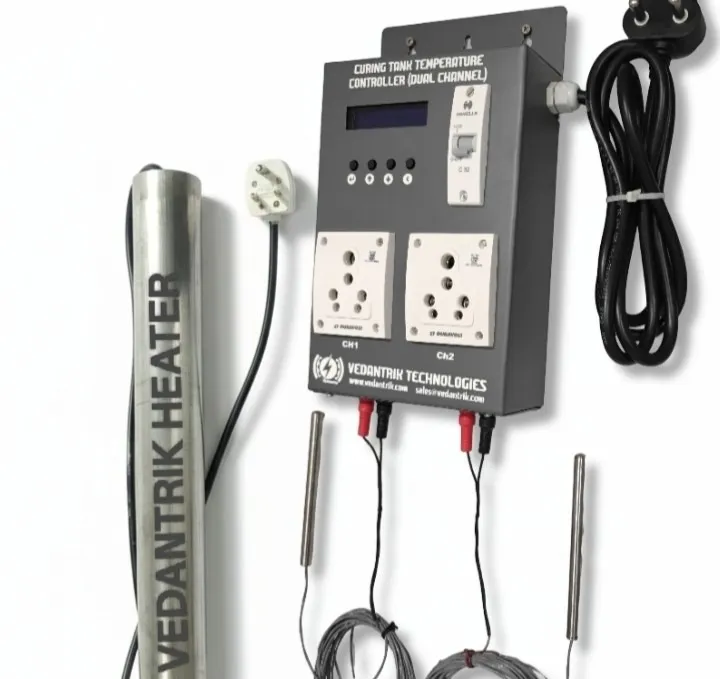
Installation of automatic curing tank temperature controllers, that allow independent temperature monitoring and regulation, can ease up the curing process by regulating the temperature variations without the need for manual interventions.
Advanced controllers maintain the 27 +/- 2°C temperature range by turning the heating element ON when temperature of the water falls below 25°C and turn it OFF when the temperature rises above 29°C, ensuring the curing proceeds in the ideal temperature range, complying with the IS standard.
Circulation of water within tanks is also an important factor to consider, since it ensures that all specimens experience the same thermal environment, and continuous monitoring allows for real-time adjustments to optimize the overall curing process.
Without these measures, the concrete cubes may achieve sub-optimal strength, and show higher permeability, and show premature deterioration under environmental stress.
Additionally temperature during the curing process also affects the micro structure development. Since the hydration is an exothermic reaction, it is highly influenced by variations in temperature.
Higher Temperature of the water during the Curing process accelerates the hydration process, but also leads to coarse and less uniform micro structure development which affects other proportions of the concrete.
By maintaining the tank within specified temperature limits, as required by IS 516 standard, engineers and laboratory technicians ensure that test results are consistent, repeatable, and meaningful.
This allows for proper evaluation of mix performance, material selection, and construction quality, while simultaneously preventing early-age cracking and long-term strength loss.
Keywords