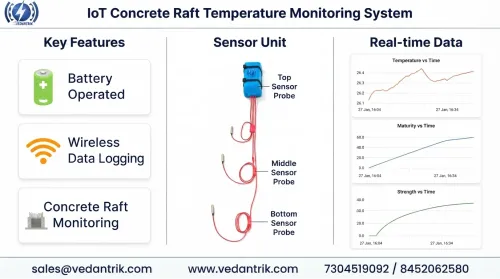
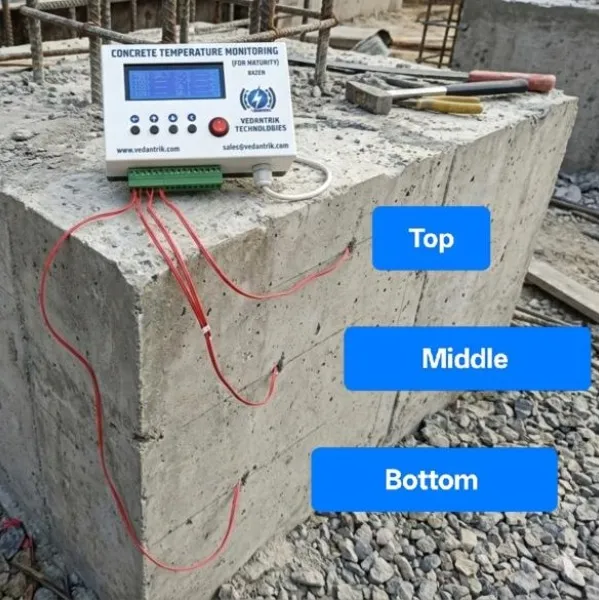
“Early-age behavior” of mass concrete refers to the critical period starting from placement through the first few hours and days when hydration is active, heat generation is at peak, and temperature gradients develop.
During this phase, the internal (core) temperature rises substantially due to the bulk volume while the surface temperature rises in a gradual manner due to ambient cooling, creating a thermal gradient.
ACI 207.1R-05 highlights that the main characteristic distinguishing mass concrete from regular concrete is exactly this thermal behavior during early age.
Because the heat cannot dissipate quickly, and concrete volume restricts heat flow, internal temperatures can peak within 24–48 hours depending on mix, ambient conditions, unless it is mitigated by cooling or insulation measures.
Early-age thermal behavior also affects strength development. While the hydration process is important for strength gain, if the temperature gets too high, or temperature gradients remain uncontrolled, micro-crackings may form.
Cracks formed during this early-age period may propagate, merge, or allow ingress of water and aggressive agents (chlorides, sulfates), leading to reduced durability, corrosion of reinforcement, and compromised structural integrity, compromising long-term durability, and structural integrity.
Keywords