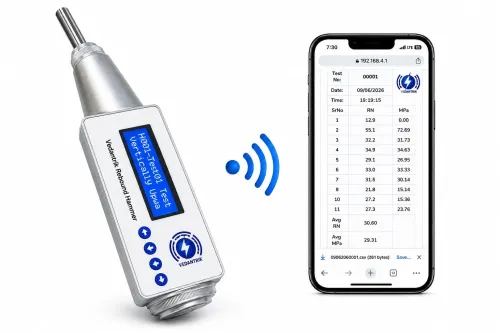

The rebound hammer test, also known as Schmidt hammer test, is a non-destructive testing (NDT) used to assess the compressive strength and surface hardness of the concrete. It was first developed by Ernst Schmidt in the 1950s and has since become one of the most common and widely used tests for compressive strength evaluation of concrete.
The main instrument consists of a spring-controlled mass called a plunger that slides on a calibrated scale within the main body. When the plunger of the main body is pressed against a solid surface such as concrete, the spring loaded mass is released, striking the steel plunger in contact with the concrete surface.
The mass then rebounds with a consistent and reproducible velocity, and the extent of the rebound is measured on the scale to get the rebound number. This rebound number is then empirically correlated to the compressive strength of the concrete, which is obtained using standard calibration charts or curves provided by National & International standards IS-516, ASTM C805, DIN 1048, and BS1881.
The working of the rebound hammer test is based on the elastic rebound of the surface, which depends on the hardness and stiffness of the material being tested. A harder surface will cause greater rebounds, indicating the stronger and denser nature of the concrete, while lower rebounds indicate the opposite.
The test is performed by holding the hammer perpendicular to the surface of concrete, ensuring good contact between the plunger and the surface. Multiple readings (usually 9-10 readings) are taken at different points on the same area, to get the average rebound value,for strength estimation.
This practice minimizes the error and improves the accuracy of the process. However it must be taken into consideration that the test primarily measures the surface hardness, which can be influenced by a variety of factors, and therefore, is an indirect method that requires correlation with laboratory test results.
The rebound hammer test can be used in both horizontal and vertical positions, but corrections must be applied depending on the orientation of the hammer, since the gravitational force influences the rebound reading. Furthermore, the calibration of the rebound hammer is also essential before testing to ensure accuracy and consistency in results.
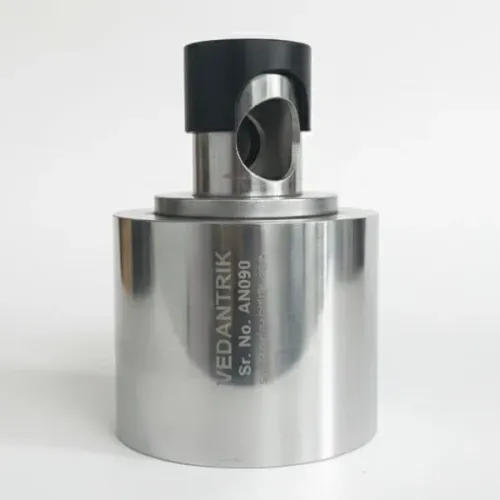
The calibration is typically done using a standard steel anvil. The interpretation of the test result is done using standard guidelines given by IS-516, ASTM C805, DIN 1048, and BS1881.
Keywords