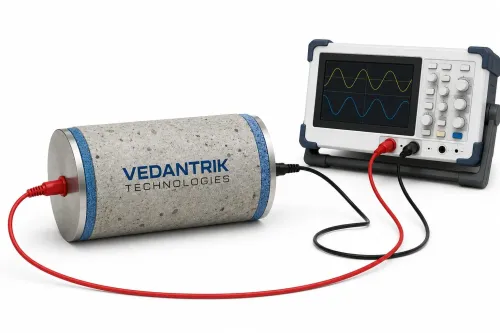
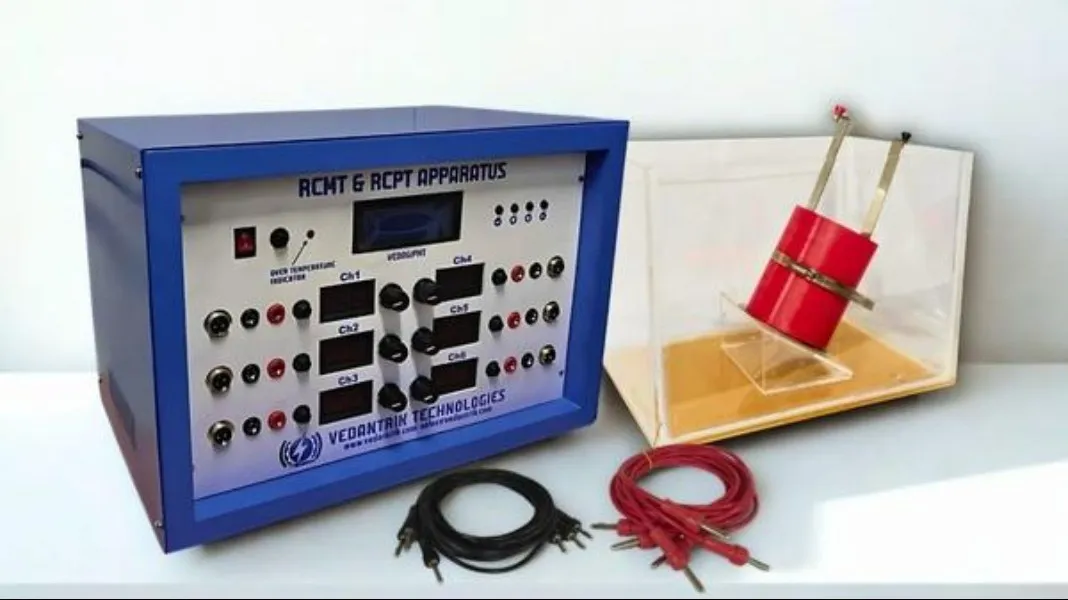
The Rapid Chloride Migration Test measures the non-steady-state migration coefficient, also known as migration coefficient or Dnssm. This migration coefficient provides a quantitative value of the rate at which chloride ions move through concrete when subjected to an external electric field.
However, the RCMT involves several parameters, each of which contributes to the accuracy and interpretation of results.
The primary parameters measured or recorded during the test include:
1. Applied Voltage (V)
Applied voltage provides the driving force for chloride ion migration. Higher voltages lead to faster migration but can also cause excessive heating. The final voltage to be set depends on the initial current reading, which is recorded at 30V.
2. Test Duration (t)
The migration process is timed, typically ranging from 6 to 96 hours. Time influences the chloride penetration depth and calculation of Dnssm.
3. Chloride Penetration Depth (Xd)
Penetration depth is manually measured by splitting the concrete specimen into two halves and applying silver nitrate solution on the internal surface. Silver nitrate reacts with chlorides to form a white precipitate, which is measured by a standard scale to get average penetration depth. This depth directly the travel distance of chloride ions and reflects resistance to chloride ingress in the final calculation.
4. Specimen Thickness (L)
The distance between the specimen’s exposed surfaces must be measured precisely. Any variation affects the electric field and thus the migration rate.
5. Initial and Final Temperatures
Temperature influences ion mobility. Excessive heating due to electrical current can alter the final results.
6. Concrete Characteristics
While it can not be directly measured by the test, water–cement ratio, type of cement, presence of supplementary cementitious materials, and curing conditions determine pore structure and therefore influence RCMT results.
Why These Parameters Matter
RCMT parameters are important because they all collectively determine how well chloride ions move through the concrete. The obtained result of RCMT reflects the permeability, pore connectivity, and overall durability of the concrete.
A lower Dnssm value generally correlates to higher longer term durability performance of concrete structures in an aggressive environment.
The parameter measured in the test also ensures reproducibility. Standardizing voltage, test duration, and specimen dimensions allows for reliable comparison between different mixtures, quality assessment and mix design modifications.
In summary, the RCMT’s measurement parameters are critical because they determine the test’s sensitivity, reliability, and usefulness in predicting long-term chloride ingress.
Keywords