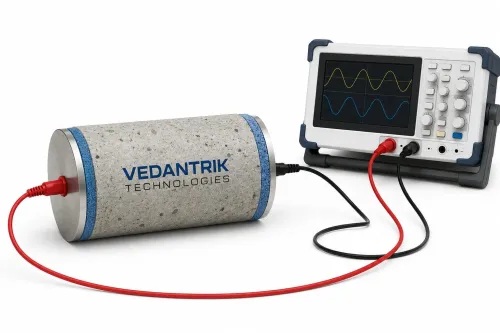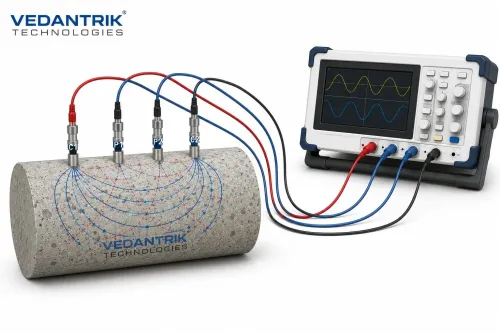
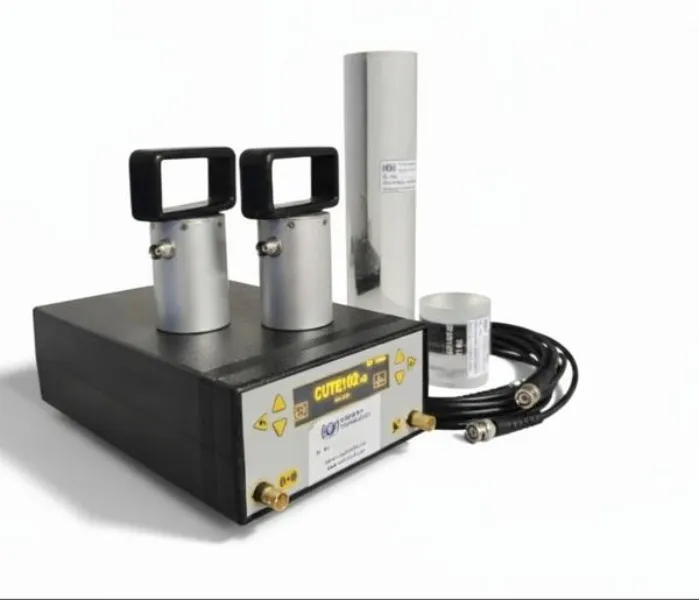
Ultrasonic pulse velocity is a non-destructive testing method that allows engineers to evaluate the concrete’s quality by calculating the velocity of high frequency waves that propagate through the concrete.
The principle behind UPV is straightforward, the sound waves travel faster through denser and more elastic materials and its movement is interrupted if the internal structure is heterogeneous due to cracks, honeycombing, or voids.
Hence the actual UPV readings depend on a wide range of interacting factors and understanding these influences is essential to interpreting results accurately and ensuring that the test reflects the true condition of the concrete.
As already highlighted, the most significant factors are the concrete’s density and elastic properties. In simple terms, well compacted and dense concrete with minimal deformations allows ultrasonic waves to travel at higher velocity.
Whereas, less dense concrete where there is entrapped air, voids, or honeycombing disrupts the transmission of waves. Similarly, the type aggregate used in the concrete also plays a major role, where hard aggregates like granite improve the velocity, while softer aggregates slow it down.
Moisture content in the concrete can also affect the propagation of waves. Saturated concrete specimens often transmit ultrasonic waves much more effectively than dry concrete because the water improves the contact between the solid particles of the concrete and provides a continuous path for transmission.
As a result, saturated samples often show high velocities, meaning that the field moisture conditions must also be taken into account while performing the test and if possible, testing should be done in consistent moisture states.
Concrete’s age is also a factor that should not be ignored since it can also influence the final result.
As concrete hydrates during its curing period, the calcium silicate hydrate (CHS) gel forms and increases the overall density and stiffness, which facilitates the transmission of Ultrasonic waves, causing UPV readings to rise over time.
Thus, velocity values obtained at 3 days will differ significantly from the values at 28 days or 90 days. This natural increase can sometimes be mistaken for improved structural quality unless evaluated properly.
Other influencing factors include temperature, reinforcement presence, surface conditions, testing path length, equipment calibration, and coupling quality between the transducers and the concrete surface. Misalignment of probes or poor couplant can introduce significant errors.
In summary, UPV results are shaped by a complex interaction of material properties, environmental factors, and testing conditions. Proper interpretation requires understanding all these influences, documenting on-site conditions thoroughly, and comparing readings against realistic baselines rather than relying solely on absolute velocity values.+
Keywords