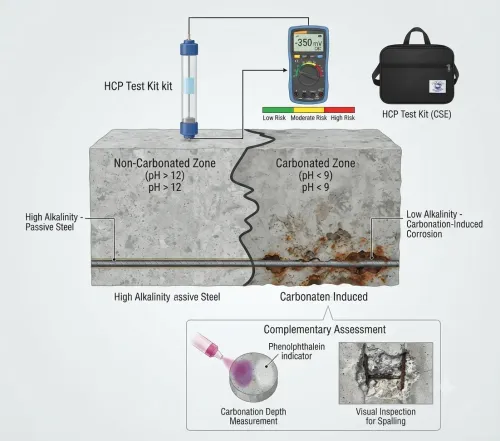
Inside reinforced concrete, a natural oxide layer surrounds the reinforced stee land protects it from different ions present in the pore solution. However, some aggressive agents such as chloride ions or CO2 can reach and disintegrate this layer, exposing the steel surface to the surrounding moisture which can initiate corrosion.
The corrosion initiates when iron gives away its electron, which is then captured by the O2 and H2O to form Hydroxyl ions (OH-), that in return react with Fe ions to form iron oxide or Hydroxide. The corrosion byproducts then set cathodic and anodic sites on the steel surface which generates an electrical potential in that localized region.
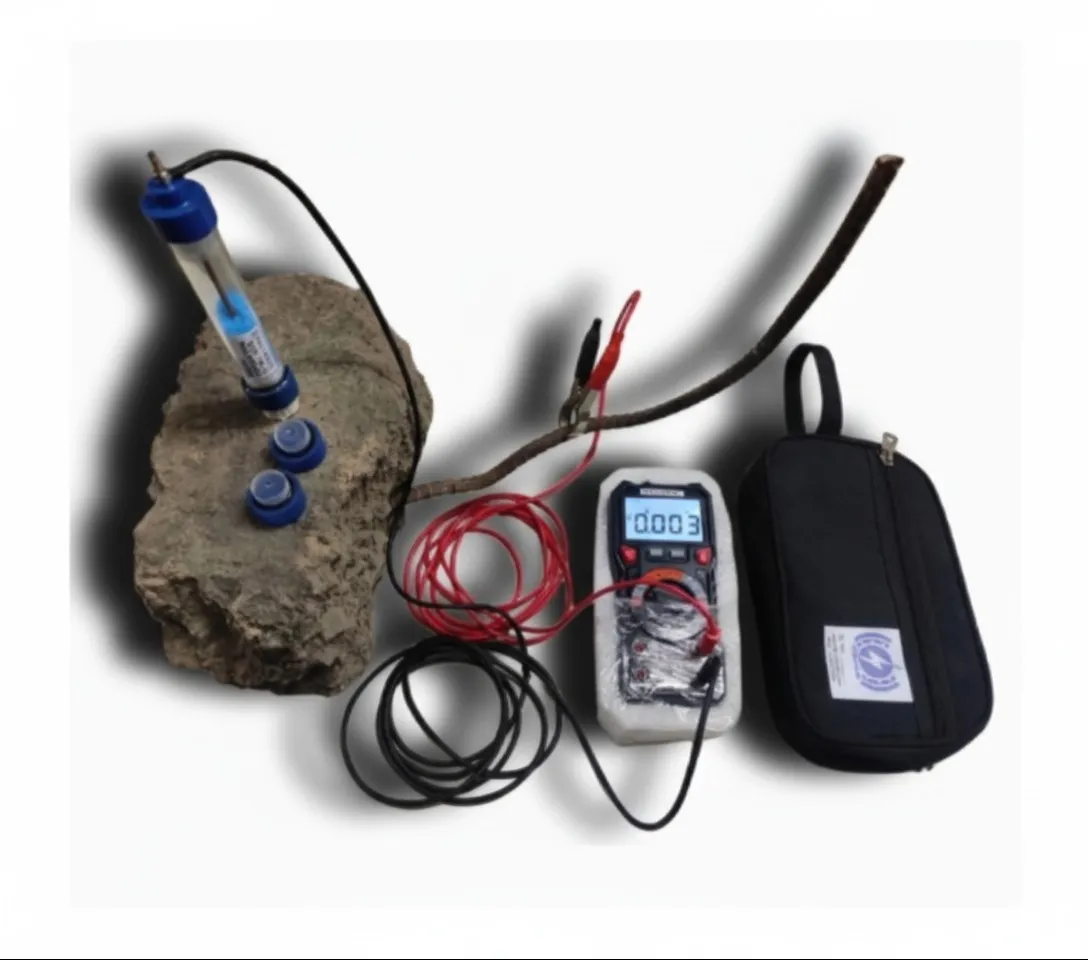
This electric potential is measured by connecting the reinforcing steel (reinforcement) to a reference electrode, typically a copper/copper sulfate (Cu/CuSO₄) electrode, which has its own potential.
This measured potential difference is an indicator of the electrochemical activity of the steel surface relative to the reference.
By measuring the potential at various points on the concrete surface, engineers can map the likelihood of corrosion across the structure. The half-cell potential itself does not indicate the corrosion rate directly but the probability of the corrosion potential activity.
Negative potentials generally indicate a higher risk of corrosion, while more positive potentials suggest a lower likelihood of active corrosion.
ASTM C876 standard provides guidance on electrode selection, measurement procedures, and interpretation of results.
According to ASTM C876, potentials values more negative than -350 mV indicates a high probability of corrosion, potentials between -200 mV and -350 mV indicate uncertain conditions, and potentials more positive than -200 mV suggest a low probability of corrosion.
The half-cell corrosion potential is a widely used test because it is non-destructive, relatively simple, and allows for mapping over large areas of a structure.
It is particularly useful for evaluating aging infrastructure, bridges, and marine structures where reinforcement corrosion is a primary concern.
Keywords