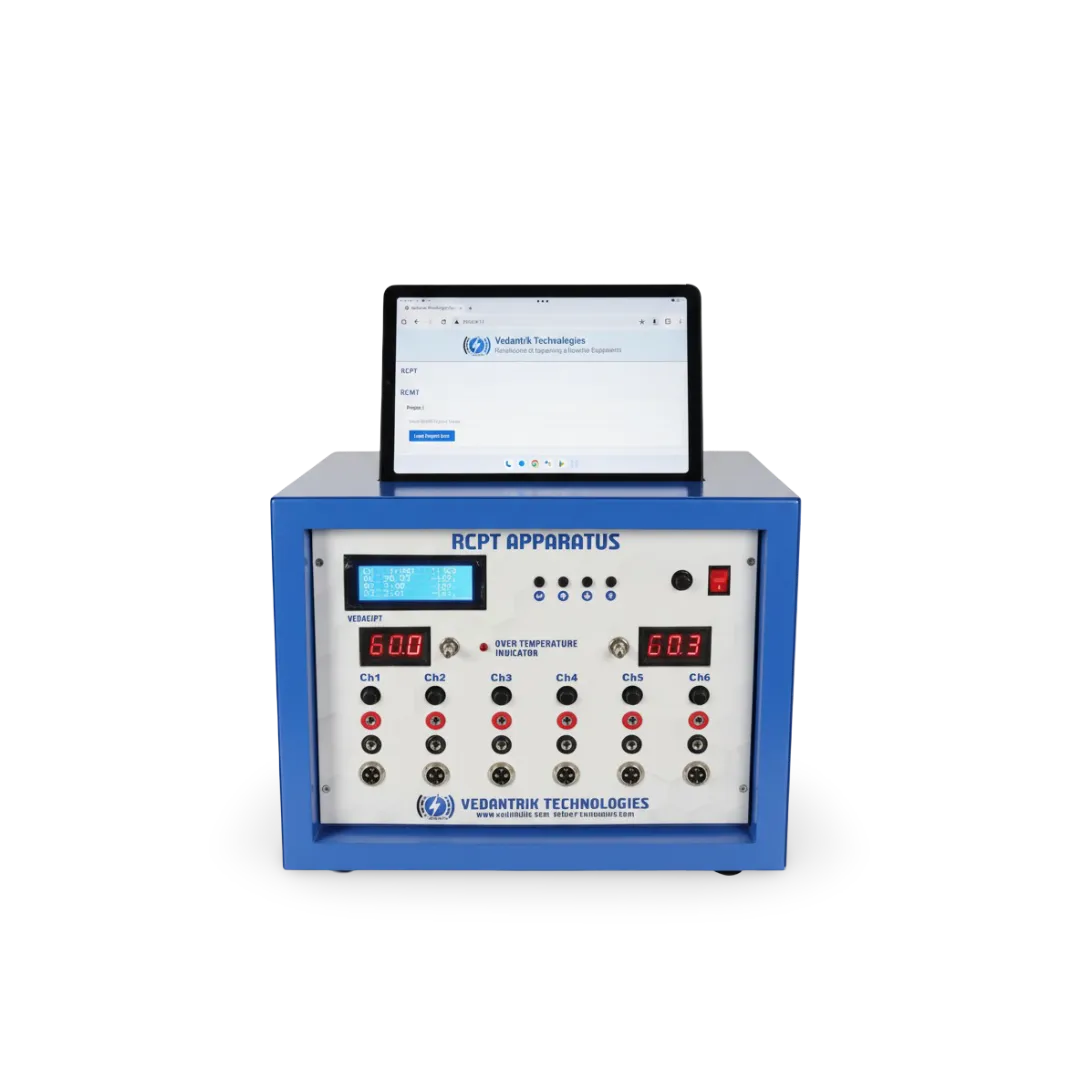
The Rapid Chloride Penetration Test (RCPT) , as recommended by ASTM C1202, is a laboratory test that is designed to evaluate long term durability of concrete within few hours.
The test is conducted to measure the chloride ion permeability in concrete. Chloride ions can penetrate the concrete structures and reach the rebar, where it can disintegrate the oxide layer protecting the rebar, exposing it to moisture, leading to corrosion. Since concrete structure in aggressive environments are more prone to deterioration, assessing their durability prior is crucial.
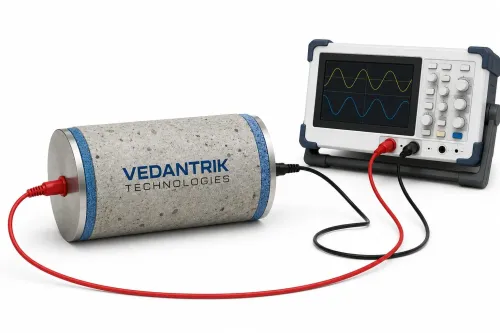
In RCPT, a concrete samples with dimensions of 100 mm diameter and 50 mm thickness is placed between two chamber, which are later filled with 3% NaCl and 0.3N NaOH solution respectively. The whole test runs for 6 hours at a constant 60V. In the span of 6 hours, 13 readings are logged each at interval of 30 mins, and the final result is calculated in coulombs by integrating current over time.
The underlying assumption behind RCPT is that concrete with higher permeability allows more chloride ions to pass, and therefore facilitates higher current flow. This higher permeability is often times attributed to lager pore size that may have formed either due to the nature of concrete mix design or improper curing.
In contrast the concrete which have more refined pore structure shows low permeability, and resist the chloride ion movement.
One of the advantage of RCPT is that it is applicable for quality control, mixture optimization, and comparing different binders and supplementary cementitious materials. For example, mixtures containing fly ash or slag typically show significantly reduced charge passed due to refined pore structures and reduced ionic mobility.
RCPT remains one of the most widely used durability tests worldwide due to its accessibility, repeatability, and well-established interpretation of result.
Keywords