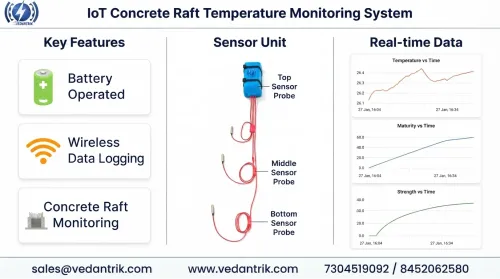
Concrete curing is an essential process because it directly affects natural progression of cement hydration, which is highly sensitive to temperature changes.
Fluctuations of temperature in the curing tank, affects the progress of cement hydration, and influences the early age strength development in concrete.
Since cement hydration is an exothermic process and releases heat, which if not controlled properly can accumulate, it raises the internal temperature of the concrete.
The elevated temperature accelerates the hydration process but also causes improper micro-structure development, which changes the pore structure and hardness of the concrete cube.
However, if the temperature remains too low, it can slow down the hydration process which delays the early age strength development.
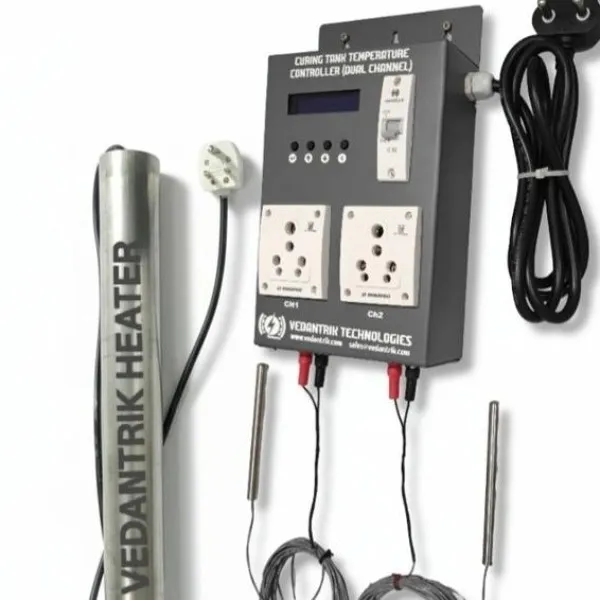
Hence continuous temperature regulation of curing tanks becomes necessary, to mediate optimal curing conditions for concrete curing.
As per the guidance of IS 516, the ideal temperature range for optimal curing is 27 +/- 2°C, any deviation from the standard range can affect the hydration process significantly.
For both laboratory and field applications, curing tank temperature monitoring becomes crucial as it verifies that concrete curing is performed at optimal conditions and meets the standards.
Optimal curing ensures, strength tests conducted on cylinders or cubes are accurate and reliable, results of concrete durability tests like RCPT and RCMT are accurate and not affected due to improper curing.
Since improper curing can affect the natural way of micro-structure development, it can increase the porosity of the concrete, which leads to increased permeability of the concrete to chloride ions. This can create false RCPT or RCMT results and mis-interpretation about the concrete mix design.
By continuously tracking temperature, engineers and laboratory personnel can detect deviations, assess risks of thermal cracking, and take immediate corrective measures, such as adjusting water temperature in the curing tank, circulating the water for uniformity, or modifying environmental controls in curing rooms.
Along with optimum strength and durability development, ideal curing temperature also allows for concrete mix design optimization, by tracking the hydration of concrete mix combined with different admixtures, SCMs, which affects the hydration kinetics of the design.
In simple terms, a curing tank with continuous monitoring keeps the curing conditions consistent, which is important for checking mix designs, meeting standards, and researching new cement-based materials.
Continuous monitoring makes curing a controlled and reliable process, reducing errors, improving consistency, and protecting the long-term quality of the concrete
Keywords