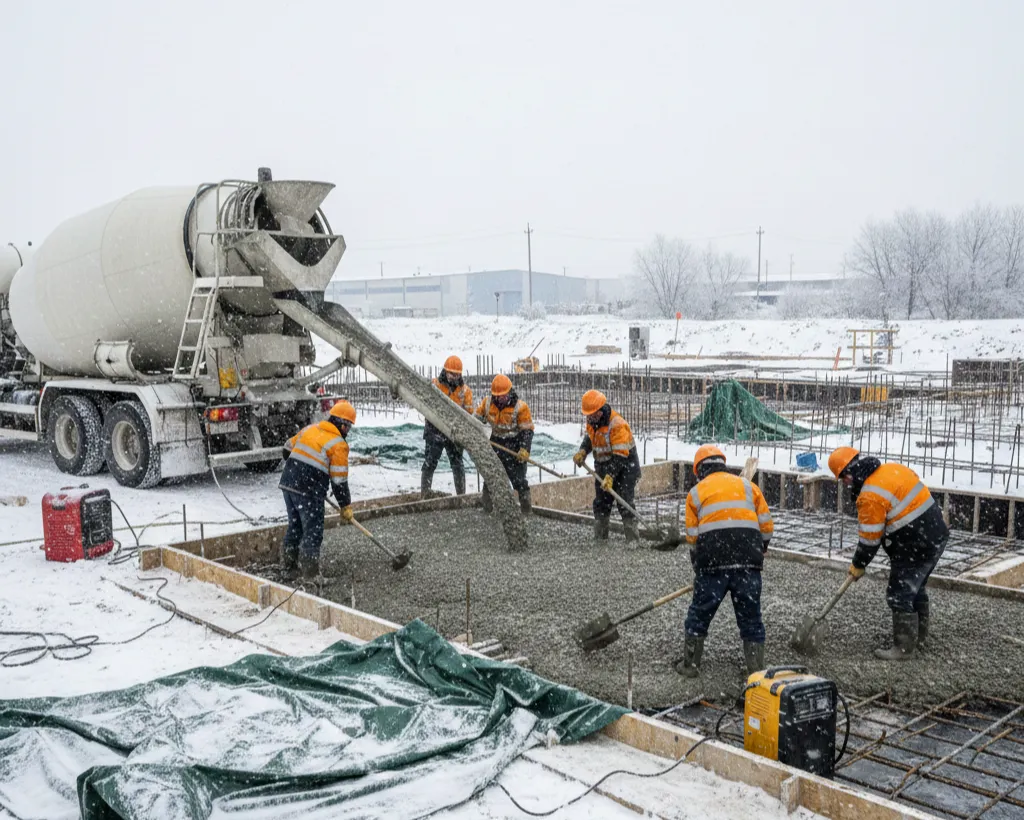
Cold weather presents new challenges for the temperature management of mass concrete, mainly due to its effect on cement hydration process. The hydration of cement being a exothermic process, generates heat that gradually increases the internal temperature of the concrete.
In low ambient temperatures, however, this heat is dispersed rapidly in the environment, especially from the surface of the concrete, which can create steep temperature gradients between the interior and the exterior.
These gradients are a major cause of early-age thermal cracking, as the outer layers cool faster than the warmer core, creating tensile stresses that the relatively weak early aged concrete cannot resist.
In addition to cracking, cold conditions also delays the development of early-age strength, because low temperatures slow down the chemical reactions of hydration, extending the setting time and delaying the concrete’s load-bearing capacity.
If temperatures drop near or below freezing, the risk of frost damage increases because water within the pores can freeze, expand, and disrupt the internal structure of the concrete.
To resolve these issues, engineers need to employ various thermal control strategies. For example pre-heated mixing water and aggregates, use of accelerators, can boost internal hydration rates and reduce any delay in strength gain.
Continuous monitoring of internal and surface temperatures is critical for determining the effectiveness of these measures and for preventing thermal cracking.
Additionally, concrete mix design can be adjusted for cold-weather conditions. Using lower water-cement ratios, incorporating supplementary cementitious materials such as fly ash or slag, and controlling aggregate gradation can improve heat retention and minimise cracking risk.
By understanding the interaction between ambient temperature, hydration heat, and thermal stress, engineers can prevent development of internal cracks, ensure proper strength development, and maintain long-term durability. Effective cold-weather concreting not only protects the structure during early ages but also reduces maintenance costs and improves the lifespan of mass concrete structures.
Mass Concrete temperature Monitoring system
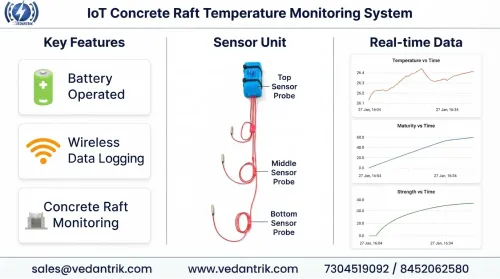
Mass concrete temperature monitoring device developed by Vedantrik technologies is an advanced temperature monitoring and data logging system specifically designed for mass concrete applications like raft, foundations, hot blocks and other mass concretes to prevent thermal stresses and micro cracking.
Wire-length Challenges in Mass Concrete Temperature Monitoring
In mass concrete applications, temperature sensors are typically embedded at multiple levels — the top, middle, and bottom of the pour — to accurately monitor temperature differentials during curing. However, in high-rise building foundations, the raft thickness can reach up to 3 meters or more, creating significant wire-length challenges.
As the sensors are placed deeper within the concrete, the distance between the sensors and the data loggers (which are usually installed at a controlled, accessible location) can exceed 5 meters. This extended wire-length can lead to inaccurate or higher temperature readings.
The commonly used RTD (Resistance Temperature Detector) thermocouples in concrete temperature monitoring are typically accurate only up to a cable length of approximately 5 meters. Beyond this distance, the increase in lead resistance can result in elevated or higher temperature readings. This is particularly problematic because the lead resistance is non-linear and not directly proportional to the cable length, making it difficult to apply standardised correction factors. Consequently, extended cable lengths introduce a significant source of error in temperature measurements.
But the device developed by vedantrik technologies for mass concrete temperature monitoring can give accurate temperature readings even if wirelengths are above 100 meters with accuracy of +/- 1 degree celsius.
The device logs temperature data at user-defined intervals, with a standard recording interval of 30 minutes. The system utilizes high accuracy sensors, which are embedded in the concrete, during casting and remain in place throughout the curing process. These sensors feed temperature data to the device’s internal storage, which can be accessed later wirelessly using mobile phone or laptop via wifi, the device supports Wi-Fi connectivity, allowing users to access and monitor data in real time through a PC, laptop, or mobile device. By providing accurate and timely temperature data, the system supports informed decisions regarding concrete strength development, enabling optimized construction schedules, timely formwork removal, and improved quality control in mass concrete applications.