Moisture content inside the concrete can greatly affect the half cell corrosion potential readings, because the movement of electrical current depends on the presence of moisture. Therefore, understanding how moisture content inside the concrete pores affect the final result becomes essential.
Concrete is a porous material, and the pores are often interconnected with each other forming a capillary network which extends to great lengths, along with micro cracks or small voids, all of which contain water and dissolved ions.
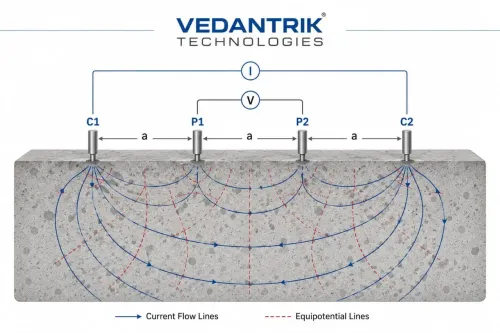
When concrete has enough moisture, ions increase the electrical conductivity of the concrete, which lowers the overall resistance between the steel and the reference electrode. This provides stable and accurate potential measurements that reflect the true electrochemical condition of the steel.
In contrast, if the concrete structure is too dry, then the electrical conductivity decreases, and resistance increases dramatically, which affects the final potential measurement. This can lead to false interpretation of the corrosion probability. For this reason, moisture conditions at the time of testing must be considered carefully.
Additionally the moisture content also affects the corrosion process itself. Higher moisture content can also accelerate the corrosion process by acting as an electrolyte in the presence of oxygen, forming Hydroxyl ions (OH-), which then reacts with Fe ions, forming corrosion byproducts.
Thus, moisture content not only impacts the measurement but also influences the actual electrochemical behavior of the rebar. This means that Half cell corrosion potential readings taken during wet conditions may more accurately reflect corrosion risk, while readings in dry conditions may underestimate the seriousness of corrosion activity.
Environmental factors such as recent rainfall, temperature, humidity, and exposure conditions can all influence moisture levels of the concrete. Concrete near the surface dries quickly, while deeper layers may remain moist. These gradients can affect readings taken at different points on the same structure.
For consistent results, it is recommended to perform HCP testing under relatively uniform environmental conditions or to lightly wet the surface beforehand, as recommended by ASTM C876 testing standards.
In summary, moisture content matters because it controls the conductivity of concrete, influences the corrosion mechanism, and affects the reliability and interpretation of half-cell potential measurements.
Ensuring appropriate moisture conditions is essential to obtaining accurate, repeatable, and meaningful assessments of corrosion probability in reinforced concrete structures.
Keywords