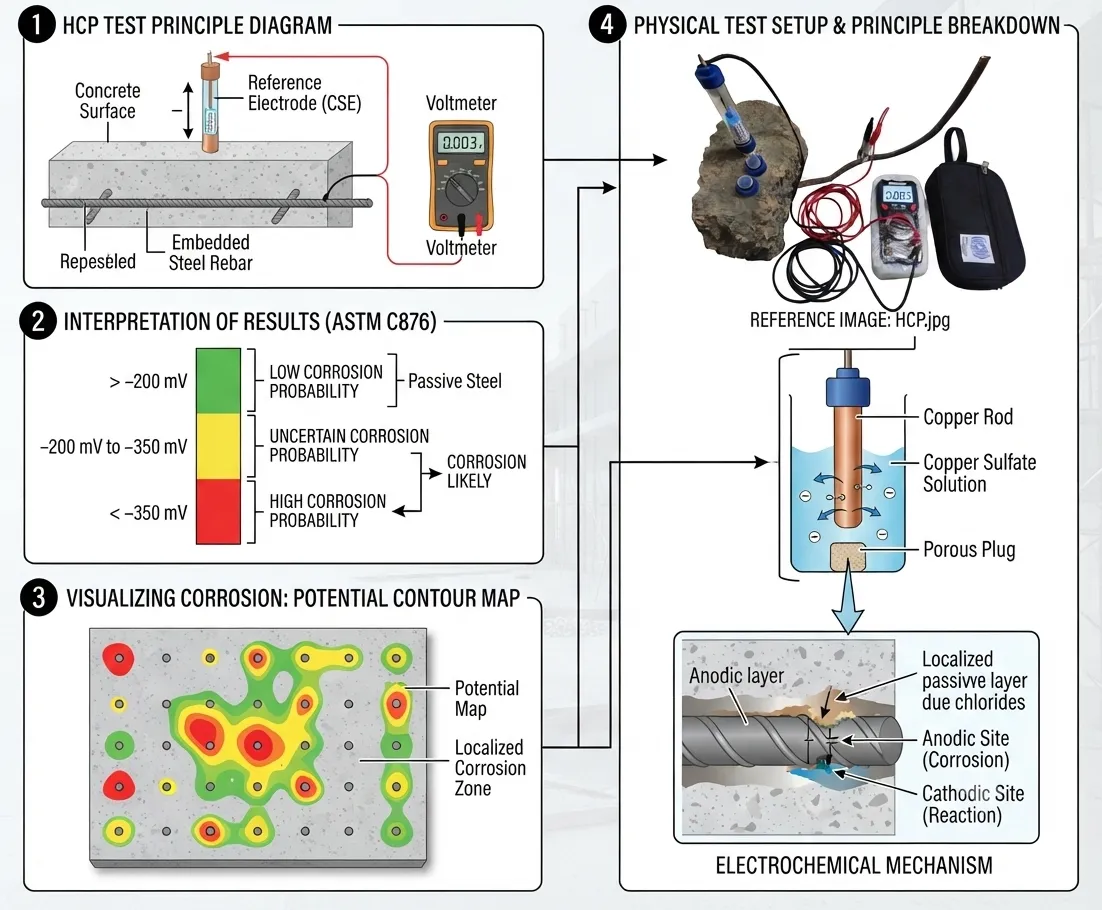
Successful Half Cell Potential Tests require careful planning and systematic execution. Before testing starts, engineers should review structural drawings, identify reinforcement locations, and determine suitable grid spacing based on the size and complexity of the structure.
Electrical continuity of the reinforcement should be checked to ensure that all measurements represent a common reinforcement network. Any discontinuities should be documented and considered during interpretation.
The concrete surface should be cleaned and, when necessary, lightly moistened to improve electrical contact. Care should be taken to avoid excessive surface water, which can affect readings.
Measurements should be taken on a regular grid pattern to provide uniform coverage of the structure. Areas showing unusually negative potentials should receive additional measurements to better define the extent of corrosion activity.
Environmental conditions such as temperature, humidity, recent rainfall, and exposure conditions should be recorded during testing. Following the procedures outlined in ASTM C876 helps ensure reliable data collection and consistent interpretation.
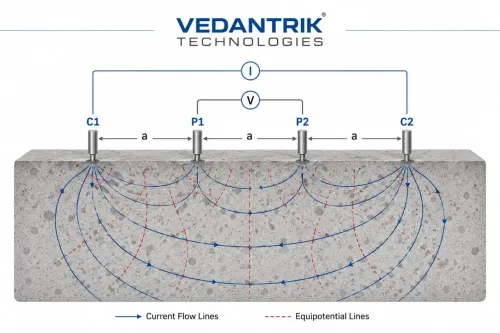
To improve assessment accuracy, Half Cell Potential Tests are often combined with other testing methods such as concrete resistivity testing, chloride analysis, carbonation testing, cover measurements, and visual condition Tests .
Keywords