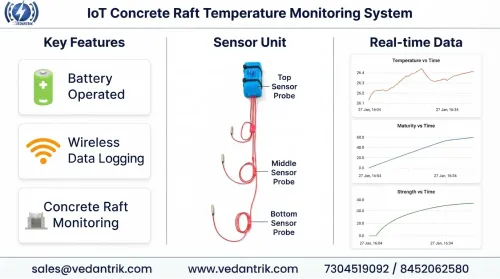

Concrete maturity is often considered a complex and somewhat abstract concept in civil engineering, which leads to misunderstandings in practice. In simple terms, it is a time–temperature relationship index that represents how concrete gains strength as cement hydrates over time under varying temperature conditions.
The basic idea behind maturity is that concrete strength development is not governed by time alone, but by the combined effect of time and temperature. As cement hydrates, heat and time together control the rate at which the internal structure of concrete forms and hardens. Therefore, maturity reflects the cumulative thermal exposure of concrete from the time of casting.
A key principle of this concept is that concrete with the same mix design and the same maturity value will have approximately the same strength, even if their temperature histories are different. In other words, what matters is not how the concrete reached that condition, but the total thermal energy it experienced during curing.
Temperature plays a major role in this process. At higher temperatures, cement hydration accelerates, leading to faster early-age strength gain. At lower temperatures, hydration slows down significantly, which delays strength development and may affect construction schedules.
To quantify this effect, temperature is recorded over time and converted into a maturity value using established mathematical models such as the Nurse–Saul equation or the Arrhenius activation energy method. These models integrate temperature history to produce a single maturity index, usually expressed in units such as °C·hours or °C·days, which can be correlated with concrete strength.
This relationship allows engineers to estimate in-place concrete strength without relying solely on conventional cube or cylinder (CTM) tests, which may not always represent actual field conditions. Instead of waiting for lab results, maturity-based monitoring provides a more immediate and practical way to assess strength development.
One of the biggest advantages of the maturity method is real-time strength prediction, which is especially useful in situations such as cold-weather concreting, hot-weather concreting, temperature-controlled pours, and fast-track construction projects where timing is critical.
However, an important limitation of this method is that it is mix-specific. A maturity curve developed for one concrete mix cannot be directly applied to another. Variations in cement type, supplementary cementitious materials (SCMs), chemical admixtures, and water–cement ratio can significantly change hydration behavior, requiring a new calibration for each mix design.
Overall, the maturity concept provides a practical and reliable way to understand and predict concrete strength development, as long as it is properly calibrated and used within the correct mix conditions.
Keywords