Managing curing tank temperature during the monsoon season presents a different set of challenges compared to hot weather conditions. While ambient temperatures are generally more moderate during monsoon, the continuous rainfall, high humidity, and fluctuating environmental conditions can still affect the stability and uniformity of curing water temperature.
During monsoon, frequent rain showers can cause sudden drops in ambient temperature, especially when curing tanks are located in semi-open or outdoor laboratory environments. This leads to rapid cooling of curing water, which may bring the temperature below the recommended range of 27 ± 2°C specified in IS 516. Such fluctuations can slow down cement hydration and affect the consistency of strength development in concrete cubes.
High humidity conditions during monsoon also reduce evaporation losses, which can help maintain moisture but may contribute to temperature instability when combined with rainwater ingress into curing tanks. Direct rainfall entering the tank can create localized cold zones, resulting in non-uniform temperature distribution.
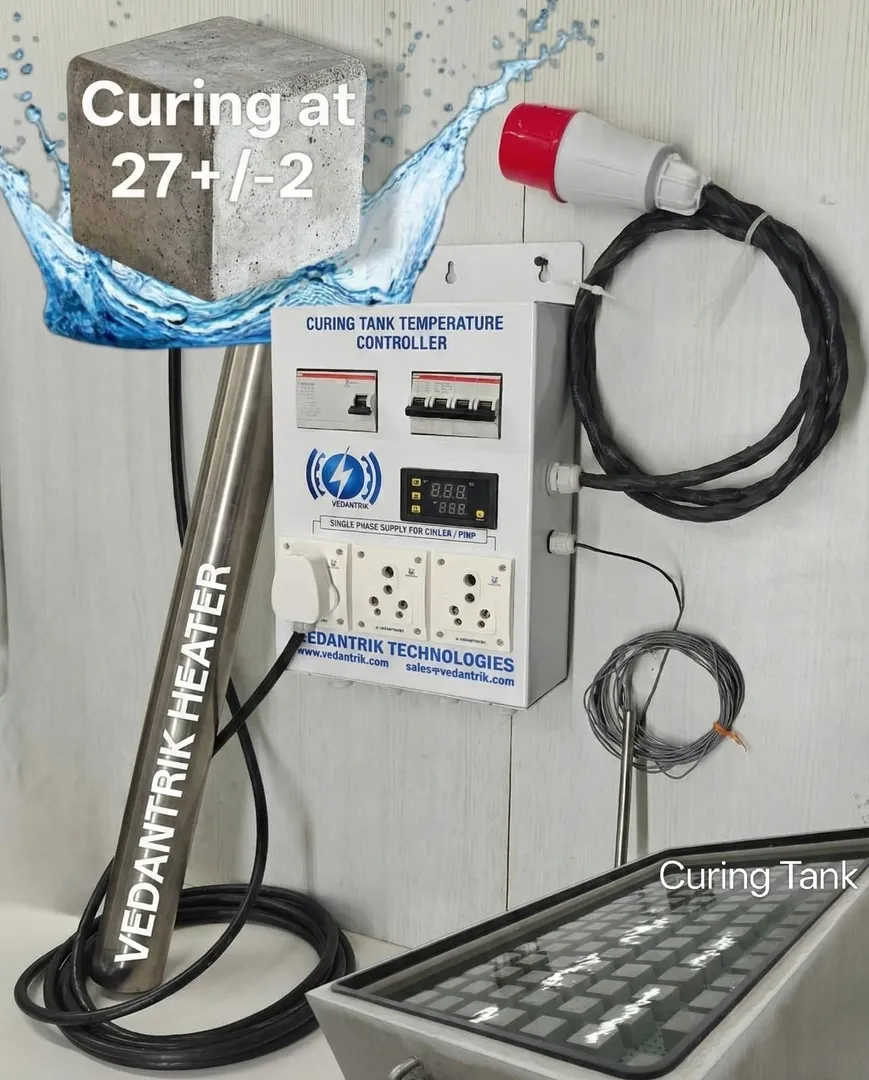
In this scenario, an automatic temperature controller system plays a critical role in maintaining stable curing conditions. The controller continuously monitors water temperature and activates heating or cooling mechanisms as required to keep the tank within the standard range. This helps compensate for sudden temperature drops caused by rain or ambient weather changes.
When paired with a controlled circulation system, the effectiveness improves further. Continuous water movement ensures uniform temperature distribution throughout the tank, preventing cold spots that can otherwise lead to uneven curing of concrete specimens.
Without proper temperature control during monsoon, inconsistent curing conditions can lead to variations in hydration rate, resulting in non-uniform strength development and unreliable test results. In some cases, slower hydration in cooler conditions may delay early strength gain, affecting project timelines and quality control decisions.
Additionally, repeated temperature fluctuations can influence the microstructure of cement paste, potentially affecting long-term durability characteristics such as permeability and resistance to ingress of harmful agents.
Therefore, effective curing tank management during monsoon is not just about maintaining moisture, but ensuring stable and uniform temperature control using an automatic temperature controller system, supported by circulation and continuous monitoring. This ensures that concrete specimens develop under standardized conditions, leading to accurate and reliable strength and durability test results.
Keywords