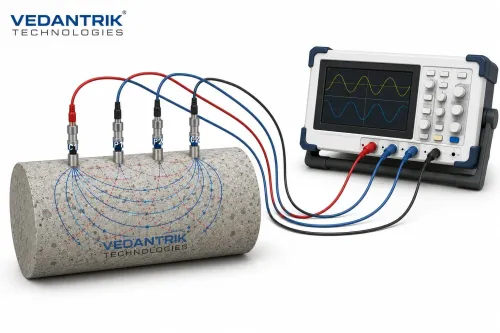
Moisture content inside concrete has a major impact on Ultrasonic Pulse Velocity (UPV) readings. Since UPV testing measures how fast ultrasonic waves travel through concrete, changes in moisture levels can affect the wave speed and influence the final test results.
Concrete contains many interconnected pores, capillaries, and voids. When these spaces are filled with water, they provide a continuous path that allows ultrasonic waves to travel more easily. On the other hand, when the pores contain air, the waves are partly absorbed and scattered, which reduces the measured velocity.
Because of this, saturated concrete usually shows higher UPV values than dry concrete, even when both have the same strength and quality. If moisture conditions are not considered, the test results may give a misleading impression of the concrete's condition.
Moisture can also affect the detection of microcracks. In dry concrete, microcracks slow down the movement of ultrasonic waves and lower the UPV reading. However, when the concrete is saturated, water can fill these cracks and help the waves travel faster, making the cracks less noticeable during testing.
The distribution of moisture within the structure is also important. If some areas are wetter than others, UPV readings may vary from one test location to another. In such cases, correction factors or calibration curves may be needed to improve the accuracy of the results.
For the most reliable comparison, UPV tests should be performed on concrete elements that have similar moisture and exposure conditions. Overall, moisture content is an important factor in UPV testing, and understanding its effect helps ensure more accurate interpretation of the result