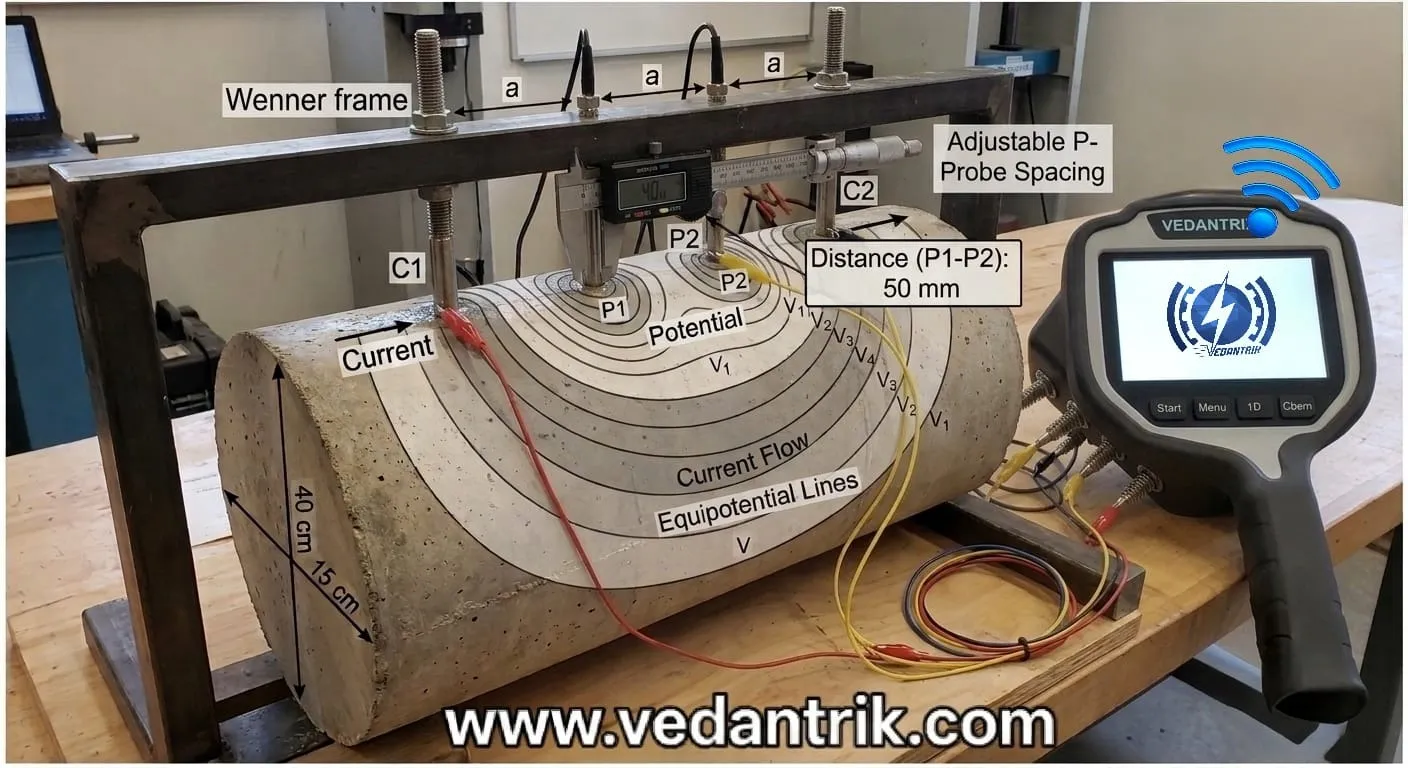
Bulk resistivity is a laboratory method that measures the electrical conductivity of the concrete core or cylinder across its entire volume.
Bulk resistivity is a highly accurate method that enables the engineers to measure the materials resistance against the movement of the aggressive ion, mostly chloride ions, which is often the leading cause of the corrosion in steel reinforcement.
Once the corrosion begins, it can lead to cracking and loss of strength in reinforced concrete structure. Bulk resistivity helps predict this process by revealing how easily ions can move through the concrete matrix.
In bulk resistivity testing, cylindrical concrete samples are placed between two conductive plates, and a voltage is applied across the specimen. The resulting current flow is measured, and resistivity is calculated by considering the geometry of the specimen.
Since the measurement is taken against the entire volume, bulk resistivity provides a more accurate representation of the concrete’s internal pore structure and connectivity than surface-based tests.
Concrete permeability and its ionic diffusion both influence the final result of resistivity. A dense and more refined micro structure shows low permeability and high resistivity measurement.
Conversely, a porous concrete with interconnected capillaries has low resistivity, allowing chloride ions to penetrate more rapidly. This correlation enables engineers to use resistivity values to estimate diffusion coefficients, which helps for service-life prediction.
Bulk resistivity is particularly useful for evaluating new mix designs. For example, the addition of supplementary cementitious materials (such as fly ash, slag, or silica fume) significantly improves chloride resistance by refining pore structure. This increases the resistance of the concrete.
Therefore, bulk resistivity testing allows manufacturers and engineers to optimize their concrete mix to ensure high-performance concrete in aggressive environments.
One of the major advantages of bulk resistivity is its standardization. Unlike surface resistivity, which can be influenced by moisture gradients or carbonation at the concrete surface, bulk resistivity is measured under controlled laboratory conditions.
Concrete Cores are typically saturated before testing, ensuring consistent moisture content. This improves repeatability and helps in direct comparison between different mixes.
Overall, bulk resistivity is a reliable, efficient, and scientifically grounded approach for predicting chloride penetration in concrete.
Its strong correlation with micro structure, permeability, and diffusion behavior makes it an essential tool for durability design and material optimization.
Keywords