Half-Cell Corrosion Potential (HCP) testing is used to check the likelihood of corrosion in reinforcement steel by measuring the electrical potential difference between embedded steel and an external reference electrode.
This potential difference shows the electrochemical condition of the steel surface. Since corrosion is an electrochemical process, changes in this potential occur when steel changes from a passive (protected) state to an active corrosion state. Engineers use these readings to estimate whether corrosion is likely happening.
In concrete, steel is usually protected in a passive state because of the highly alkaline environment created by cement hydration. This results in fairly stable and relatively positive potential values.
However, when chlorides from seawater or de-icing salts enter the concrete, or when carbonation reduces the alkalinity, this protective layer on the steel breaks down. Once the conditions support electrochemical reactions, corrosion starts, and the steel potential becomes more negative.
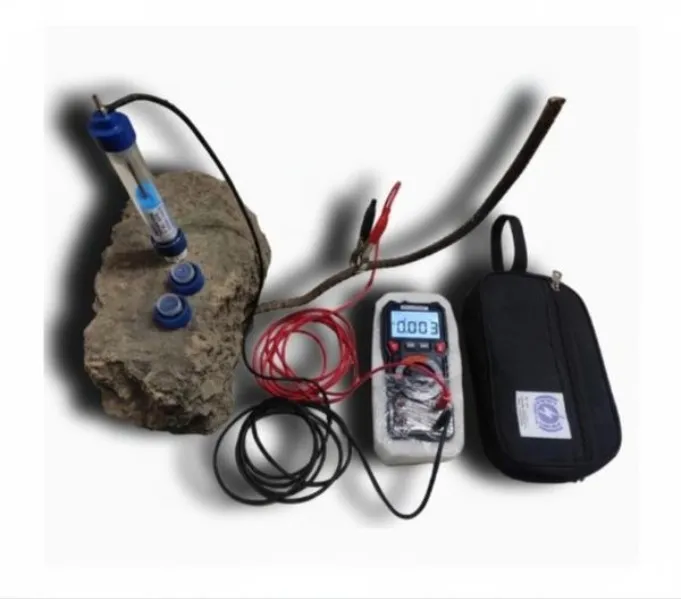
In HCP testing, a copper/copper sulfate reference electrode (CSE) is placed on the surface of the concrete, and a voltmeter is used to measure the potential difference between the electrode and the embedded steel.
Based on ASTM C876 guidelines, a potential more negative than −350 mV (CSE) indicates a high chance of corrosion, while values more positive than −200 mV suggest a low chance. Values between −200 mV and −350 mV are uncertain and usually need further testing.
It is important to note that HCP testing only shows the probability of corrosion, not how fast it is occurring. A very negative value means corrosion is likely, but it does not tell the corrosion rate.
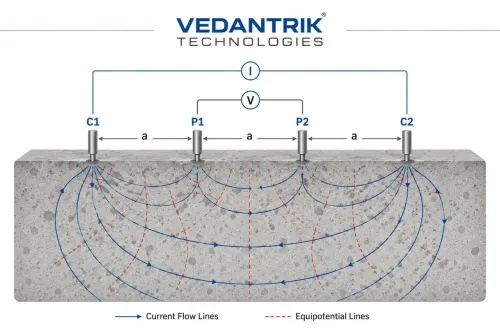
Because of this, engineers often combine HCP results with other tests like concrete resistivity or polarization resistance to get a clearer picture of both corrosion risk and corrosion rate.
HCP results are often shown as contour maps, which help identify areas of the structure that may be more prone to corrosion, such as joints, edges, or areas exposed to moisture and chlorides.
These maps also help distinguish between anodic areas (where corrosion starts) and cathodic areas (where reactions continue), giving a clearer understanding of what is happening inside the structure.
In summary, HCP testing helps detect the likelihood of rebar corrosion by measuring electrical potential, making it an important tool for checking the condition of reinforced concrete structures.
Keywords