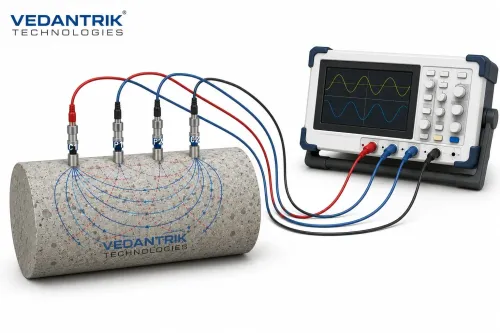
The Rapid Chloride Migration Test (RCMT), as defined in NT Build 492, is a laboratory method specifically developed to determine the rate at which chloride ions penetrate concrete when an external electrical potential is applied.
The RCMT test is used to assess the ability of a concrete mix to resist chloride ion migration, since chloride ions can damage the protective oxide layer around steel reinforcement, eventually leading to corrosion over time.
In this test, chloride ion movement is accelerated by applying a direct voltage across a concrete specimen. This creates an electric field that drives the ions from the negative side toward the positive side, allowing them to penetrate deeper into the concrete.
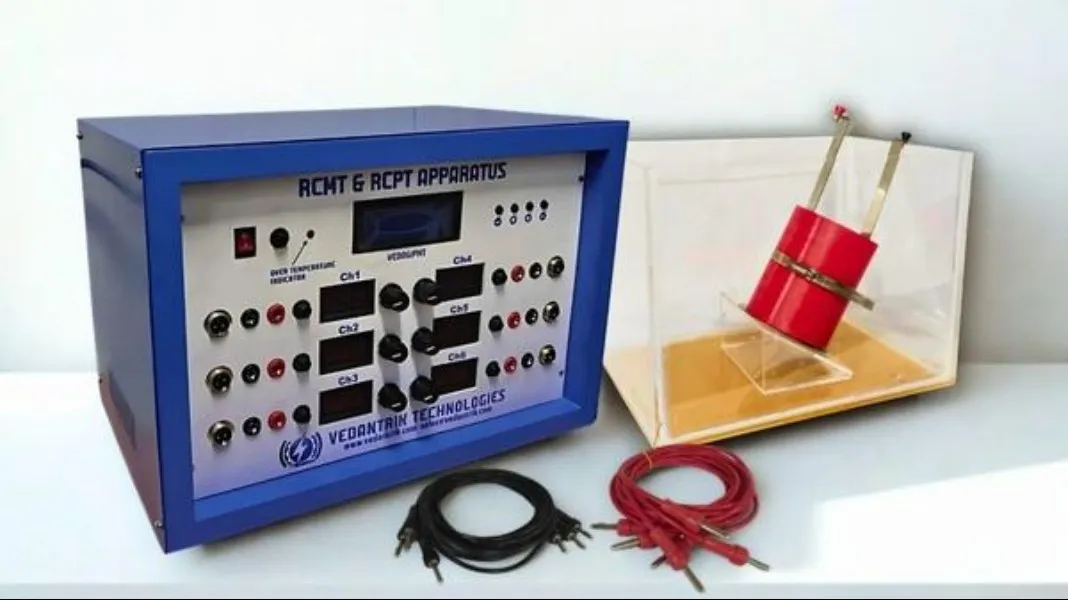
A concrete core specimen of 100 mm diameter and 50 mm thickness is placed inside a rubber sleeve, which separates two compartments. One side is filled with a sodium chloride (NaCl) solution connected to the anode, while the other side contains a sodium hydroxide (NaOH) solution connected to the cathode.
The sample is arranged so that its bottom surface is in contact with the NaCl solution and the top surface is exposed to the NaOH solution. An initial voltage of 30V is applied, and the initial current is measured. Based on this reading, the RCMT equipment recommends the appropriate voltage and test duration according to NT BUILD 492.
At the end of the test, the final temperature of the system is recorded. The concrete specimen is then split, and the freshly exposed surface is sprayed with silver nitrate (AgNO₃) solution. The depth of chloride penetration is then visually examined.
The penetration distance of chloride ions is used to calculate the non-steady-state migration coefficient (Dnssm). This coefficient is a quantitative measure of the concrete’s resistance to chloride ingress. Lower values indicate better durability performance, a denser microstructure, lower water–cement ratios, and the use of supplementary cementitious materials such as fly ash, slag, or silica fume.
One key advantage of the RCMT method, especially in quality control applications, is its high sensitivity to changes in concrete microstructure that influence chloride ion movement. This makes it possible to distinguish between different high-performance concrete mixes that may otherwise show similar results in RCMT testing.
Keywords