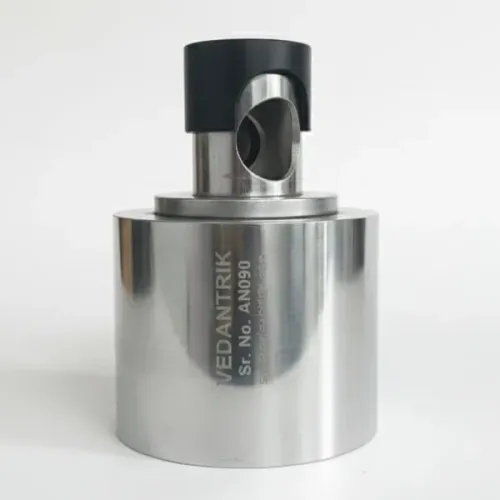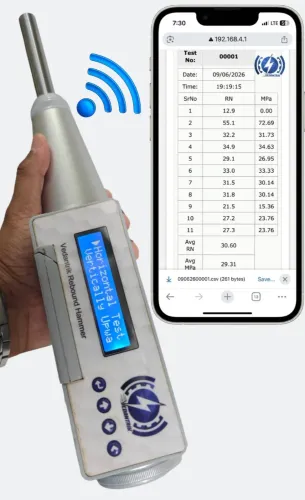
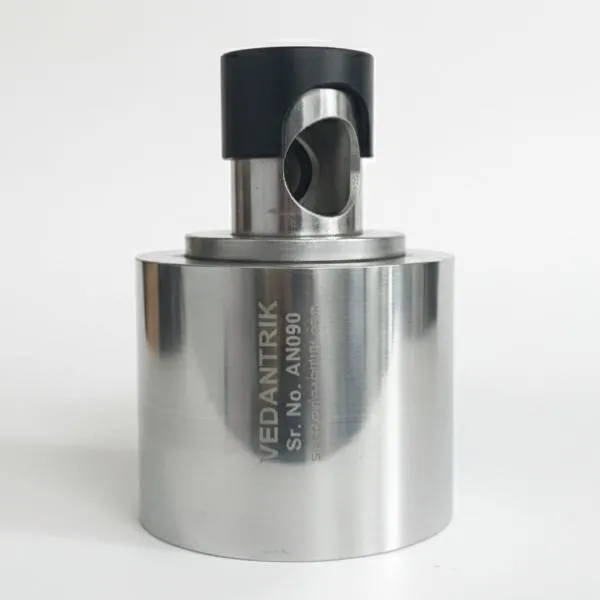
An anvil is used as a certified reference material to verify the calibration of a rebound hammer. As per IS 516, a properly functioning and calibrated rebound hammer should typically give a rebound value of 80 ± 2 on a standard anvil, which has a Rockwell hardness of HRC 66 ± 2.
Its main purpose is to provide a standardized and consistent reference for checking and calibrating the accuracy of the rebound hammer (also known as the Schmidt Hammer). This instrument is widely used to assess surface hardness and estimate the compressive strength of concrete structures. Over time, internal mechanical parts of the rebound hammer—such as the spring, plunger, and impact mass—can experience wear and tear, which may lead to deviations in rebound readings. The steel anvil helps identify such errors so they can be corrected before the hammer is used on actual concrete surfaces.
The calibration anvil is made from high-grade alloy steel that is hardened and tempered to ensure surface uniformity and high mechanical strength. This reduces energy losses due to vibration or movement during impact. The impact surface of the anvil has a Rockwell hardness of approximately HRC 66 ± 2 as per IS 516, providing a dense and uniform surface close to an ideal standard. This ensures that when the rebound hammer plunger strikes the anvil, the rebound number depends only on the hammer’s impact energy and internal mechanism, not on surface irregularities.
During calibration, the rebound hammer is held perpendicular to the anvil surface, and multiple impacts are carried out—typically 6 to 8 readings. The average rebound value is then compared with the standard reference range of 80 ± 2. If the readings fall within this range, the hammer is considered properly calibrated. If there is a significant deviation, it indicates that the hammer may require repair or mechanical servicing to restore accuracy. Therefore, using a properly calibrated hammer on an anvil ensures accurate rebound testing of concrete in the field.
Purpose of the Anvil:
- To ensure the rebound hammer produces consistent and accurate rebound values
- To verify the performance of the rebound hammer
- To identify wear, spring weakening, or other mechanical faults in the hammer
- To ensure compliance with standards such as IS 516 and ASTM C805
Principle of the Anvil:
The calibration of a rebound hammer is based on the interaction between the hammer’s plunger and a reference material with well-defined mechanical properties. The anvil serves as this reference due to its near-ideal elastic behavior, uniform density, and minimal energy loss under impact. Unlike concrete, which is heterogeneous and can show variable responses, a steel anvil provides a highly consistent and predictable striking surface. Its high elastic modulus and strength ensure that contact with the hammer remains almost entirely elastic, with very little permanent deformation. This consistency allows the rebound hammer to produce repeatable readings, which act as a benchmark for instrument calibration.
The principle is based on basic mechanics: the hammer’s plunger strikes the surface at a known velocity, and part of the kinetic energy is returned as rebound. The rebound value depends on the hardness and elasticity of the surface. When the hammer strikes the steel anvil, almost no energy is lost through plastic deformation, and it rebounds with a velocity close to that of an ideal elastic collision. This makes the steel anvil a reliable standard, providing a consistent reference value unaffected by the natural variability seen in materials like concrete. In addition, it helps detect systematic errors, verify the condition of the internal spring and plunger mechanism, and identify any calibration drift over time.
Keywords