
Controlling the temperature gradient or thermal gradient in mass concrete is extremely important to prevent thermal cracking, shrinkage cracks, and long-term durability problems in large concrete pours such as raft foundations, pile caps, dams, retaining walls, and industrial foundations.
During the hydration process, cement generates a large amount of heat inside the concrete mass. The middle or core portion of the raft becomes hotter while the top surface cools faster due to exposure to the atmosphere. If the temperature difference between these portions becomes excessive, thermal stresses develop which can lead to cracking.
As per industry practice, ACI guidelines, and IS recommendations, proper insulation and continuous temperature monitoring are essential to control the thermal gradient in mass concrete.
One of the most effective methods to control thermal gradient in raft foundations and mass concrete is by insulating the top surface immediately after concrete pouring.
Generally, the raft surface is covered with:
- 50 mm Thermocol Sheets (Expanded Polystyrene Insulation)
- Tarpaulin Sheets or Plastic Sheets
The thermocol sheet acts as an insulation layer and reduces rapid heat loss from the top surface of the concrete.
The tarpaulin sheet helps in:
- Preventing moisture loss
- Maintaining proper curing conditions
- Protecting concrete from sudden cooling
- Reducing shrinkage cracks
Why Insulation is Important in Mass Concrete
Heat always travels from a higher temperature region to a lower temperature region.
In mass concrete, the core temperature remains high due to heat generated during cement hydration. If the top surface is directly exposed to the atmosphere, heat escapes rapidly from the surface while the core remains hot. This creates a high temperature differential within the concrete mass.
By covering the raft with thermocol sheets, the heat flow from the top surface is significantly reduced. As a result:
- Surface cooling becomes gradual
- Temperature difference reduces
- Thermal stresses are minimized
- Chances of thermal cracking decrease
Proper insulation helps maintain uniform temperature distribution within the concrete.
Common Mistake in Temperature Differential Measurement
One of the most common mistakes in mass concrete monitoring is considering the temperature difference between:
- Core temperature and ambient temperature
This is generally incorrect for thermal gradient evaluation.
The actual temperature differential should be measured between:
- Middle/Core portion of the raft
- and
- Top portion of the raft
Similarly, temperature difference between:
- Middle/Core portion
- and
- Bottom portion
should also be monitored to ensure heat is not excessively transferring into the ground.
Correct Thermocouple Sensor Locations in Mass Concrete
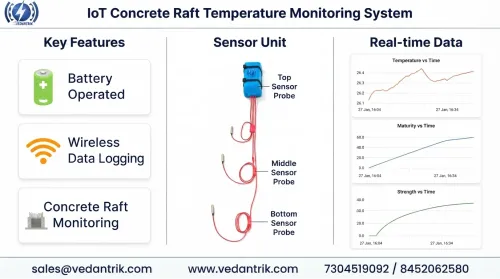
For accurate temperature monitoring, thermocouple sensors should be installed at three critical locations:
1. Top Sensor Location
The top sensor should generally be installed:
- Approximately 150 mm (6 inches) below the top concrete surface
This sensor measures the top concrete temperature and helps evaluate surface cooling.
2. Middle/Core Sensor Location
The middle sensor should be installed at:
- Center of the raft
- or
- 1/2 H location
where H = total height or thickness of the raft.
This sensor records the peak core temperature generated during hydration.
3. Bottom Sensor Location
The bottom sensor should generally be installed:
- Approximately 150 mm (6 inches) above the bottom surface or ground level
This sensor helps evaluate heat transfer toward the ground.
Importance of Top-Middle-Bottom Temperature Monitoring
Continuous monitoring of temperatures at Top, Middle, and Bottom locations helps engineers:
- Calculate thermal gradient accurately
- Monitor temperature differential
- Prevent thermal cracking
- Control cooling rate
- Ensure proper curing conditions
- Maintain compliance with project specifications
Recommended Temperature Differential in Mass Concrete
As per industry practice and ACI recommendations, the temperature differential in mass concrete should generally be maintained within 20°C. Excessive thermal gradient may lead to surface cracking, internal thermal stresses, shrinkage cracks, and long-term durability problems.
Advanced Wireless Monitoring by Vedantrik Technologies
Vedantrik Technologies provides advanced Wireless and Battery-Operated Mass Concrete Temperature Monitoring Systems for raft foundations and mass concrete projects across India.
Our wireless monitoring system offers:
- Real-time live temperature monitoring
- Mobile and laptop connectivity
- No long cable routing
- Minimal chances of wire damage
- Accurate Top-Middle-Bottom monitoring
- Hassle-free installation and operation
Since the wireless devices are installed directly near the thermocouple sensors, the chances of cable damage during concreting become almost negligible.
Keywords