Deciding the number of temperature monitoring locations in mass concrete is important to properly understand heat development and temperature variation inside the structure. It helps in controlling thermal cracking and ensuring safe construction of raft foundations, pile caps, dams, and other large concrete elements. The number of locations depends on raft size, thickness, geometry, and construction sequence.
Assessment of Raft Geometry
The first step is to study the raft geometry from approved structural drawings. This includes thickness, overall plan area, and total volume of concrete. Larger and thicker rafts generate more heat and show higher temperature differences, so they require more monitoring locations compared to smaller rafts.
Understanding Pour Plan and Sequence
The pour plan and sequence of concrete placement must be carefully studied. This includes segmentation of pours, construction joints, and vertical joints. The raft is divided into different pour blocks, and each block should be represented by at least one monitoring location to properly capture temperature behavior.
Identification of Critical Monitoring Locations
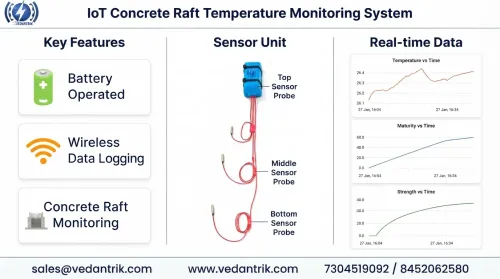
Critical monitoring points are selected on the raft plan. At each location, sensors are installed in a vertical alignment at three levels:
- Top sensor
- Middle (core) sensor
- Bottom sensor
This arrangement helps in understanding temperature variation from surface to core.
Basis for Selection of Critical Locations
Selection of monitoring points should be done in consultation with the structural consultant or concrete technologist. Key factors include raft thickness, structural layout such as columns and shear walls, load concentration zones, and expected thermal restraint conditions. Areas with higher stress or heat buildup should always be prioritized.
Segmentation Based on Pour Sequence
The raft is divided into segments based on the pour sequence and construction joints. The central point (centroid) of each segment is identified and selected as a monitoring location. This ensures proper coverage of all construction zones and uniform temperature tracking.
Coverage Optimization
Additional monitoring points may be added to improve coverage, especially in:
- Large raft areas
- Irregular shapes
- Zones with varying thickness
- Areas with different restraint conditions
This helps in getting a more accurate temperature profile of the entire structure.
Edge and Corner Considerations
Edges and corners lose heat faster because they are exposed to surrounding air on more sides. These areas often show higher temperature differences compared to the core. Therefore, at least one monitoring location should be placed near edges or corners to capture this variation properly.
Guidelines for Number of Monitoring Locations
There is no strict codal rule defining the exact number of monitoring points based on raft size. However, as a general industry practice:
- One monitoring location is considered per ~500 m² of raft area
This can be adjusted based on project requirements, consultant recommendations, structural importance, and budget considerations.
Sensor Installation Arrangement
At each monitoring location, sensors are installed vertically at three levels:
- Top sensor: placed approximately 150 mm below the top surface to measure surface temperature
- Middle (core) sensor: placed at mid-depth (around 50% of raft thickness), where maximum heat is expected
- Bottom sensor: placed approximately 150 mm above the bottom surface to monitor heat transfer to the ground.
Keywords