Improving accuracy in Ultrasonic Pulse Velocity testing is important for reliable assessment of concrete quality. UPV results are widely used to estimate uniformity, detect defects, and assess structural integrity. Following standards such as IS 516 (Part 5 / Section 1: 2021) and ASTM C597 helps ensure consistent and accurate results.
Proper surface preparation is the first step to improve accuracy. The test surface should be smooth, clean, and free from loose particles. Any roughness can cause scattering of ultrasonic waves, leading to incorrect velocity measurements. Using an appropriate coupling agent ensures better transmission of waves between the transducer and concrete surface.
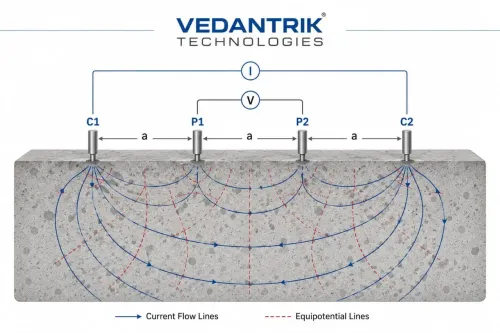
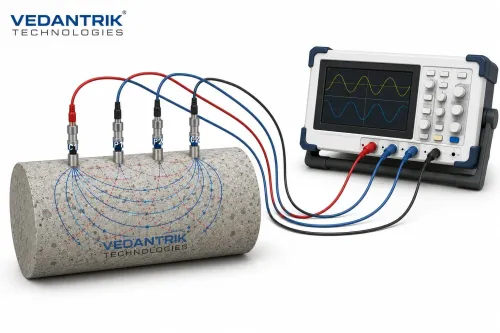
Selecting the correct test method is also important. Direct transmission gives the most accurate results, followed by semi-direct and indirect methods. Whenever possible, direct transmission should be used as recommended in both ASTM C597 and IS 516 (Part 5 / Section 1: 2021).
Consistent transducer positioning improves repeatability. The distance between probes should be measured accurately, and multiple readings should be taken at each location to obtain an average value. This reduces random errors and improves reliability.
Environmental conditions also play a role in accuracy. Temperature, moisture content, and curing conditions can influence pulse velocity. Testing should be carried out under controlled or comparable conditions for meaningful results.
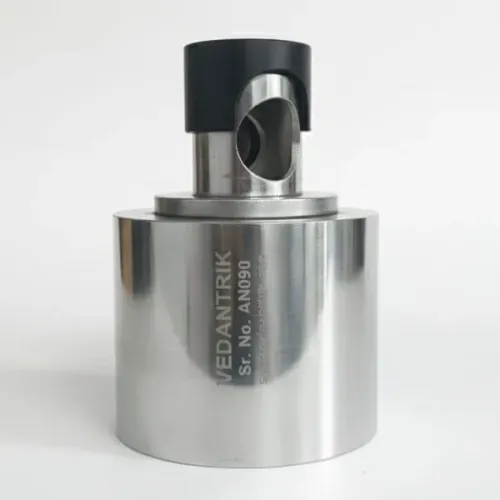
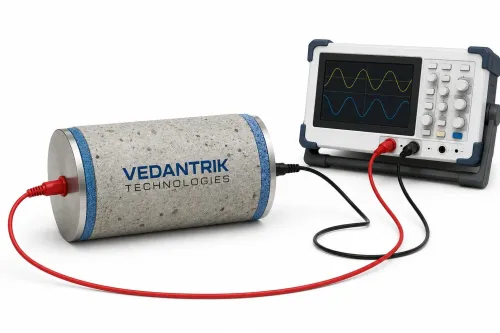
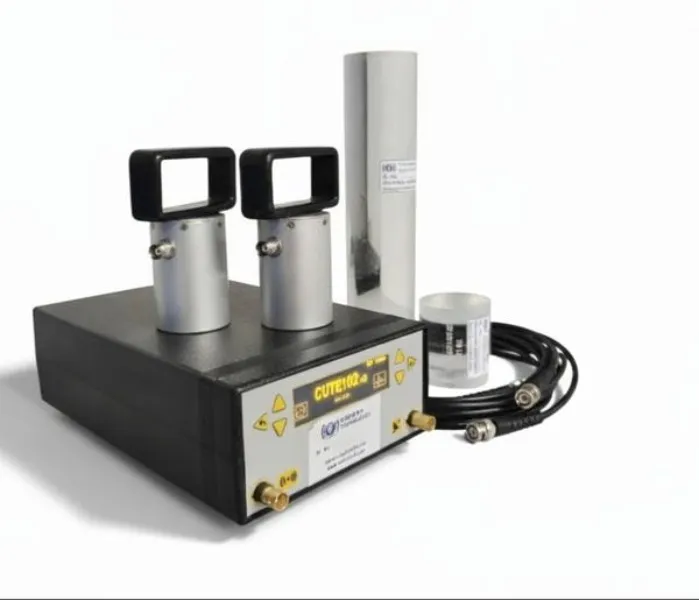
Finally, regular calibration of the UPV instrument is essential. A standard calibration bar should be used to verify equipment performance before testing begins. Routine maintenance ensures long-term stability and accurate readings.
By following proper procedures, maintaining equipment, and adhering to IS 516 (Part 5 / Section 1: 2021) and ASTM C597, engineers can significantly improve the accuracy and reliability of UPV testing results.
Keywords