Concrete curing is an important process that has a direct effect on the strength gain, maturity, durability and the surface hardness of the concrete.
While mostly concrete curing is associated with maintaining enough moisture, temperature also plays an important role, particularly in laboratory and field spaces where concrete specimens are immersed in curing tanks.
The temperature of the curing tank strongly affects the cement hydration process, and plays a huge role in gradual hardening and strength development of the concrete.
Cement hydration is an exothermic process, hence,heat is released as the hydration progresses. If the temperature of the curing tank is too low, hydration proceeds at a slower rate, which then delays early-age strength gain of the concrete.
Whereas, if the temperature is excessively high, then cement hydration occurs at a faster rate, which leads to rapid but non-uniform micro-structure development, increased porosity, affecting the long term durability of the concrete.
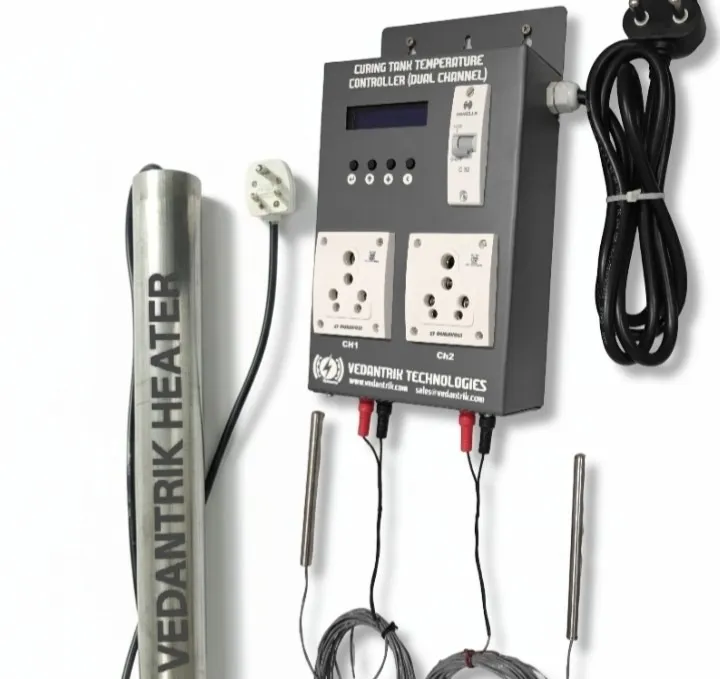
Therefore, regulating the temperature change during the concrete curing becomes a crucial task.
According to the guidelines of IS 516, water temperature during the curing process should be generally maintained 27 +/- 2°C, which provides the ideal conditions for optimal strength gain in typical Portland cement concrete.
The role of curing extends beyond the concern for optimal strength development.
Curing is a process which directly affects the micro-structure development of the concrete, which influences many other vital properties of the concrete.
Improper micro-structure development can increase concrete permeability, which may go unnoticed and affect the results of RCPT or RCMT tests. If the concrete core was taken from the cube itself, it can lead to inaccurate judgement of the mix design.
Uniform water temperature during the curing also ensures optimal hardness and prevents formation of micro-cracks, which can reduce its durability.
The importance of curing tank temperature cannot be overstated: it is a fundamental parameter that ensures concrete achieves its full potential in strength, durability, and performance under both laboratory and field conditions.
Keywords