Mass concrete structures such as raft foundations, pile caps, piles, footings, dams, and large industrial foundations generate a large amount of heat during the cement hydration process. This heat of hydration leads to a rise in the internal temperature of concrete and often creates a temperature gradient between the core and the surface.
When this temperature difference becomes excessive, it can result in thermal stresses within the concrete, which may lead to cracking and long-term durability problems in the structure.
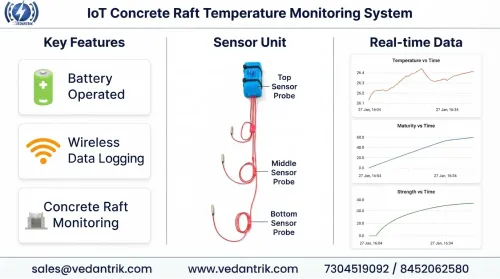
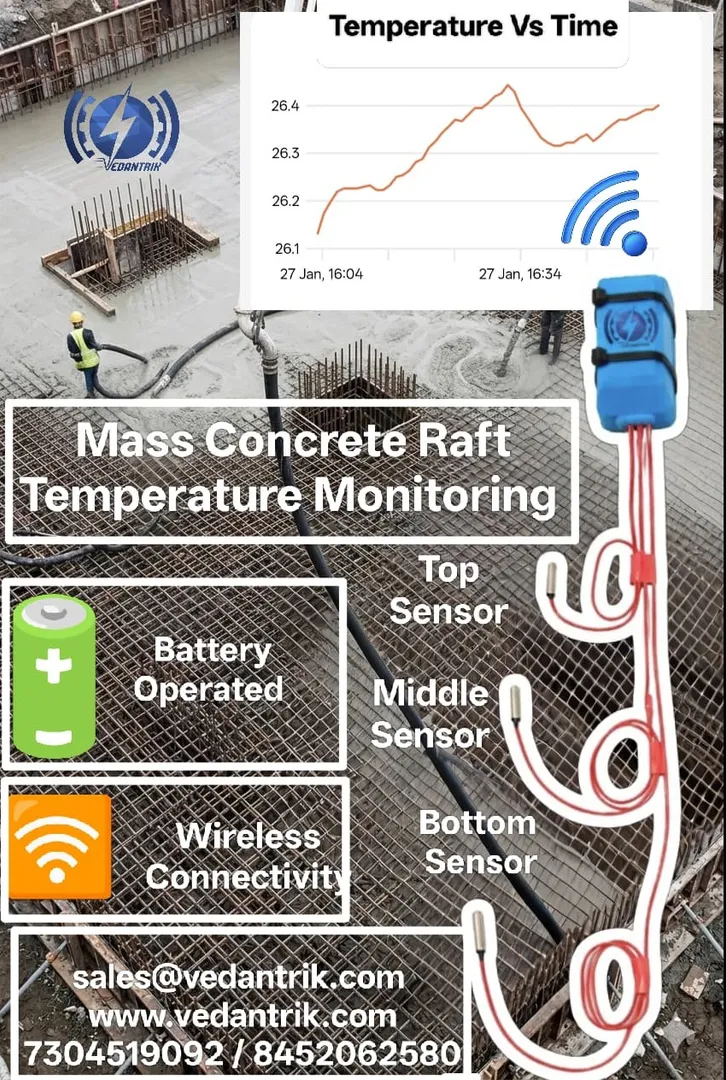
To prevent such issues, continuous temperature monitoring during the curing stage becomes essential. Our Wireless Mass Concrete Temperature Monitoring System offers a simple and reliable solution for real-time tracking of internal concrete temperature, along with in-place strength estimation using the maturity method.
This system is developed for contractors, consultants, infrastructure developers, and quality control engineers who require accurate temperature and strength data in large concrete pours to ensure better construction control and decision-making.
Wireless Concrete Temperature Monitoring Technology
Conventional mass concrete monitoring systems typically use long thermocouple wires connected to data loggers. This setup increases installation complexity, cost, and also carries a risk of cable damage during construction activities.
In contrast, this system uses compact battery-powered wireless sensors that are embedded directly into the concrete, eliminating the need for long wiring systems.
These sensors continuously measure the internal temperature of concrete and transmit data wirelessly in real time. This enables engineers to closely monitor curing conditions and make timely decisions regarding curing control, formwork removal, and construction scheduling.
Concrete Maturity and Strength Monitoring
The system also supports the Concrete Maturity Method, which estimates in-situ compressive strength based on the temperature history of concrete.
By using temperature data along with maturity calculations, engineers can:
- Estimate concrete strength in real time
- Determine safe formwork removal time
- Reduce dependence on cube or cylinder testing
- Improve construction speed and safety
Concrete maturity monitoring is widely applied in bridges, high-rise buildings, dams, and other major infrastructure projects where early-age strength control is critical.
Key Features of the System
- Wireless temperature monitoring without external cables
- Battery-powered embedded sensors placed inside concrete
- Strength estimation using the concrete maturity method
- Low-cost sacrificial sensors left permanently in concrete
- Real-time internal temperature data tracking
- Suitable for large volume concrete pours
- Simple installation before concreting
Applications of Mass Concrete Temperature Monitoring
This system is suitable for monitoring temperature in:
- Raft foundations
- Pile caps
- Piles
- Footings
- Large foundations
- Dams and water-retaining structures
- Bridge foundations
- Industrial and infrastructure projects
By monitoring temperature effectively, engineers can control thermal behavior, reduce the risk of cracking, and improve overall structural durability.
Cost-Effective Monitoring Solution
A major advantage of this system is its low-cost sacrificial sensor design. The sensors are embedded within the concrete and remain permanently in place after casting.
This eliminates the need for reusable probes, long cables, and additional maintenance, thereby reducing installation effort, equipment cost, and overall operational complexity.
Benefits for Construction Projects
Using this system helps construction teams:
- Prevent thermal cracking in mass concrete
- Monitor internal temperature in real time
- Estimate in-situ strength using the maturity method
- Optimize curing and formwork removal timing
- Improve quality control and durability
- Reduce manual testing errors and dependency
Overall, this system provides a practical and efficient way to control temperature effects in mass concrete and ensure safer, faster, and more reliable construction outcomes.
Keywords