
Temperature is a key factor that dictates the maturity index of freshly placed concrete. Immediately after fresh concrete is placed, its internal temperature begins to elevate, majorly because of hydration, and subsequently accumulates as the hydration progresses.
The initial temperature of the mix strongly affects the early age strength development, since elevated temperatures tend to increase the rate of the hydration process, which allows for significant early strength development but may also increase the risk of shrinkage and cracking due to the formation temperature gradients.
In contrast, cooler conditions can delay the setting by lowering the rate of hydration process, which also slows down the early strength development, prolonging the construction time.
Additionally, hydration progresses in a nonlinear fashion, causing recurrent temperature fluctuations which affects the maturity accumulation over time.
Short-term heat spikes, whether from environmental exposure or exothermic reactions, can sharply increase maturity, leading to overestimation of long-term strength if the temperature rise does not proportionately promote microstructural development.
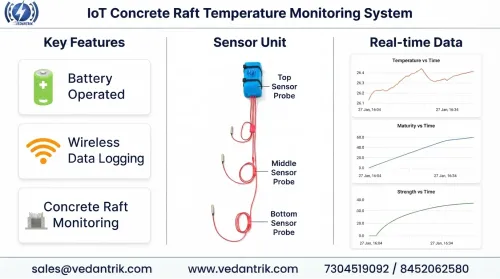
Hence the effect of temperature is monitored and logged at different times intervals, by placing embedded sensors inside the concrete. This enables engineers to capture and map the thermal behaviour, which then later can be used to establish maturity strength correlation using the Nurse–Saul equation.
In practical terms, temperature control becomes crucial for predictable maturity development. The goal is to manage curing temperature to ensure uniformity, since thermal gradients can cause differential maturity within the same concrete, which complicates strength prediction.
Ultimately, temperature governs the kinetics of hydration and thus the rate at which strength is gained. Understanding its influence both in steady and fluctuating conditions is fundamental to accurate maturity assessment.
Keywords