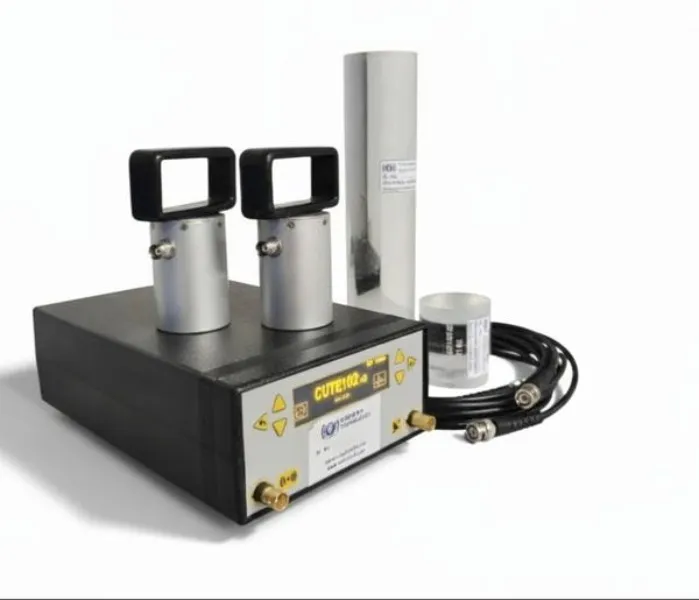
The Ultrasonic Pulse Velocity (UPV) test is a non-destructive testing method used by engineers to examine the internal quality of concrete. In modern construction projects, where durability, safety, and performance are critical, UPV plays an important role in evaluating concrete without causing any damage to the structure. This makes it suitable for both new construction quality checks and the assessment of existing structures.
The test works by sending high-frequency ultrasonic waves through concrete and measuring the time taken for these waves to travel from a transmitter to a receiver. The speed of wave propagation depends on the internal condition of the concrete. Dense, uniform, and sound concrete allows faster wave transmission, whereas the presence of cracks, voids, or deterioration slows it down.
Because wave velocity is affected by key concrete properties such as density, elasticity, homogeneity, and overall integrity, UPV provides valuable insight into the internal condition of the material without destructive intervention.
The results are interpreted by comparing the measured velocity values with standard guidelines such as IS 516 (Part 5/Sec 1): 2018 and ASTM C597.
UPV testing is commonly used to identify internal defects including cracks, honeycombing, voids, delamination, and weak zones. It is widely applied in structures such as bridges, dams, pavements, tunnels, buildings, and precast elements. Beyond defect detection, it also helps assess uniformity and track deterioration over time.
To improve reliability, UPV is often combined with other non-destructive techniques like the rebound hammer test, half-cell potential test, and pull-out methods.
Keywords