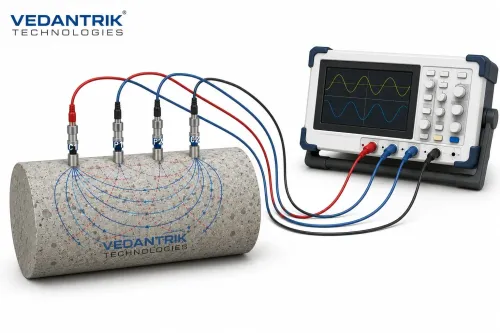
Fly Ash, Ground Granulated Blast Furnace Slag (GGBS), and Silica Fume are commonly used in modern concrete to improve durability and reduce long-term damage. One of the main threats to reinforced concrete structures is chloride ingress, where chloride ions enter the concrete and reach steel reinforcement, causing corrosion. This leads to cracking, spalling, and reduction in service life of structures, especially in marine, coastal, and de-icing salt environments.
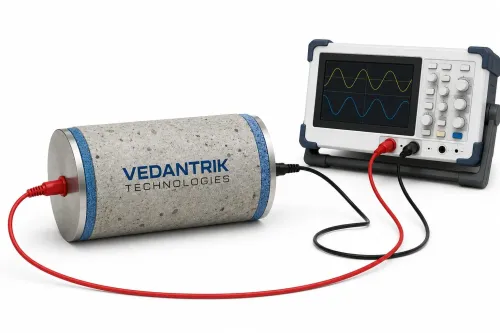
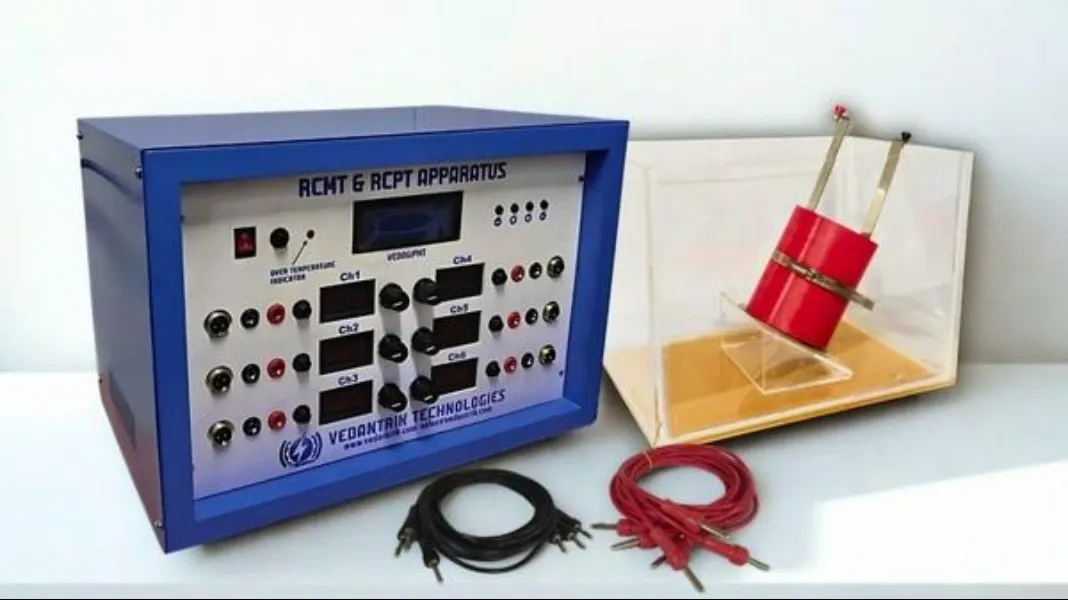
To evaluate how well concrete resists chloride penetration, the Rapid Chloride Migration Test (RCMT) is widely used. This test is based on the standard NT Build 492. In this method, a voltage is applied across a saturated concrete sample, which forces chloride ions to move through the concrete. After the test, the depth of chloride penetration is measured, and the Chloride Migration Coefficient (Dnssm) is calculated. This value shows how fast chlorides can move through the concrete. A lower value means better resistance and higher durability.
SCMs like Fly Ash, GGBS, and Silica Fume improve chloride resistance by making the concrete denser. Fly Ash reacts slowly and improves long-term strength and durability. GGBS reduces permeability by forming a denser internal structure. Silica Fume is very fine and fills small pores, greatly reducing the movement of water and chlorides.
RCMT is very useful for comparing different concrete mixes with SCMs. For example, a mix with GGBS will usually show a lower Dnssm value compared to normal cement concrete, meaning better resistance to chloride penetration. Similarly, mixes with Silica Fume show even higher resistance due to a very compact microstructure.
This test is important for designing durable concrete in structures like bridges, highways, marine structures, and industrial floors. It helps engineers choose the right combination of cement and SCMs based on actual performance rather than only mix proportions.
In India, durability requirements are generally guided by IS 456:2000, which defines exposure conditions and minimum durability requirements. However, it does not directly measure chloride transport. RCMT fills this gap by giving a measurable performance value (Dnssm), which can be used for better mix design decisions.
In short, RCMT helps engineers clearly understand how Fly Ash, GGBS, and Silica Fume improve concrete durability by directly measuring chloride resistance in a fast and reliable way.
Keywords