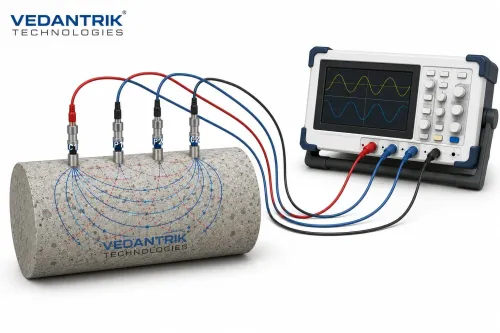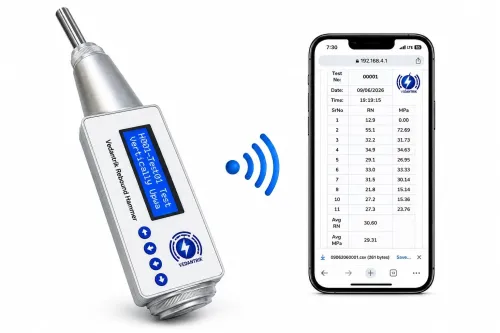

Mass concrete temperature monitoring is extremely important in large concrete pours because concrete generates a significant amount of heat during the hydration process. If the temperature difference between the internal core of the concrete and the outer surface becomes too high, it can create thermal stresses that may lead to cracking and long-term durability problems.
As per international practices and guidelines such as ACI 207.1R (Guide to Mass Concrete) and ACI 301, the recommended temperature difference between the core and top surface of mass concrete is generally maintained within 20°C. In some projects, depending on consultant specifications and concrete mix design, the allowable temperature differential may be extended up to 25°C.
In Indian construction practice, IS 14591:1999 – Guidelines for Temperature Control of Mass Concrete also recommends controlling thermal gradients and limiting temperature differentials to minimize the risk of thermal cracking.
The temperature inside the concrete mass is usually highest at the middle or core section because the heat generated during cement hydration gets trapped within the concrete. At the same time, the top surface cools faster due to exposure to the surrounding environment. If the cooling rate becomes excessive and the temperature difference exceeds the permissible limit, tensile stresses develop within the concrete, resulting in surface cracks or internal thermal cracking.
Apart from temperature differential, the maximum core temperature is also an important factor in mass concrete monitoring. According to ACI 207.2R and several project specifications, the core temperature is generally maintained below 70°C to reduce the risk of delayed ettringite formation (DEF) and durability-related issues.
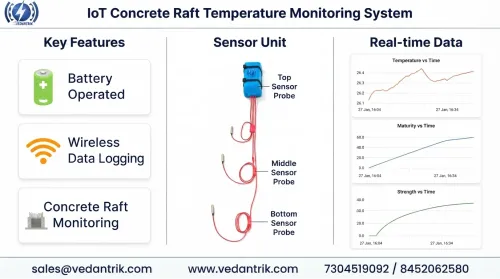
To properly monitor temperature behavior, thermocouples are installed at:
- Top location
- Middle/Core location
- Bottom location
These sensors continuously record temperature readings and help engineers monitor:
- Core temperature
- Surface temperature
- Top-Middle-Bottom temperature readings
- Temperature differential
- Peak hydration temperature
- Cooling rate of concrete
Continuous monitoring allows engineers to take corrective actions if the temperature rise or differential exceeds the permissible limits specified in project quality plans and standards.
Mass concrete temperature monitoring is commonly required in:
- Raft foundations
- Pile caps
- Dams
- Bridges
- Metro projects
- Retaining walls
- Industrial foundations
- Power plants
- Infrastructure projects
- High-rise building foundations
Vedantrik Technologies provides advanced Wireless and Battery-Operated Mass Concrete Temperature Monitoring Systems for accurate and real-time monitoring of concrete temperatures. Our system helps engineers monitor live temperature readings through mobile phones, laptops, and tablets without the risk of cable damage or power interruption.
By using wireless devices installed directly near the thermocouple sensors, the chances of cable damage become almost negligible, ensuring reliable and uninterrupted temperature data throughout the curing process while maintaining compliance with ACI and IS guidelines for mass concrete temperature control.
Keywords