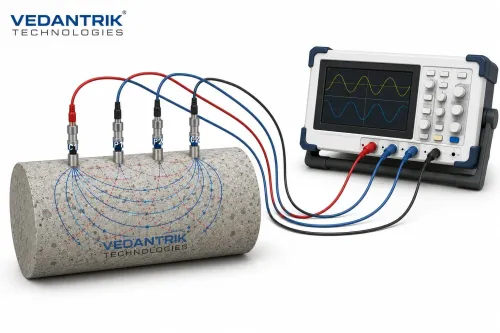

Mass concrete temperature control is one of the most important aspects of large concrete pours such as raft foundations, pile caps, dams, bridges, retaining walls, and industrial foundations. During the hydration process, cement generates a large amount of heat inside the concrete mass. If the temperature rise becomes excessive, it can lead to thermal cracking, durability problems, and long-term structural issues.
To avoid these problems, international and Indian standards specify limits for the maximum allowable temperature in mass concrete.
Maximum Temperature Limit in Mass Concrete
As per Indian Standards (IS Code)
According to IS 14591:1999 – Guidelines for Temperature Control of Mass Concrete, the maximum temperature of mass concrete is generally recommended to be maintained below 70°C.
This limit is widely followed in Indian construction projects to reduce the risk of:
- Thermal cracking
- Delayed Ettringite Formation (DEF)
- Excessive thermal stresses
- Long-term durability issues
Indian consultants and project specifications commonly adopt the 70°C temperature limit for raft foundations, pile caps, and large concrete pours.
Maximum Temperature as per ACI Guidelines
According to ACI 207.2R – Report on Thermal and Volume Change Effects on Cracking of Mass Concrete and references from ACI 201, the maximum allowable concrete temperature can be permitted up to 85°C.
However, ACI guidelines also emphasize that lower temperatures are always preferable for better durability and crack control.
The 85°C limit is considered an upper threshold under controlled conditions and special mix designs. In practical construction projects, engineers generally try to maintain temperatures significantly lower than this value.
Why Excessive Temperature is Dangerous in Mass Concrete
When concrete temperature rises excessively during hydration, several problems can occur:
- Thermal cracking
- Internal tensile stress development
- Surface cracking
- Reduced durability
- Increased shrinkage
- Delayed Ettringite Formation (DEF)
- Long-term structural deterioration
The risk becomes higher in large concrete sections because heat generated inside the concrete cannot dissipate quickly.
Importance of Temperature Differential
Apart from maximum temperature, another critical factor is the temperature difference between the concrete core and the surface.
As per ACI recommendations and industry practice core-to-surface temperature differential is generally maintained within 20°C
Excessive temperature differential can also lead to thermal cracking even if the maximum temperature remains within permissible limits.
As per Indian Standard IS 14591, the recommended maximum temperature in mass concrete is generally maintained below 70°C, while ACI guidelines may allow temperatures up to 85°C under controlled conditions.
However, for better durability and crack prevention, most construction projects aim to maintain lower concrete temperatures along with controlled temperature differentials.
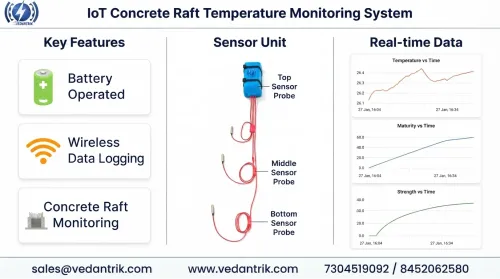
Proper thermocouple installation and continuous temperature monitoring play a vital role in ensuring safe and durable mass concrete construction.
Keywords