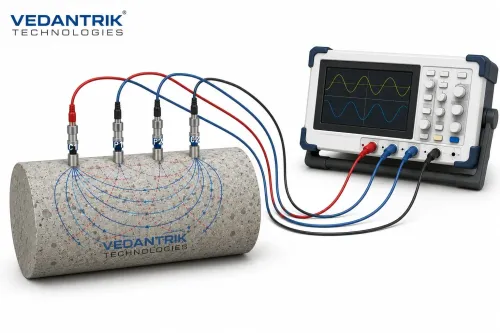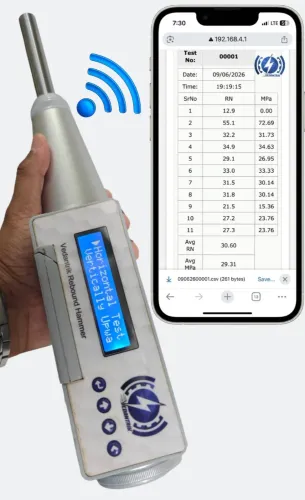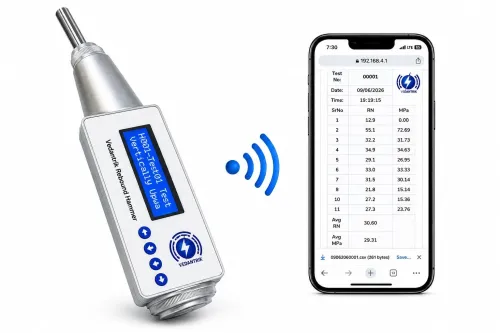
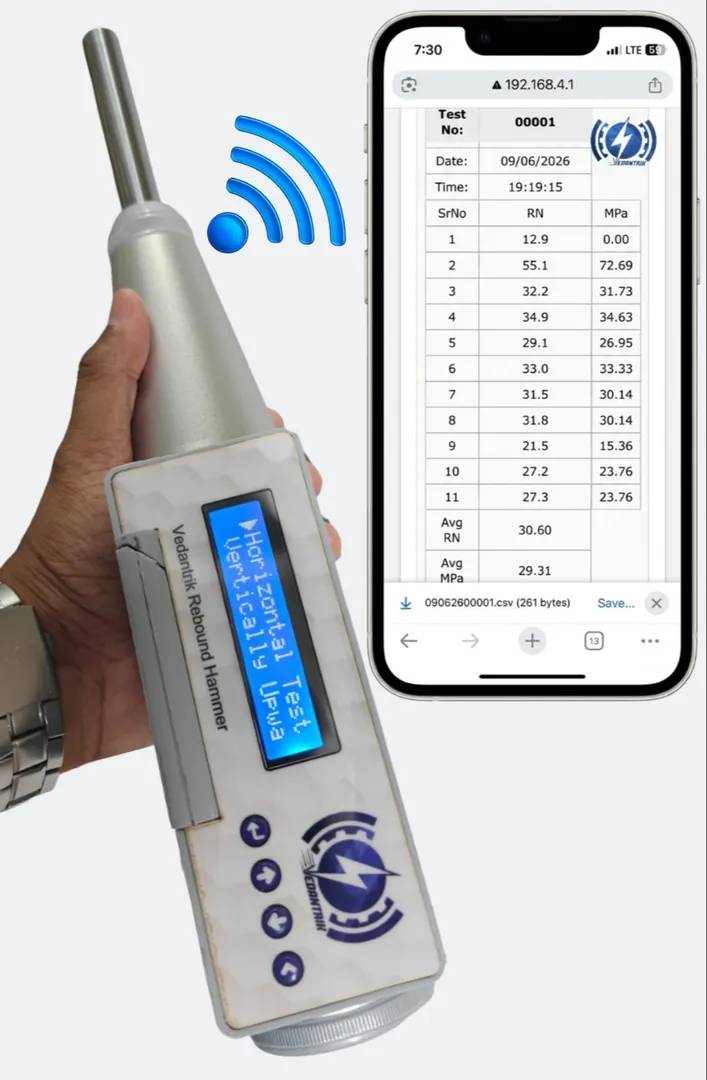
The Digital Rebound Hammer is a modern advancement in non-destructive testing (NDT) used for quick on-site evaluation of concrete strength. It works on the Schmidt rebound principle and is widely used for field testing of concrete structures in accordance with standards such as IS 516, ASTM C805, DIN 1048, and BS 1881. Compared to traditional mechanical rebound hammers, the digital version offers improved accuracy, better data handling, and more reliable strength estimation.
One of the main advantages of the Digital Rebound Hammer is its higher accuracy and reduced human error. In conventional rebound hammers, readings depend on manual observation of the rebound scale, which can lead to reading errors. In the digital version, the rebound value is captured electronically by built-in sensors and displayed directly, ensuring more precise and consistent results.
Another important benefit is fast and real-time strength assessment. The device provides immediate rebound values on-site, allowing engineers to quickly estimate the compressive strength of concrete without waiting for laboratory results. This makes it highly useful for construction quality control, especially in large projects where timely decisions are required.
The Digital Rebound Hammer also offers data storage and traceability, which is a major improvement over traditional systems. Modern devices can store multiple test readings, average values, and test locations. Some models also allow data transfer to computers or software systems for further analysis and documentation. This improves quality control records and makes reporting more systematic and reliable.
In addition, the instrument provides better consistency in testing. Since multiple readings are automatically recorded and averaged, the influence of local surface variations is reduced. This ensures more stable results when compared to manual single-point readings.
Another key advantage is its portability and ease of use. The device is compact, lightweight, and suitable for field conditions. It can be used in different orientations such as horizontal, vertical upward, and vertical downward positions, making it flexible for testing various structural elements like slabs, beams, and columns.
The Digital Rebound Hammer is also cost-effective and non-destructive, meaning it does not damage the structure during testing. This makes it ideal for repeated assessments of existing structures, quality checks during construction, and condition monitoring of aging infrastructure.
However, like all rebound hammer tests, the method primarily measures surface hardness rather than direct compressive strength. Therefore, results can be influenced by factors such as surface smoothness, moisture condition, carbonation, and concrete age. For this reason, standards such as IS 516 and ASTM C805 recommend taking multiple readings and using calibration curves for more reliable strength estimation.
Overall, the Digital Rebound Hammer combines the well-established Schmidt principle with modern digital technology, making it a fast, accurate, and efficient tool for on-site concrete strength verification and quality control in compliance with international standards.
Keywords