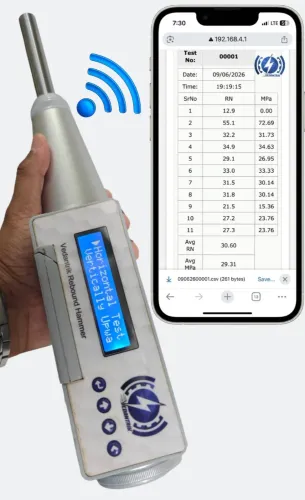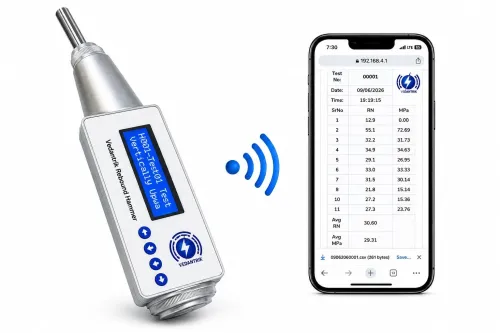

Digital Rebound Hammer testing is a popular non-destructive testing (NDT) technique used for assessing the quality and uniformity of concrete structures. It provides a quick estimation of concrete surface hardness and helps engineers evaluate the approximate compressive strength of concrete without damaging the structure.
Although digital rebound hammers offer improved accuracy, automatic calculations, and data storage capabilities, incorrect testing practices can significantly affect the reliability of results. Many errors occur due to improper instrument handling, unsuitable testing locations, incorrect interpretation, or failure to follow standard procedures.
Understanding common mistakes and adopting proper testing practices is essential for obtaining accurate and dependable results.
1. Testing Without Proper Instrument Calibration
One of the most common mistakes in digital rebound hammer testing is using an instrument without checking its calibration status.
A digital rebound hammer consists of mechanical and electronic components that may lose accuracy due to:
- Continuous use
- Mechanical wear
- Environmental exposure
- Improper storage
An uncalibrated instrument may provide incorrect rebound values, leading to inaccurate strength estimation.
How to Avoid It:
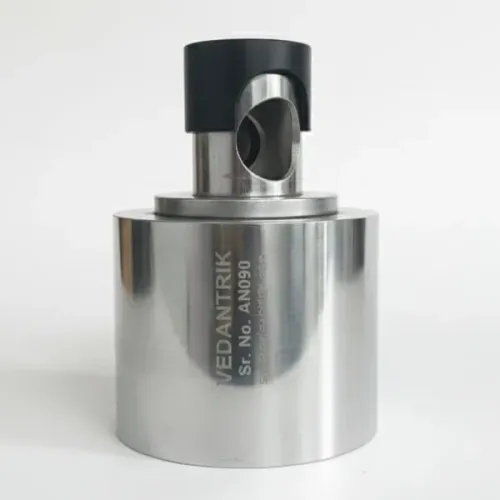
- Perform regular calibration using a standard test anvil with HRC 66 Hardness index.
- Verify instrument performance before major testing work.
- Maintain calibration records.
- Service the instrument if abnormal readings are observed.
Proper calibration ensures that the measured rebound values represent actual concrete conditions.
2. Testing on Unsuitable Concrete Surfaces
The quality of the test surface directly affects rebound hammer readings. Testing on unsuitable surfaces is a major source of error.
Common unsuitable areas include:
- Cracked concrete surfaces
- Rough or uneven surfaces
- Areas with exposed aggregate
- Surfaces covered with paint or plaster
- Locations near edges or corners
These areas may absorb impact energy differently and produce unreliable readings.
How to Avoid It:
- Select smooth and clean concrete surfaces.
- Remove loose particles and surface coatings before testing.
- Avoid damaged areas unless specifically evaluating deterioration.
- Maintain proper spacing between test points.
A properly prepared surface provides more consistent results.
3. Taking Too Few Test Readings
Another common mistake is relying on a single rebound value or a limited number of readings to determine concrete quality.
Concrete is not completely uniform, and strength may vary within the same structural element due to differences in:
- Compaction
- Aggregate distribution
- Curing conditions
- Material properties
A single reading may not represent the actual condition of the concrete.
How to Avoid It:
- Take multiple readings from different locations.
- Calculate the average rebound value.
- Remove abnormal readings according to standard procedures.
- Test representative areas of the structure.
Multiple readings improve accuracy and reduce the effect of local variations.
4. Incorrect Positioning and Testing Direction
The direction of impact affects rebound values because gravity influences the movement of the internal hammer mechanism.
Common mistakes include:
- Holding the instrument at an incorrect angle
- Applying uneven pressure
- Not keeping the hammer perpendicular to the surface
Although many digital rebound hammers have automatic angle correction, incorrect operation can still affect results.
How to Avoid It:
- Follow the manufacturer's operating instructions.
- Maintain proper contact between the hammer and concrete surface.
- Apply consistent pressure during each test.
- Record the testing direction.
Correct positioning ensures consistent impact energy transfer.
5. Ignoring Environmental and Concrete Conditions
Testing without considering environmental conditions can lead to incorrect interpretation.
Factors that influence results include:
- Surface moisture
- Temperature
- Concrete age
- Carbonation
- Curing conditions
For example, wet concrete generally produces lower rebound values, while carbonated surfaces may produce higher values.
How to Avoid It:
- Record environmental conditions during testing.
- Consider moisture and age effects.
- Avoid comparing results from significantly different conditions.
- Use appropriate correction factors when required.
Understanding concrete conditions helps engineers interpret results accurately.
6. Incorrect Interpretation of Rebound Values
A common misunderstanding is assuming that rebound value directly represents concrete strength. The rebound hammer measures surface hardness, which is indirectly related to compressive strength.
Incorrect interpretation may occur when:
- Standard strength conversion charts are used without considering concrete type.
- Results are treated as exact strength values.
- Local concrete conditions are ignored.
How to Avoid It:
- Use appropriate calibration curves.
- Follow guidelines such as IS 13311 (Part 2):1992.
- Combine rebound hammer results with other testing methods when required.
- Apply engineering judgment before making decisions.
7. Poor Data Recording and Management
Traditional testing methods often involve manual recording, which can lead to calculation errors. Although digital rebound hammers reduce this problem, poor data management can still affect final reports.
Common issues include:
- Missing test location details
- Incorrect labeling of readings
- Failure to store calibration information
- Lack of photographic documentation
How to Avoid It:
- Use digital storage features effectively.
- Record location, date, and testing conditions.
- Maintain organized test reports.
- Back up collected data.
Proper documentation improves traceability and future assessment.
Keywords