Concrete resistivity is a non destructive testing method that allows the measurement of concrete’s resistance against the movement of ionic charges inside the concrete that can corrode the steel reinforcement.
The resistivity of the concrete is mainly dependent on the micro structure, porosity, voids or cracks that may be present.
Since these structures may be filled with water and dissolved ions, their resistivity is influenced by factors such as moisture content, temperature, pore connectivity, and ionic concentration.
A high resistivity value indicates that the pore structure shows lower electrical conductivity, which correlates with lower corrosion risk.
Conversely, low resistivity indicates that ions move more freely, which increases the likelihood of corrosion of steel reinforcement. The Wenner probe technique is one of the most effective ways to measure this parameter.
Moisture is one of the most critical factors affecting resistivity. Concrete is a porous material, and the degree of moisture content affects the concrete’s conductive properties.
When concrete is fully saturated, its pores are filled with water, it facilitates pore continuity forming a clear pathway, allowing ions to move easily and resulting in low resistivity values.
When concrete dries, air replaces some of the pore water, and hinders the movement of ions, which then influences electrical pathways increasing the resistivity of the concrete.
Hence, moisture content inside the concrete has significant effects on the overall resistance of the concrete against the ions which can cause steel reinforcement corrosion.
This sensitivity makes resistivity a powerful indicator of moisture-related deterioration processes, including chloride ingress.
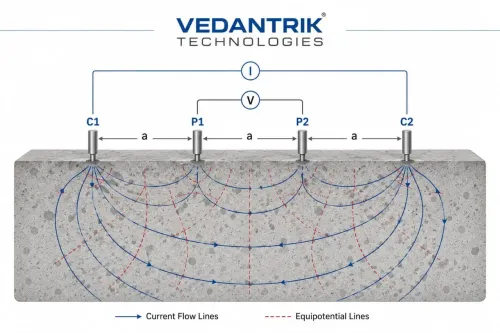
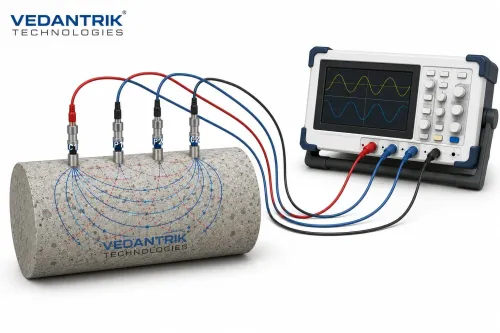
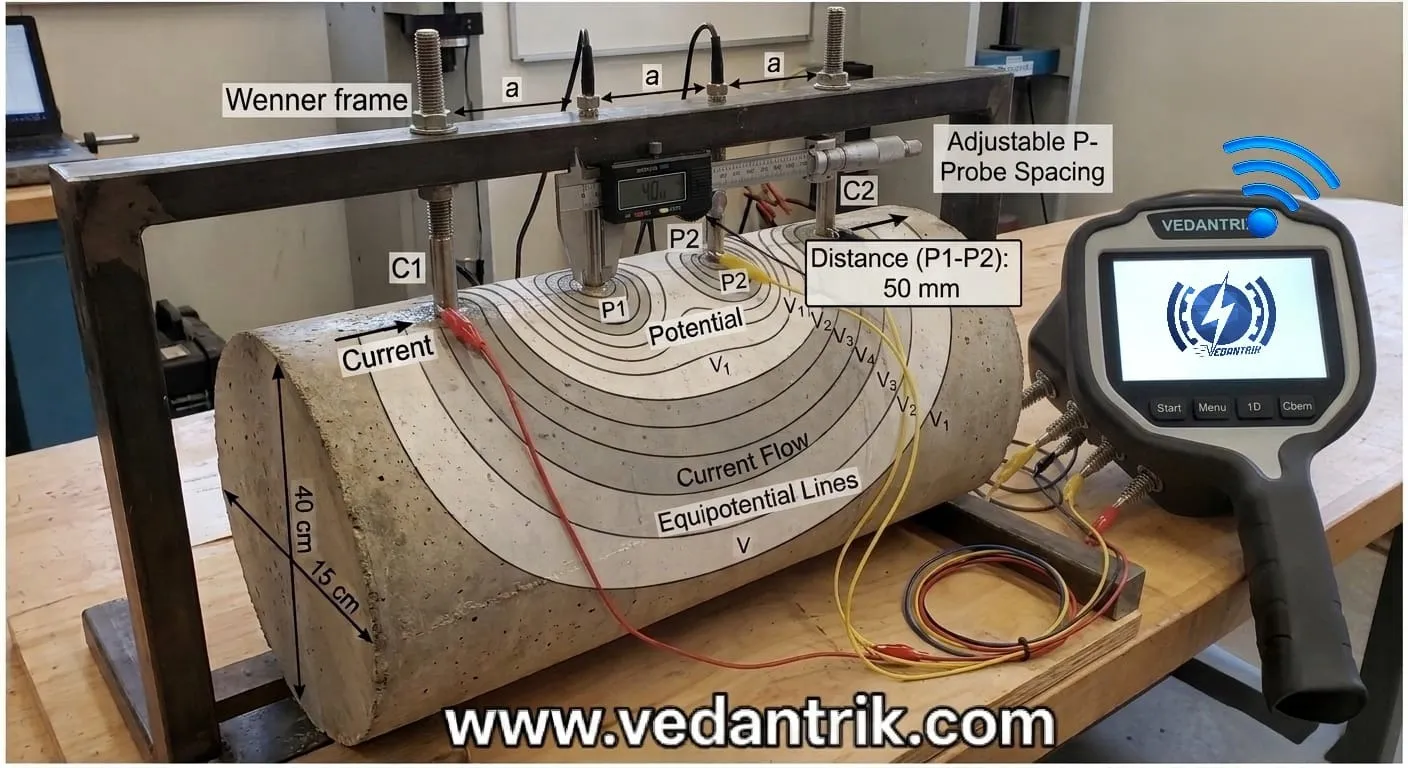
The most common method to evaluate the resistivity is the Wenner probe method, which involves placing four equally spaced electrodes on the surface of the concrete and passing an electrical current through the outer electrodes while measuring voltage between the inner ones.
The calculated resistivity reflects how easily the current travels through the concrete. In this technique the measurement depth is roughly equal to the electrode spacing; different probe sizes allow engineers to evaluate different layers of the concrete structure.
However, one limitation of the method is the formation of moisture gradients within a concrete element can significantly affect readings. For example, surface layers may be more dry than the interior, resulting in higher resistivity values at the surface.
Additionally, moisture-related resistivity changes correlate strongly with chloride permeability of the concrete. Saturated concrete has lower resistivity and faster chloride penetration, while dry concrete slows diffusion.
This relationship helps engineers evaluate how quickly harmful ions may reach reinforcing steel.
Overall, resistivity testing using the Wenner probe provides crucial insights into concrete’s moisture-driven behavior, enabling accurate assessment of corrosion risk and service-life expectations.
Keywords