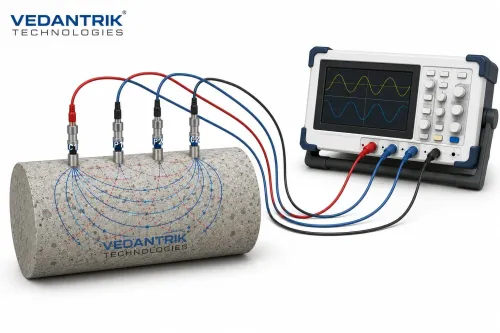
Concrete resistivity testing is a non-destructive method used to measure the electrical resistance of concrete, which reflects its ability to resist the movement of ions.
Concrete resistivity is particularly important to evaluate, since movement of ions inside the concrete is directly related to its permeability, which gives insight about the concrete durability.
Concrete is porous in nature, due to its microstructure development. These pores can become interconnected forming large capillary networks that span deep inside the concrete structure.
This pore continuity often facilitates the movement of ions inside the concrete and sometimes passage of aggressive agents such as chloride ions, that dist-ingrate the protective oxide layer around the steel reinforcement, promoting the corrosion.
In many concrete structures, corrosion of the steel reinforcements can lead to loss of strength and reduced service life. Since corrosion is an electrochemical process that creates electrical potential difference inside the concrete, electrical resistivity becomes a reliable indicator of the likelihood of corrosion activity.
High resistivity indicates slower ion movement and reduced corrosion risk, while low resistivity indicates an environment where corrosion may progress rapidly. This makes resistivity a valuable parameter in durability assessment.
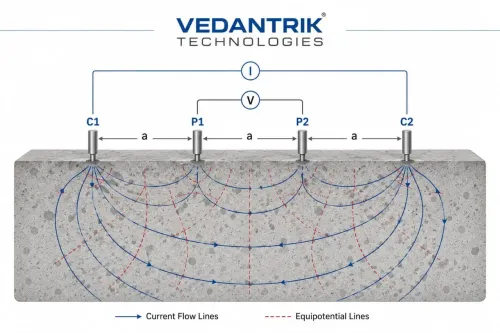
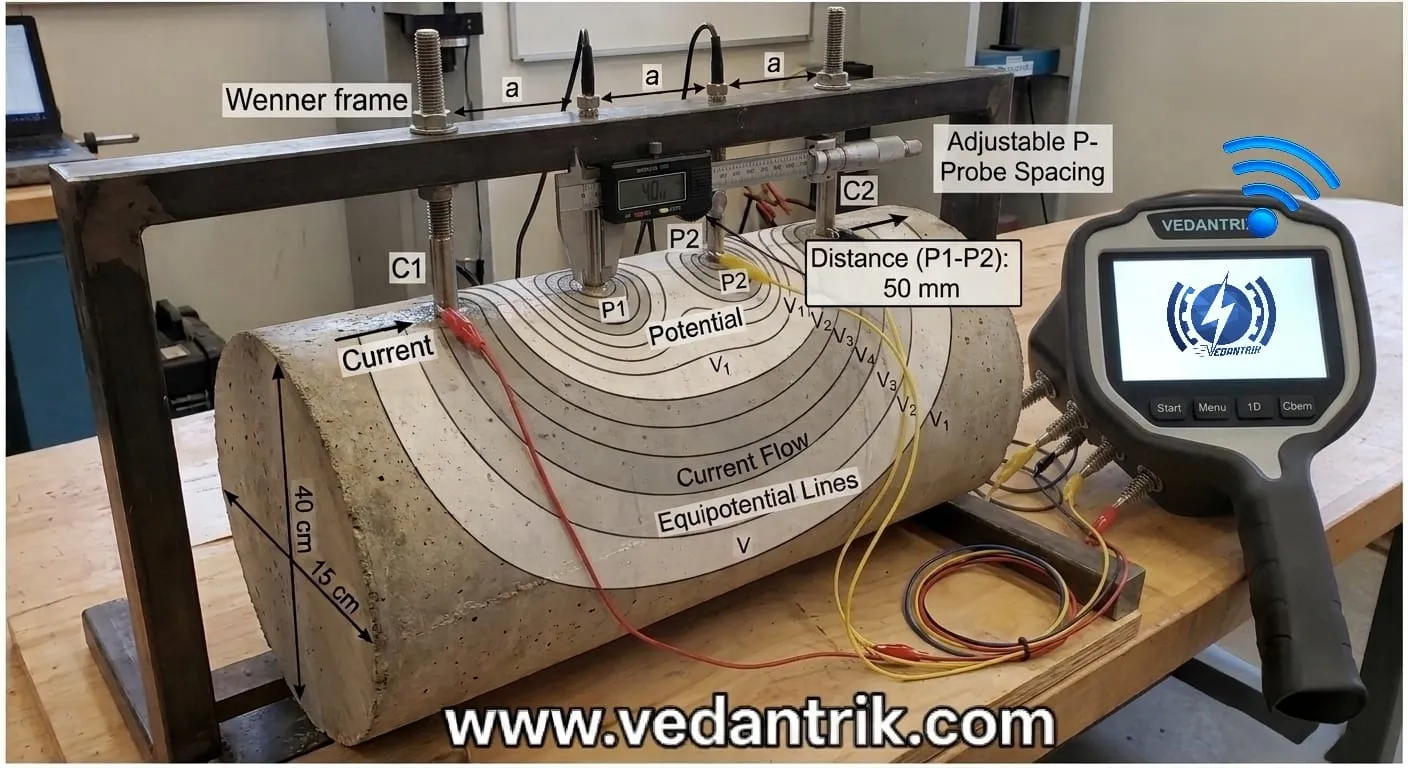
The Wenner four point probe method is one of the most widely used techniques to measure the surface resistivity of concrete structures, mainly due to its simplicity, accuracy and ease of use.
In summary, the method involves placing four electrodes at equal distance in a linear alignment on the surface of the concrete. A fixed current is applied through the outer electrodes, and the potential is measured across the inner electrodes.
The drop in the electrical potential is then measured to calculate the resistance. This resistance value is then multiplied by the electrode spacing distance, to get the resistivity of the concrete.
Because the electrodes maintain equal spacing, the method allows for standardized comparisons across different concrete compositions, ages, and moisture conditions.
Resistivity indirectly reflects the effect of several key factors that influence concrete strength and durability. These factors mostly include moisture content, pore structure, chloride content and degree of water saturation inside the concrete.
Water saturation inside the concrete is the most important factor that affects the concrete’s resistivity. Saturated concrete with interconnected pore networks tends to have low resistivity, and promote faster chloride movement and increase the risk of corrosion.
In contrast, well-cured concrete with a dense micro-structure typically shows high resistivity, by restricting the movements of chlorides, and prolongs the durability of the concrete structure.
Additionally, many durability models and service-life prediction tools rely on resistivity values as input parameters.
When combined with other durability tests such as chloride content, half-cell potential, or carbonation depth measurements, resistivity testing provides a more comprehensive understanding of long-term performance.
Overall, concrete resistivity testing, particularly using the Wenner four-point method, plays a critical role in modern durability assessment.
It offers engineers a powerful, non-invasive tool to predict corrosion risk, evaluate material quality, and support long-term maintenance planning for reinforced concrete structures.
Keywords