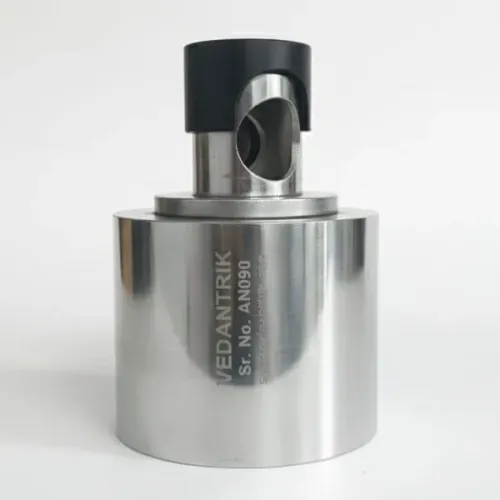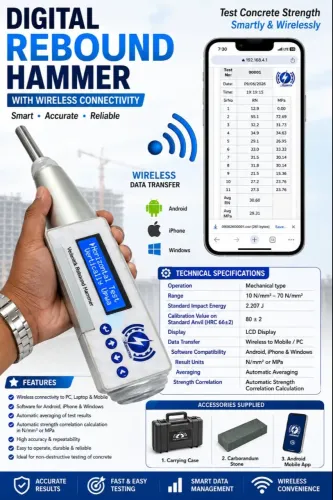
Based on the Schmidt principle, Vedantrik Technologies has developed a compact, durable, and easy-to-use Digital Rebound Hammer for reliable on-site estimation of concrete strength. The instrument is designed in compliance with major standards such as IS 516, ASTM C805, DIN 1048, and BS 1881, ensuring consistent and dependable results.
The Digital Rebound Hammer is a non-destructive testing (NDT) device used to check the surface hardness and overall quality of concrete. In this test, the plunger of the hammer is pressed against the concrete surface, which releases a spring-controlled mass that strikes the surface. The rebound of this mass is measured electronically and shown as a digital rebound value. This value is related to the hardness of the concrete surface—higher rebound values generally indicate stronger and denser concrete.
Each instrument is properly calibrated so that the rebound readings correctly represent the spring action and the surface condition of the concrete. In digital models, the readings are automatically captured and displayed, which reduces manual reading errors and improves accuracy. The compressive strength of concrete is then estimated by comparing the average rebound value with standard calibration curves provided with the device. This allows engineers to quickly check concrete strength directly at the site and supports effective quality control.
The Digital Rebound Hammer, also called the Schmidt Digital Hammer, is one of the most widely used non-destructive methods for checking concrete strength in the field. It was developed in the 1950s by Ernst Schmidt and works on the simple principle of elastic rebound—harder concrete gives a higher rebound, while weaker concrete gives a lower rebound.
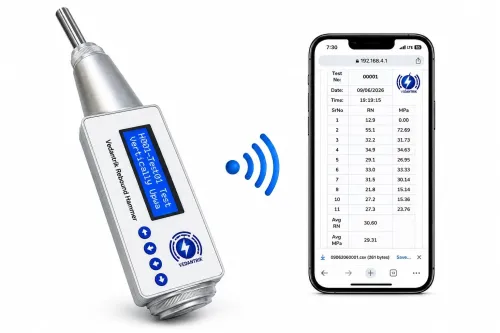
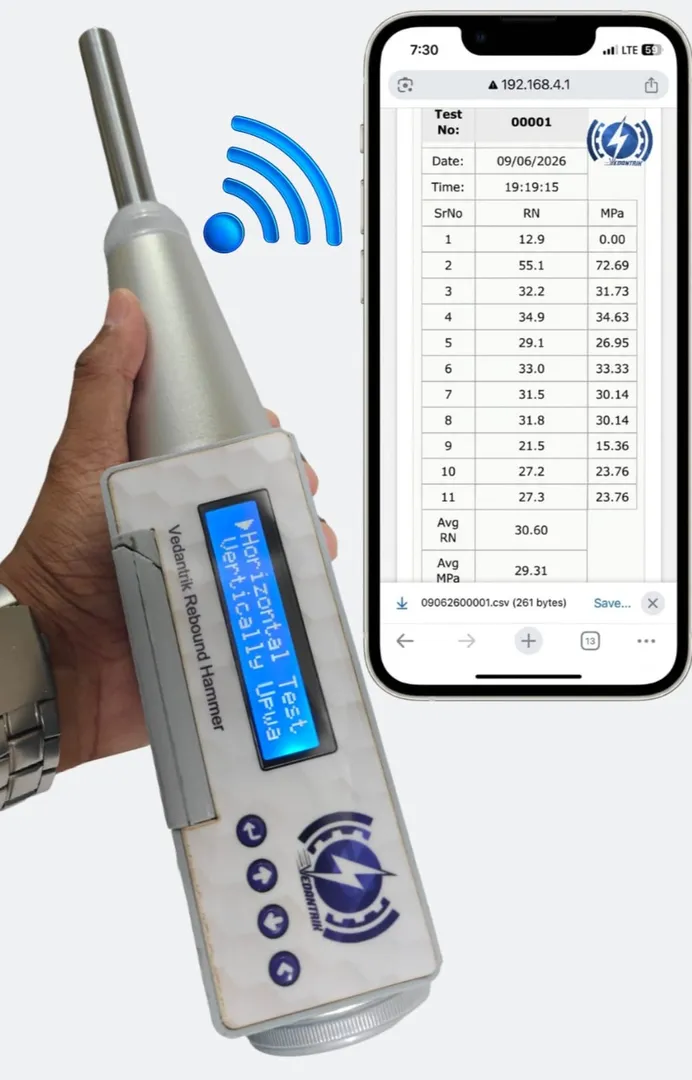
In digital versions, sensors automatically record the impact and rebound, making the process more accurate and reducing human error. The results can also be stored or transferred for further analysis, which improves consistency and record-keeping.
The rebound values are converted into compressive strength using standard calibration charts given in codes such as IS 516, ASTM C805, DIN 1048, and BS 1881. Strong and dense concrete gives higher readings, while poor-quality or weaker concrete gives lower values.
For reliable results, multiple readings (usually 9–10) are taken at different points in the same area, and the average is used. This helps reduce local variations. However, since the test mainly measures surface hardness, results can be affected by factors like surface moisture, carbonation, and surface condition. Because of this, it is considered an indirect method and is often supported with other tests when high accuracy is needed.
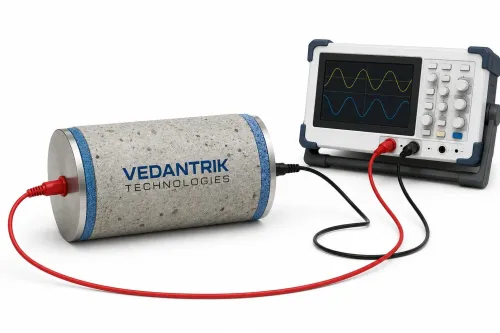
The Digital Rebound Hammer can be used in different positions such as horizontal, vertical upward, and vertical downward. Correction factors may be required depending on the angle of testing, as gravity can influence the rebound. Proper calibration using a standard steel anvil is also important to maintain accuracy.
Overall, the Digital Rebound Hammer combines the basic Schmidt principle with modern digital technology, making it a fast, simple, and reliable tool for on-site concrete strength estimation while following international testing standards.
Keywords