Monsoon conditions can significantly influence concrete maturity development and strength gain, especially in on-site construction where environmental conditions are difficult to control. Since concrete strength development depends mainly on temperature, time, and moisture, the changing weather during monsoon directly affects hydration and early-age performance.
During the monsoon season, frequent rainfall and high humidity create highly variable curing conditions. While moisture is necessary for cement hydration, uncontrolled exposure to rainwater can disturb the concrete surface. It may wash away fine particles, increase surface porosity, and reduce the quality of the top layer, leading to lower surface strength and reduced durability over time.
Temperature plays an even more critical role in strength development. The maturity method is commonly used to estimate concrete strength based on the combined effect of time and temperature. However, during monsoon, lower ambient temperatures slow down hydration, resulting in delayed setting and slower strength gain. This can affect construction progress, especially when early strength is needed for formwork removal or loading.
When establishing a maturity–strength relationship, such fluctuating conditions can also affect the accuracy of the Nurse–Saul method, which assumes a linear relationship between temperature and hydration. In reality, cement hydration follows a nonlinear, exponential behavior, meaning this assumption becomes less accurate under varying temperature conditions typically seen during monsoon. A more refined approach, such as the Arrhenius method, accounts for the temperature sensitivity of chemical reactions and provides a better representation of hydration kinetics under changing thermal conditions.
These temperature variations also influence the formation of calcium silicate hydrate (C–S–H) gel, which is the primary product responsible for concrete strength. Lower and inconsistent temperatures slow down C–S–H formation, leading to delayed microstructure development, reduced early-age strength, and in some cases a less dense cement matrix. This can impact both short-term performance and long-term durability.
Sudden weather changes, such as heavy rain followed by cooler conditions, can further create non-uniform curing across a structure, resulting in uneven strength development and variability in quality.
Although high humidity can help reduce surface drying and support curing to some extent, excessive and uncontrolled moisture exposure may still cause bleeding, segregation, and surface defects.
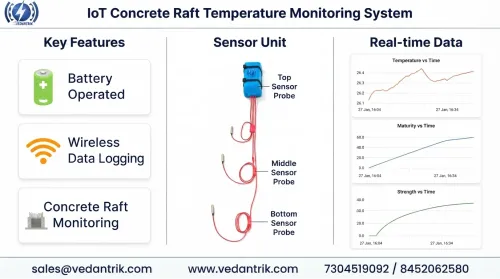
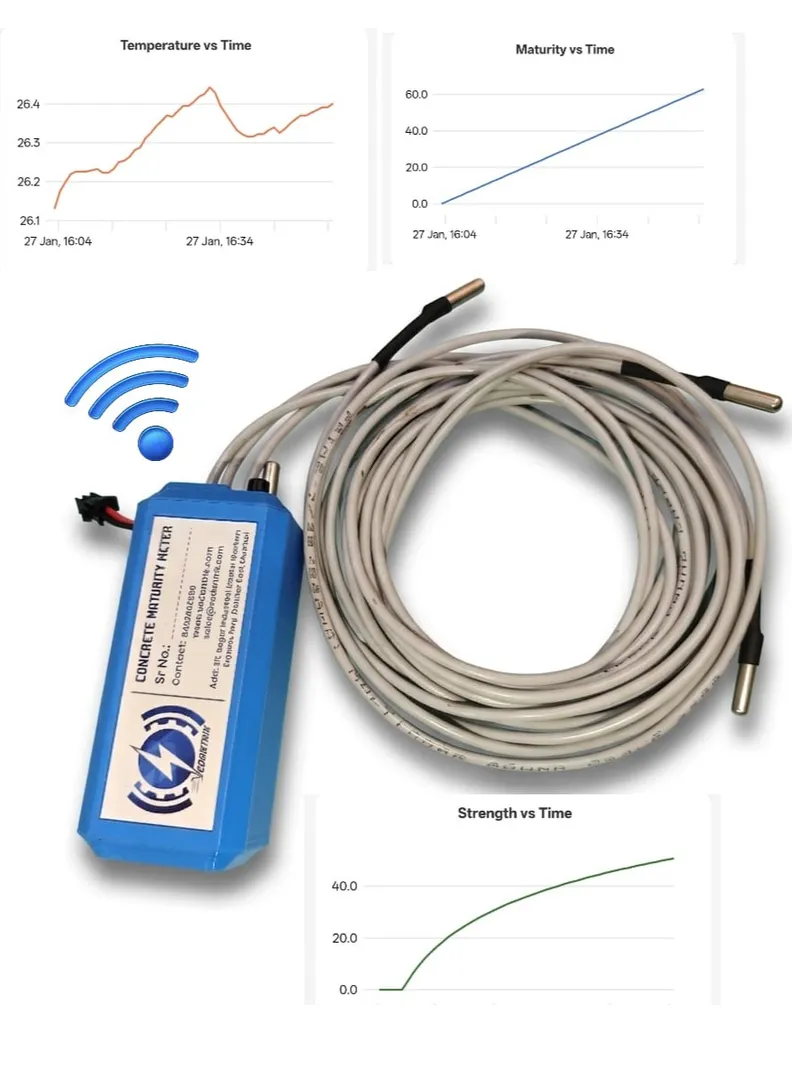
Because of these challenges, maintaining stable curing conditions during monsoon becomes essential. Proper protection measures, along with continuous temperature monitoring, help improve reliability in strength prediction. In such scenarios, systems like Vedantrik maturity and temperature monitoring solutions can assist in tracking real-time temperature variations and improving the accuracy of maturity-based strength estimation under field conditions.
Overall, monsoon conditions introduce several uncertainties in concrete curing, making controlled protection and accurate temperature monitoring critical for consistent maturity development and long-term concrete performance.
Keywords