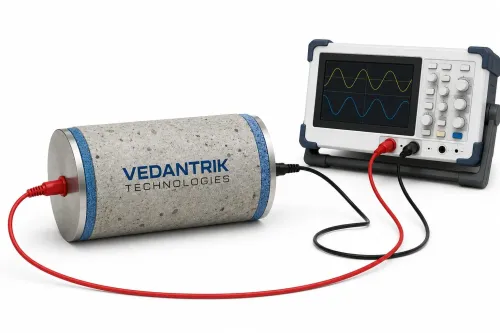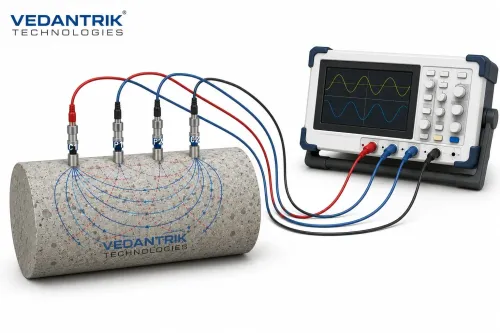
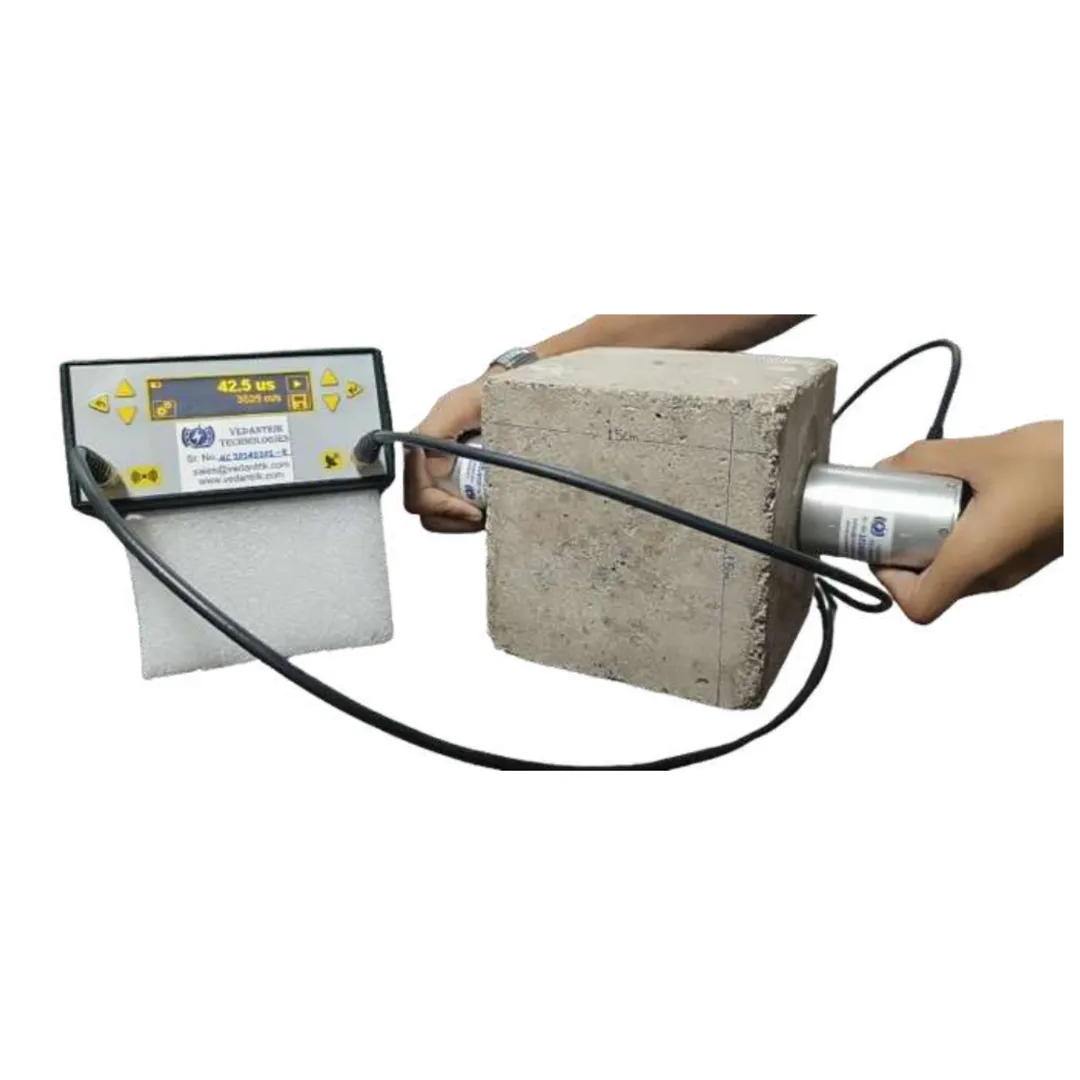
Ultrasonic Pulse Velocity (UPV) in concrete is strongly influenced by the internal structure of concrete, also called its microstructure. UPV works by sending a high-frequency sound wave through concrete and measuring how long it takes to travel a known distance. The speed of this wave depends mainly on how dense, uniform, and continuous the concrete is. In general, good-quality concrete with fewer defects allows the wave to travel faster, while poor-quality or damaged concrete slows it down.
One of the main factors affecting UPV is porosity, which means the presence of small pores or air voids inside concrete. When concrete has more pores, it becomes less dense and less stiff. Since ultrasonic waves travel poorly through air, these voids reduce the speed of the wave. Even a small increase in porosity can noticeably reduce UPV values because it breaks the continuity of the material.
Cracks inside concrete also have a major effect on UPV. Cracks interrupt the path of the wave and cause it to reflect, scatter, or lose energy. If the crack is large or runs across the wave path, the UPV value drops significantly. Even very fine microcracks, which may not be visible, can reduce velocity because they disturb the internal continuity of the concrete.
The interfacial transition zone (ITZ), which is the thin region between cement paste and aggregates, also affects UPV. This zone is usually weaker and more porous than the main cement paste. If the ITZ is dense and well-bonded, the wave passes smoothly through the concrete. If it is weak or porous, it slows down the wave and increases scattering, leading to lower UPV values.
The type and stiffness of aggregates used in concrete also influence UPV. Strong, dense aggregates like granite or basalt allow faster wave transmission because they are stiff and conduct stress waves well. Lightweight aggregates, on the other hand, reduce UPV because they are less stiff and absorb more wave energy.
Moisture condition is another important factor. Wet or fully saturated concrete generally shows higher UPV than dry concrete. This is because water fills the internal voids and improves the transmission of sound waves. In dry concrete, air in the pores reduces wave movement and increases scattering, which lowers the UPV reading.
The age of concrete and the level of hydration also change UPV over time. As concrete cures, hydration products such as calcium silicate hydrate (C–S–H) fill the pores and make the structure denser and stiffer. This increases UPV. However, when concrete is damaged by chemical attack, corrosion of steel, or freeze–thaw cycles, new cracks form inside the concrete, which reduce UPV.
UPV testing is defined in standard codes to ensure proper and consistent use. In India, IS 13311 (Part 1): 1992 and IS 516 (Part 5/Sec 1): 2018 describe how the test should be carried out and interpreted. Internationally, ASTM C597 provides the standard method for ultrasonic pulse velocity testing of concrete. These standards also clearly state that UPV is mainly used to assess quality and uniformity of concrete, rather than directly measuring strength unless it is calibrated with other tests.
Overall, UPV is a very useful non-destructive test because it gives information about the internal condition of concrete. It is highly sensitive to cracks, voids, moisture, and bonding quality, making it an effective method for checking the quality and uniformity of concrete structures.
Keywords