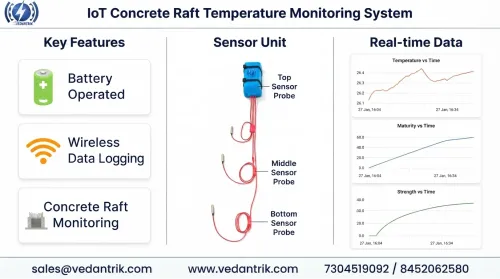
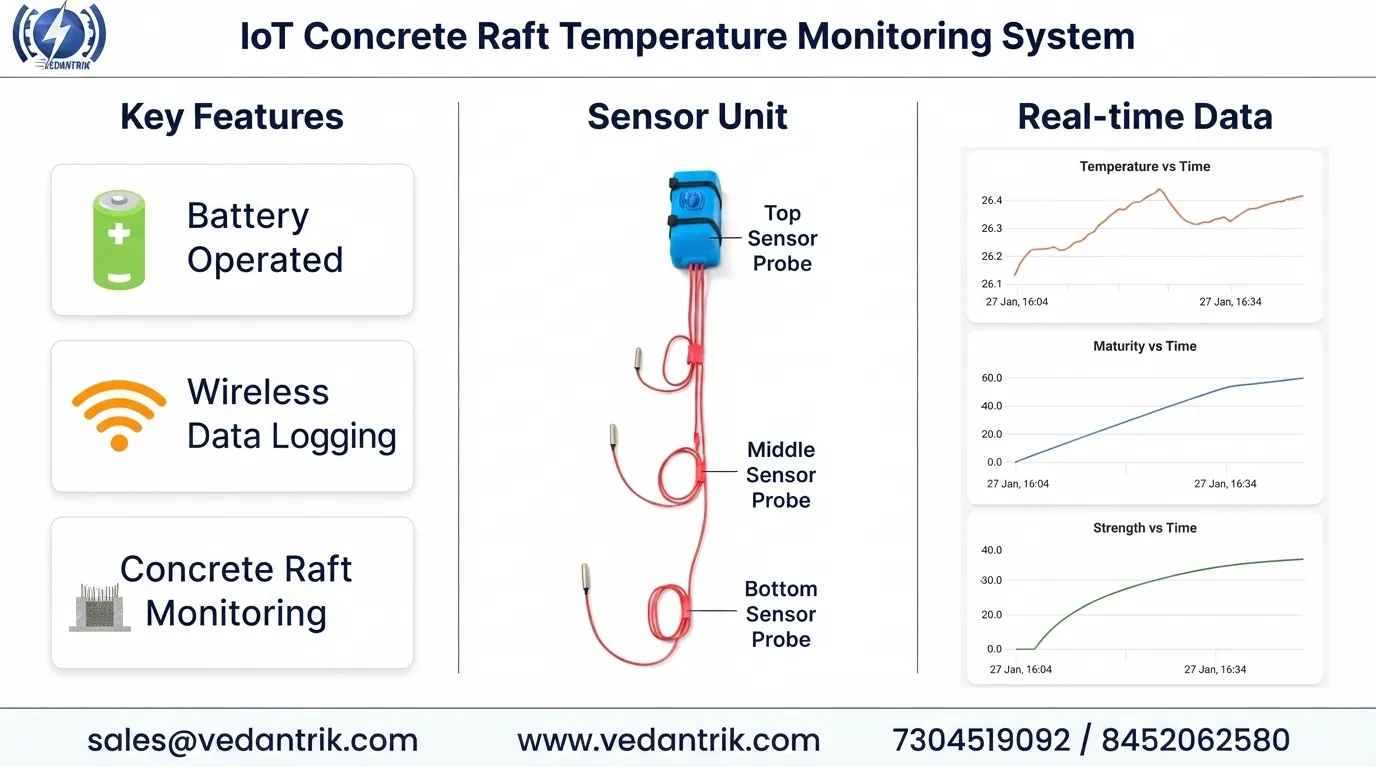
The strength and durability of concrete depend heavily on curing conditions. Curing controls how cement reacts with water and how the internal structure of concrete develops. The Concrete maturity method is used to study this effect by combining time and temperature into a single value called maturity. This helps engineers understand how well concrete is curing inside a structure.
In Concrete curing, the main goal is to keep enough moisture and suitable temperature so that cement hydration continues properly. According to American Society for Testing and Materials ASTM C511, standard curing in labs is done at 23 ± 2°C with high humidity above 95%. These conditions are ideal because they allow concrete to gain strength in a steady and controlled way.
In real construction sites, conditions are not so stable. In hot climates like India, temperatures can vary from about 10°C at night to more than 40°C during the day. As per Bureau of Indian Standards IS 456:2000, concrete should be cured for at least 7 days for OPC cement and longer (10–14 days) for blended cement. But in practice, curing is often affected by water shortage, weather changes, or poor site control.
Temperature is the most important factor in maturity development. When temperature is low (below 10°C), hydration becomes very slow. This delays strength gain and slows construction work. When temperature is moderate (20–30°C), hydration happens at a steady and ideal rate. When temperature is high (above 35°C), concrete gains early strength quickly but may lose long-term quality due to faster water loss and uneven hydration.
Moisture is also very important. Even if the temperature is good, concrete will not hydrate properly if it dries out. Lack of water stops cement particles from fully reacting. This leads to weak zones inside concrete, more pores, and lower durability. The maturity method mainly uses temperature, so it does not directly measure moisture loss, which is a limitation.
Curing conditions also affect the internal structure of concrete. Good curing helps form more calcium silicate hydrate (C-S-H), which fills empty spaces inside concrete and makes it dense. Poor curing leaves more voids, which increases permeability. This allows water, chemicals, and gases to enter easily, reducing long-term durability.
In large structures like raft foundations or thick walls, heat from cement hydration can raise internal temperatures above 60°C. At the same time, the outer surface may stay cooler. This temperature difference can create internal stress and even small cracks. These cracks can affect strength and also change maturity readings at different points in the structure.
Structural performance is often evaluated using maturity values. Higher maturity means more hydration has taken place, which usually means higher strength. Engineers use this to estimate in-place strength without breaking concrete samples. This helps decide when to remove formwork, apply loads, or continue construction work safely.
However, curing conditions can affect how accurate this evaluation is. For example, concrete cured in high heat may gain strength quickly at first but may not reach the same long-term strength as concrete cured at moderate temperature. This happens because rapid hydration can create a less uniform internal structure. So, two concretes with the same maturity value may still behave differently.
Standards like ASTM C1074 require that maturity-strength relationships be created using real site conditions. If this is not done properly, predictions can be wrong. This is very important for blended cement types like Portland Pozzolana Cement (PPC) and Portland Slag Cement (PSC), which behave differently from normal OPC cement.
Curing also affects shrinkage. If curing is poor, concrete dries faster and shrinks more. This can cause cracks, especially when the structure is restrained. These cracks reduce durability and can weaken long-term performance, even if early strength looks acceptable.
Even with these limitations, the maturity method is very useful in practice. It helps engineers connect real field conditions with strength development. Instead of relying only on fixed curing time, engineers can use actual temperature data to make better decisions.
In conclusion, curing conditions have a strong effect on concrete maturity and structural performance. Standards like ASTM C511 and IS 456:2000 give basic curing rules, but real site conditions are often different. The maturity method helps bridge this gap by using temperature history to estimate strength. However, correct use requires understanding moisture effects, temperature changes, and material behavior to get reliable results.
Keywords