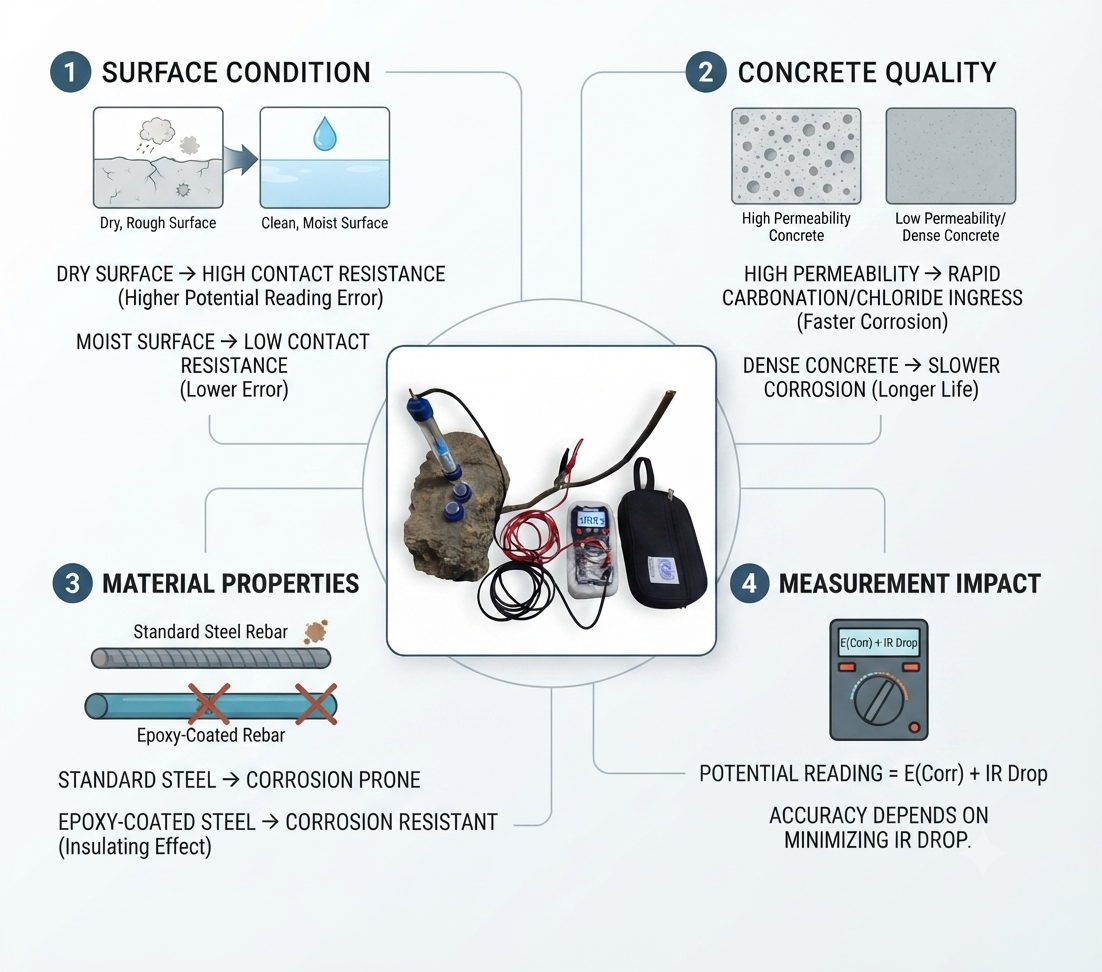
The accuracy of Half Cell Potential measurements depends heavily on the condition of the concrete surface and the quality of the concrete being tested. Poor surface conditions can lead to unstable readings and unreliable results.
Concrete surfaces covered with dust, dirt, paint, waterproof coatings, sealants, grease, or loose material can interfere with proper contact between the reference electrode and the concrete. Before testing, surfaces should be cleaned and prepared to ensure consistent electrical contact.
Concrete quality also plays an important role in the measurement process. Factors such as permeability, porosity, water-cement ratio, curing quality, and moisture retention affect how electrical current travels through the concrete. Dense and well-cured concrete may behave differently from porous or deteriorated concrete even when the corrosion condition is similar.
Material properties such as reinforcement depth, concrete cover thickness, reinforcement spacing, and reinforcement arrangement can also influence the distribution of measured potentials. In some cases, changes in these properties may create variations in readings that are unrelated to corrosion activity.
Because of these influences, engineers must evaluate HCP data together with information about the structure's design, construction materials, exposure conditions, and maintenance history. Proper interpretation requires more than simply comparing readings with standard threshold values.
Keywords