Concrete curing is a crucial process that determines the development of the micro structure, pore network and continuity, permeability, density and durability of the concrete.
Concrete resistivity primarily evaluates the electrical resistance of the concrete material, which is highly dependent on the water content, ions present in the pore solution, pore structure and network.
Hence any variation in the curing process directly influences these properties, which in turn affect the concrete resistivity value.
Proper curing conditions enhance hydration, reduces porosity, and increases resistivity, while poor curing leads to higher permeability, lower resistivity, and greater risk of corrosion in steel reinforcement.
Hence understanding how the concrete affects the electrical resistance, and how it varies between the surface and bulk resistivity measurements is essential for accurate interpretation of the test results in both field and laboratory environment.
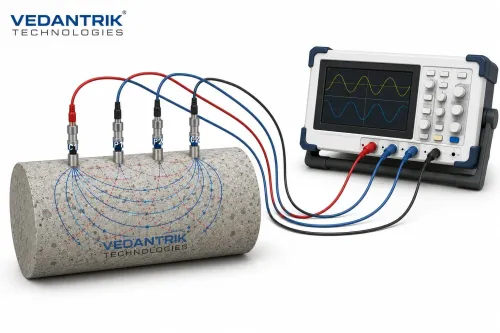
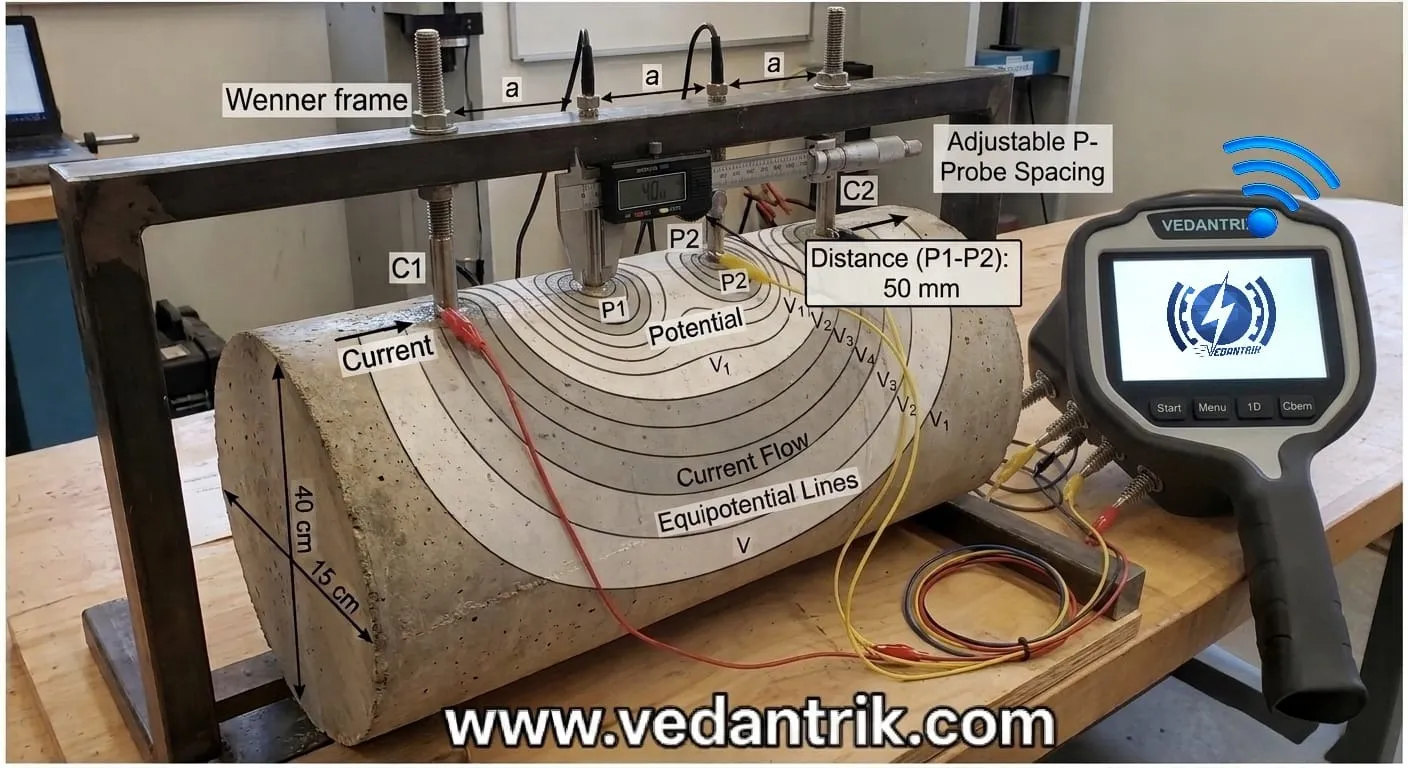
Surface resistivity of the concrete, which is measured by using Wenner four point probe method, allows estimating the electrical resistivity of the concrete surface.
Since the method is used to evaluate the surface resistivity, it is particularly sensitive to surface curing conditions, drying, carbonation, and variations in the moisture condition.
Improper curing can result in non-uniform development of the outer surface, leading to coarser and higher porosity, which increases the permeability at the surface, reducing the surface resistivity measurements even if the inner micro structure remains relatively unaffected.
This sensitivity makes surface resistivity a powerful indicator of curing quality but it also means that it must be interpreted with consideration of environmental conditions.
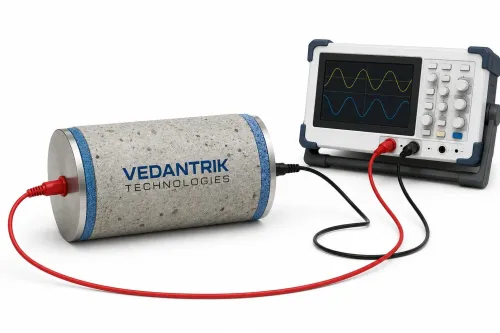
In bulk resistivity testing, cylindrical concrete samples are placed between two conductive plates, and a voltage is applied across the specimen. The resulting current flow is measured, and the resistivity is calculated by considering the dimension of the concrete specimen.
Since the measurement is taken against the entire volume, bulk resistivity provides a more accurate representation of the concrete’s internal pore structure and connectivity than surface-based tests.
Proper curing leads to continuous hydration of the internal pore structure, which increases the bulk resistivity values. Unlike surface resistivity, bulk resistivity is less influenced by environmental exposure and short-term fluctuations in moisture content.
Therefore, it is often considered a more accurate parameter when co-relating the resistivity with other concrete durability tests such as Rapid Chloride migration test (RCMT) and Rapid Chloride Penetration test (RCPT).
However, because bulk testing requires laboratory-prepared samples, it cannot easily detect improper curing at the construction site.
When comparing both methods, it becomes clear that surface resistivity is more sensitive to curing quality, while bulk resistivity provides a more stable and representative measure of internal concrete durability.
For practical applications, surface resistivity is often used for field quality control to detect inadequate curing practices, while bulk resistivity tests are used in research, design validation, and advanced durability assessments.
Ultimately, curing conditions significantly impact concrete resistivity measurements, and understanding the differences between surface and bulk methods allows engineers to select the appropriate technique, interpret results correctly, and ensure that concrete structures achieve the required long-term durability.
Keywords